How to improve your balance by strengthening your toes
I’ll never forget the day I almost ate dirt while standing perfectly still in a grocery store line. I wasn’t even moving; I just reached for a pack of gum and my center of gravity vanished like a magician’s assistant. It was a humiliating moment that forced me to realize that despite all my gym time, my foundation was essentially a stack of wet noodles. I used to think that relying on expensive orthotics was the silver bullet for my wobbly stance. I was dead wrong. I spent years neglecting the very things that connect me to the earth: my toes. If you’ve ever felt that sudden, dizzying lurch when you’re just trying to walk across a flat floor, you’re not alone. Today, we’re going to fix that by turning those neglected little digits into stabilizers that would make a tightrope walker jealous.
[image_placeholder]
Stop Relying on Your Shoes to Do the Heavy Lifting
For the longest time, I made the classic mistake of thinking more cushion meant more support. I bought the clunkiest, most expensive sneakers I could find, thinking I was doing my spine a favor. Instead, I was just muzzling my feet. According to a study published in the journal Nature, people who walk in minimalist footwear or perform specific foot-strengthening exercises can increase their intrinsic foot muscle strength by a staggering 60%. My big mistake early on was ignoring my feet until they literally stopped working for me. When I finally started focusing on toe strength, the link between my flat feet and my nagging back pain suddenly became crystal clear. It’s not just about avoiding falls; it’s about how your entire kinetic chain responds when your base is weak. If you feel like your feet are just heavy weights at the end of your legs, you’re missing out on a massive amount of stability. Have you ever noticed your balance getting worse as you’ve traded barefoot time for heavy boots?
Do these tiny exercises really live up to the hype?
I get it. You’re busy, and the idea of “toe yoga” sounds like something invented by people with too much time on their hands. You might be wondering if this is just another fitness fad or if it’s actually worth the effort. Let me tell you, I was the biggest skeptic until I realized how much a single tight ankle or a weak big toe was sabotaging my morning walks. When we lose the ability to splay our toes, we lose our natural tripod. This leads to a cascade of issues where we start searching for mobility after an injury that could have been prevented. It’s a scary feeling when you don’t trust your own feet, but it’s often just a sign that your brain has lost its connection with your foundation. When we strengthen the toes, we’re not just building muscle; we’re recalibrating our entire nervous system. We’re going to look at exactly how to wake those muscles up without needing a single piece of fancy equipment, starting with the simplest move you can do while watching TV.
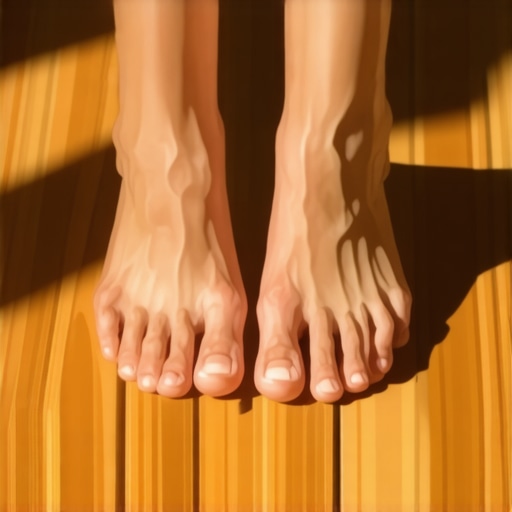
To get your balance back, you have to treat your feet like two complex machines rather than dumb blocks of meat. Think of your foot as a tripod with three points of contact: the center of your heel, the base of your big toe, and the base of your pinky toe. Most of us are walking around on what feels like two-legged stools because our toes are fused together by years of narrow shoes. By waking up these three points, you create a stable platform that protects your knees and hips from unnecessary torque.
Build a Solid Base From the Ground Up
Wake Up Your Big Toe Anchor
The big toe is your primary stabilizer. If it’s weak, your ankles wobble, and suddenly you are dealing with how a single tight ankle can cause chronic back pain. Sit in a chair with your feet flat on the floor. Try to lift just your big toe while keeping the other four glued to the ground. It sounds easy, but the first time I tried this, my brain could not find the on switch. I was staring at my foot, sweating, and nothing moved. When I finally got a flicker of movement, it felt like a tiny electric jolt. This simple isolation forces your nervous system to map the foot correctly. Once you can lift it, press it down hard into the floor and try to lift the other four. This toe yoga is the foundation of how chiropractic care enhances movement by ensuring the messages from your brain actually reach your extremities.
Master the Wide Splay for Better Grounding
Next, you need to address the mush factor. If your toes are scrunched together, your base of support is tiny. You want to learn to splay them out like a fan. I practiced this while brushing my teeth every morning. At first, my toes stayed stuck together like they were glued. I had to manually pull them apart with my fingers to remind my body what wide felt like. Why walking in flat shoes might be worsening your alignment often comes down to this lack of splay; if the shoe is flat but narrow, your foot still cannot function. Widening that base immediately changes how your weight sits on your pelvis and can even reduce the pressure on your lower spine.
Pull a Towel to Rebuild Your Arch
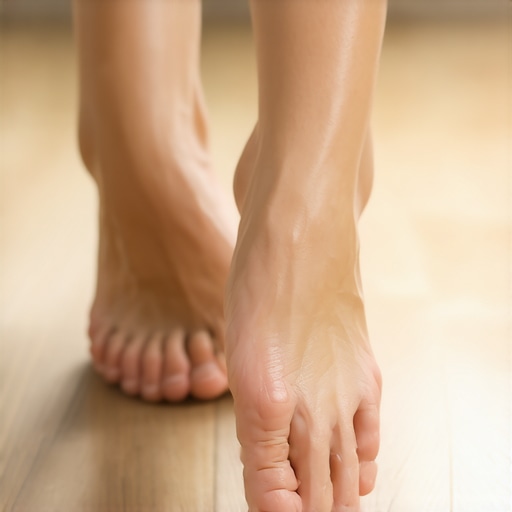
If you really want to stop the wobbly-leg syndrome, you need to work on the intrinsic muscles that hold up your arch. Place a hand towel on a hardwood or tile floor. Sit down, put your foot on the edge of the towel, and use only your toes to scrunch and pull the towel toward your heel. This is a brutal workout for muscles you did not know you had. I remember doing this three weeks into my recovery and getting a cramp so sharp I nearly fell off my chair. That cramp was actually a good sign—it meant those dormant muscles were finally waking up. Strengthening these helps explain the secret link between flat feet and chronic back pain because a strong arch acts as a natural shock absorber. When your feet can handle the impact, your lower back does not have to. Integrating this into a 3-minute morning routine to lubricate your joints ensures you are not starting your day on a shaky foundation.
But even with the best foot routine, I see people sabotage their progress by falling for the ‘more is better’ flexibility myth. Most of us have been brainwashed into thinking that if something feels tight, we need to yank on it until it lets go. In my experience, this is the fastest way to stay injured. When your brain senses instability—like those wobbly ankles we just talked about—it will actually tighten your hamstrings or your lower back as a protective ‘brake’ system. If you force those muscles to stretch, you’re essentially cutting the brake lines on a car parked on a hill. I spent months static stretching only to realize I was prolonging my back pain by removing the only stability my body had left. You need to earn your range of motion through strength, not just passive pulling.
Stop Stretching Your Way Into More Pain
The nuance that most people miss is the difference between a muscle that is short and a muscle that is ‘locked long.’ When your pelvis is tilted because your foundation is weak, your hamstrings are pulled tight like a rubber band. Stretching them further doesn’t fix the tilt; it just irritates the nerve. According to a study in the Journal of Strength and Conditioning Research, excessive static stretching can actually decrease joint stability and reduce muscle force production, which is the last thing you want if you’re already feeling unstable. Instead of reaching for your toes, focus on proven strategies for back pain relief that prioritize spinal neutral positions. This is a common trap: we mistake the sensation of a stretch for the solution to the problem, when in reality, why stretching a tight muscle isn’t always the answer becomes obvious once you realize the tightness is a symptom of weakness elsewhere.
Don’t Crush Your Lumbar Spine With a Foam Roller
Here is the ‘oops’ factor I see every single week: the person who takes a hard foam roller and tries to iron out their lower back like a piece of dough. This is a massive mistake. Your lumbar spine is designed for stability, not the kind of extreme shearing force a roller provides. When you roll your lower back, you can actually aggravate the facet joints or put unnecessary pressure on your discs. If you feel the need to roll, stick to the glutes or the upper back, but stop rolling your lower back on a hard foam roller immediately if you want to avoid a flare-up. You are much better off using chiropractic care to enhance movement by addressing the joint alignment directly rather than smashing the soft tissue into submission.
Does fixing your feet really stop the ache in your neck?
It sounds like a stretch, but the kinetic chain is a real thing. Your body is a continuous web of fascia. If your big toe isn’t anchoring you correctly, your pelvis shifts, your mid-back rounds to compensate, and your chin pokes forward to keep your eyes level. This is exactly why we look at your feet when your neck hurts. You can’t fix the ‘top’ of the building if the foundation is sinking into the mud. When we address the hidden link between neck pain and spinal health, we often find that the chronic tension in your upper traps is just your body’s desperate attempt to keep you upright because your feet aren’t doing their job. By integrating foot strength with professional adjustments, you create a system that doesn’t have to work so hard just to stand still. Have you ever fallen into this trap of stretching the same spot for years without results? Let me know in the comments below.
Once you stop the cycle of endless stretching, you have to replace it with a strategy that actually sticks. For me, that meant moving beyond bodyweight exercises and into the world of specific, targeted tools that force my anatomy to behave. I realized that if I didn’t actively maintain the space between my toes, my foundation would just collapse again the moment I put my work boots back on. This is where high-quality silicone toe spacers changed the game for me. By wearing them for just an hour an evening, I began to reverse the ‘tapered toe box’ effect that modern shoes inflict on us. As Dr. Ray McClanahan, DPM, often explains, most foot deformities are actually ‘shoe-shaped’ deformities. When you manually widen that base, you naturally restore your back mobility with proven chiropractic strategies because your pelvis no longer has to overcompensate for a narrow, unstable platform. #IMAGE_PLACE_HOLDER_D#
How do I maintain my foot and spine health over time?
Consistency is the only way to avoid backsliding into old, painful patterns. I make it a non-negotiable habit to hydrate your spinal discs every morning with simple cat-cow movements right after I do my foot mobility work. If you can spend just five minutes on your foundation every single day, you can boost your back health using simple chiropractic hacks that prevent minor morning stiffness from turning into a full-blown mobility crisis. I’ve seen too many people reach a ‘pain-free’ state and then abandon their routine, only to end up back at square one a few months later. To stay resilient, you must view these movements as hygiene, not just a temporary fix.
Why I Swear by the 30-Degree Slant Board
If you want to scale your mobility, you need to address the ankles. I started using a wooden slant board to improve my dorsiflexion, and the results were immediate. Restricted ankles are the ‘silent killer’ of proper movement patterns, often forcing the lower back to take on heavy loads it wasn’t designed for. Biomechanics expert Dr. Kelly Starrett notes that without proper ankle range, your entire posterior chain is essentially working with a handbrake on. Integrating this tool into a 3-minute morning routine to lubricate your joints ensures that you are starting your day with the mechanical clearance needed to walk, squat, and move without strain. It’s about creating a system where every joint does its own job so your lower back doesn’t have to do everyone else’s.
Proprioception is the Future of Standing Still
Looking ahead to 2025 and beyond, I predict we are going to see a massive shift toward ‘smart’ proprioceptive tools. We are already seeing the emergence of minimalist footwear with tactile feedback designed to wake up the nervous system. Eventually, we will likely have wearable sensors that provide real-time alerts the moment your arch starts to collapse or your gait becomes asymmetrical. This proactive, data-driven approach will be the ultimate tool for effective neck pain management because it catches the structural tilt at the source before the tension reaches your shoulders. If you want to revitalize your mobility and find back pain relief, you have to stop being a passive passenger in your own body. My challenge for you today: grab a tennis ball and roll the bottom of each foot for 60 seconds. It’s a tiny, specific action, but it’s the key to ensuring your foundation never crumbles again.
The Realizations That Finally Stopped My Spinal Tailspin
Reflecting on my journey from wobbly ankles to a stable spine, a few hard-won truths stand out. First, I realized that muscle size matters far less than muscle communication. You can have the strongest quads in the world, but if your big toe isn’t talking to your brain, you’re still going to be unstable. I also learned that back pain recovery isn’t just about what you do in the gym; it’s about the choices you make while standing in line or sitting at your desk. My biggest lightbulb moment? Realizing that the ‘stiffness’ in my back was actually a cry for more stability in my feet. When I stopped fighting the symptoms and started honoring the foundation, the ‘tightness’ simply evaporated because it was no longer needed for protection.
[image_placeholder]
The Minimalist Kit for a Maximum Foundation
I’ve wasted hundreds of dollars on gimmicks, but these are the items I use daily to keep my foundation solid. I swear by silicone toe spacers; they are the only thing that effectively countered years of narrow dress shoes. I also keep a 30-degree wooden slant board in my living room. It’s my go-to for opening up ankles while I’m on a phone call. For soft tissue work, a simple lacrosse ball beats any expensive massage gun for getting into the deep fascia of the foot. These tools, combined with tips from the pros on spinal alignment, have completely changed my baseline level of comfort.
Reclaim Your Ground One Step at a Time
It’s easy to feel overwhelmed by all the ‘shoulds’ in the health world, but remember that your body is incredibly adaptable. You don’t need to be perfect; you just need to be persistent. By focusing on these small, intentional movements, you are making a long-term investment in your mobility mastery. Every time you splay your toes or anchor your big toe, you are sending a signal to your nervous system that you are safe and stable. We are here to help you enhance mobility naturally so you can get back to the activities you love without that nagging fear of a flare-up. You’ve got this.
Which of these foot exercises felt the most challenging when you first tried it? Let me know in the comments below!