Why Hitting Off Mats at an Indoor Golf Simulator Is Wrecking Your Lead Hip
Why Hitting Off Mats at an Indoor Golf Simulator Is Wrecking Your Lead Hip
In recent years, the landscape of golf practice has shifted dramatically. The explosion of the indoor golf simulator market has transformed the sport from a seasonal pursuit into a year-round obsession. Whether you are searching for an indoor golf near me to escape the winter chill or booking a high-tech trackman golf session to dial in your numbers, the convenience is undeniable. You can play eighteen holes at Pebble Beach in your local warehouse facility, all while wearing sneakers and enjoying a climate-controlled environment.
However, as a physical therapist and TPI-Certified Golf Performance Specialist, I am seeing a concerning trend in my clinic. While the technology behind indoor golf simulators has advanced at light speed, the surfaces we hit from – the mats – remain a significant orthopedic challenge. Specifically, the “jarring” effect of hitting off synthetic mats is wreaking havoc on the lead hip of golfers everywhere.
I am Tyson Jorgensen PT, DPT, the Hip Team Lead at TOSH. My mission is to help golfers understand that while a golf simulator is an incredible tool for game improvement, it requires a different approach to physical maintenance than playing on natural turf. If you aren’t careful, your quest for a better swing this winter could lead to a spring season spent on the sidelines.
The Biomechanics of the Lead Hip: The Axis of the Golf Swing
To understand why a golf simulator mat is so taxing on the body, we first have to understand the role of the lead hip (the left hip for a right-handed golfer). In the modern golf swing, the lead hip is the primary axis of rotation. During the downswing, the golfer shifts their weight onto the lead side and begins a rapid, high-velocity rotation.
This movement requires an immense amount of “Lead Hip Internal Rotation.” As the pelvis rotates toward the target, the femur (thigh bone) must rotate internally within the acetabulum (hip socket). This isn’t just a graceful turn; it is a high-force event. Research indicates that the lead hip must withstand forces several times the golfer’s body weight in a fraction of a second. When you are searching for golf lessons near me, your instructor will likely emphasize “clearing the hip,” but clearing that hip requires the joint to be both mobile and stable under extreme load.
If the lead hip lacks the necessary range of motion or if the surrounding musculature is too tight to allow for this rotation, the body will find that movement elsewhere – often in the lower back or the knee. This is why maintaining hip health is non-negotiable for golfers. If you feel restricted, you might benefit from the simple move that fixes tight hips while you watch TV to ensure your joints are prepared for the demands of the simulator.
Mats vs. Turf: Why Your Trackman Golf Session is Different from the Fairway
When you play on a real golf driving range with natural grass, the club interacts with the earth in a way that dissipates energy. On a well-struck shot (or even a slightly “fat” one), the leading edge of the club digs into the soil, creating a divot. This displacement of dirt acts as a natural shock absorber. The energy of the swing is transferred into the ground and the turf, rather than back into the golfer’s body.
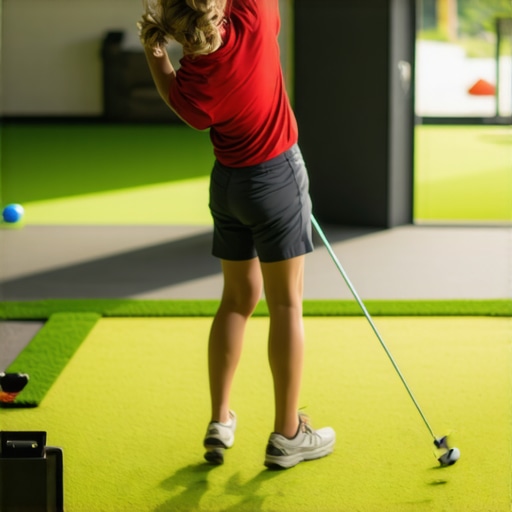
Contrast this with the typical indoor golf simulators near me. Most facilities use synthetic mats laid over a thin layer of foam, which sits directly on top of a concrete or hardwood floor. When the club head strikes this surface, there is nowhere for the energy to go. Instead of a divot, you get a “bounce.”
The “Fat Shot” Fallacy
One of the biggest dangers of the golf sim environment is what I call the “Fat Shot Fallacy.” On a trackman golf setup, you might hit a shot slightly behind the ball, but because the club bounces off the firm mat and into the ball, the launch monitor still registers a decent result. You might think you hit it pure, but your joints know the truth.
When the club head hits a hard mat, the energy that would normally be dissipated by the soil is reflected back up the shaft of the club. This creates a “jarring” effect that travels through the wrists, up the arms, and directly into the lead side of the body. Because the lead hip is the braced pivot point at the moment of impact, it absorbs a massive percentage of this reflected kinetic energy. If you’ve noticed that your golf lessons aren’t helping your physical discomfort, it might be because your new golf lessons won’t fix the back pain you get at the driving range if the underlying issue is the repetitive trauma from mat impact.
Why the Lead Hip Takes the Brunt of the “Jarring” Effect
Why is it always the lead hip? In a standard golf swing, the lead leg acts as the “brakes.” As you move through impact and into the follow-through, the lead hip must rapidly decelerate the massive forces generated during the downswing.
On natural turf, the slight “give” of the ground allows for a more gradual deceleration. On a mat, the deceleration is abrupt. It is the difference between jumping onto a crash pad and jumping onto a sidewalk. This repetitive, high-impact deceleration leads to several specific orthopedic issues:
- Tendonitis: The tendons surrounding the hip, particularly the gluteus medius and the iliopsoas, become inflamed from the repetitive shock. Research shows that “overly thin mats” are a primary cause of tendonitis in golfers who tend to “dig” or have a steep angle of attack.
- Labral Irritation: The labrum is a ring of cartilage that lines the hip socket. The jarring force of mat impact can pinch or fray this tissue, leading to deep, aching pain in the groin.
- Hip Impingement (FAI): The repetitive force can exacerbate Femoroacetabular Impingement, where the bones of the hip joint are abnormally shaped and rub against each other.
If you are frequenting a driving range near me that only offers hard, thin mats, you are essentially subjecting your lead hip to hundreds of mini-collisions every week. Over time, these micro-traumas add up to significant injury.
5 Warning Signs Your Simulator Sessions Are Hurting Your Hips
Many golfers ignore the early warning signs, attributing them to “just getting older” or “swinging too much.” However, if you are using an indoor golf simulator regularly, you need to be on the lookout for these specific symptoms:
- Groin Aching: Deep pain in the front of the hip or groin area during or after a session of indoor golf.
- Lateral Hip Pain: Tenderness on the outside of the hip bone, especially when lying on that side at night.
- Loss of Internal Rotation: If you find it harder to “turn through” the ball or notice your lead foot flaring out excessively to compensate, your hip may be tightening up to protect itself.
- Stiffness After Sitting: Feeling like you “need to pop” your hip or experiencing significant stiffness after driving home from the trackman golf near me facility.
- Referred Pain: Sometimes hip issues manifest as lower back pain or even ankle instability. In our clinic, we often find that why we adjust your ankles to fix chronic hip issues is a key part of the recovery process, as the whole kinetic chain is connected.
If you are experiencing these symptoms, it is vital to address the soft tissue tension. You can learn how to use a massage ball to release hip flexor tension as a first step in managing the day-to-day strain of simulator use.
How to Protect Your Hips While Using an Indoor Golf Simulator
The goal isn’t to stop using the golf simulator – it’s too valuable a tool for that. The goal is to use it smarter. Here is how you can protect your lead hip while still getting your reps in this winter.
1. Choose Your Facility Wisely
When searching for a golf simulator near me, don’t just look at the software. Look at the hitting surface. High-quality facilities invest in mats like the “Fiberbuilt Grass Series” or the “TrueStrike” mats. These are designed with a gel sub-base or long synthetic fibers that allow the club to “swing through” the surface, much like a real divot. This significantly reduces the jarring force sent into your lead hip. If the mat feels like a piece of carpet over a sidewalk, find a different driving range.
2. Limit Your Volume
In a golf sim, there is no walking between shots and no waiting for a playing partner. You can easily hit 100 balls in 45 minutes. This rapid-fire hitting doesn’t allow the tissues in your lead hip to recover between loads. Slow down. Step off the mat between every shot. Practice your pre-shot routine. This not only helps your golf game but also saves your joints.
3. Incorporate “Hip Loading” Drills
To withstand the forces of a trackman golf session, your hip needs to be both mobile and stable. Focus on exercises that strengthen the posterior chain and the core. I highly recommend the bridge exercise variation for a stable SI joint, which helps stabilize the pelvis and supports the lead hip during rotation.
4. Warm Up Properly
Most golfers walk from their car directly to the indoor golf simulators near me and start swinging a 7-iron. This is a recipe for disaster. Spend five minutes doing dynamic stretches – leg swings, lateral lunges, and torso rotations – to “wake up” the mechanoreceptors in your hip joints before you take your first swing.
The Long-Term Impact of Hard-Surface Practice
We must acknowledge that practicing on hard surfaces or low-grade AstroTurf can lead to serious, life-long injuries if not managed correctly. As a TPI-Certified professional, I often look at “Hip Internal Rotation” as the ultimate “Lead Hip Back Pain Predictor.” If you lose that rotation because of chronic inflammation from mat impact, your golf career will be shorter and more painful than it needs to be.
The “jarring” effect isn’t just a nuisance; it’s a mechanical stressor that can change the way you move. When the brain senses pain or potential injury in the lead hip, it will subconsciously alter your swing to avoid that pain. This leads to “early extension,” “hanging back,” and other swing flaws that not only ruin your scorecard but also put more pressure on your lower back.
Conclusion: Balancing Performance and Longevity
The rise of the indoor golf simulator is one of the best things to happen to the game, providing access and data that was once reserved for the pros. But as with any technology, it must be used with an understanding of its limitations and physical costs. Don’t let your winter practice sessions in a golf sim ruin your spring season on the grass.
By choosing facilities with better mats, managing your practice volume, and staying on top of your mobility, you can enjoy the benefits of trackman golf without sacrificing your lead hip. If you’ve been searching for indoor golf simulators near me and have started to feel that familiar ache in your hip or back, don’t wait for it to become a chronic injury.
At Quackers Spinal, we specialize in helping golfers navigate the physical demands of the sport. Whether you need a full TPI mobility assessment or targeted treatment for hip impingement, we are here to help. Contact Us today to schedule an appointment and keep your swing – and your hips – in peak condition all year long.