Why hitting off mats at an indoor golf simulator is wrecking your lead hip
Why Hitting Off Mats at an Indoor Golf Simulator Is Wrecking Your Lead Hip
The rise of the golf simulator has revolutionized how we practice. No longer are we at the mercy of the elements or the setting sun. Whether you are visiting a trackman golf facility to dial in your numbers or searching for an indoor golf simulator near me to keep your swing fluid during the winter months, the convenience is undeniable. However, as a Doctor of Physical Therapy (DPT), Board Certified Orthopaedic Clinical Specialist, and TPI Certified professional, I am seeing a concerning trend in my clinic. While indoor golf offers a high-tech way to play, hitting hundreds of balls off synthetic mats is taking a significant, often hidden, toll on the lead hip. My name is Matthew Wright, and I’ve spent my career helping golfers optimize their biomechanics. Today, we are going to explore why your favorite golf sim might be the very thing standing between you and a pain-free season.
The “False Sense of Security”: Mat Physics vs. Real Turf
One of the primary reasons golfers flock to a golf driving range with premium mats is the immediate feedback – or lack thereof. On a natural grass driving range, the ground is an honest teacher. If you hit the ball “fat” (striking the ground before the ball), the clubhead digs into the soil, the turf displaces, and the ball travels a fraction of the intended distance. You feel the heavy thud, and your ego – and your joints – receive an immediate signal that the strike was suboptimal.
Contrast this with the experience at an indoor golf facility. Synthetic mats, even high-end ones found at a trackman golf near me, are designed for durability. They consist of a layer of artificial fiber over a dense foam or rubber base. When you hit a shot fat on a mat, the club does not dig. Instead, it bounces. The “bounce effect” allows the clubhead to slide along the surface of the mat and into the back of the ball. To the golf simulators sensors, the launch angle and spin might look acceptable, giving you a false sense of security about your ball-striking consistency.
Research often highlighted by biomechanics experts on YouTube and in clinical journals suggests that “mats give you a false sense of security.” But the issue isn’t just a misleading scorecard. When that club bounces off an unyielding mat, the energy that would have been dissipated by moving dirt is instead reflected back up the shaft. This massive shockwave travels through your hands, up your arms, and eventually settles into the lead side of your body. Because the lead hip is the primary stabilizer during the impact phase, it becomes the ultimate “sink” for this excess kinetic energy. You might think you’re getting better golf lessons by seeing more “perfect” shots on the screen, but you are actually subjecting your lead hip to repetitive micro-trauma that natural turf would otherwise mitigate.
The Biomechanics of the Lead Hip at Impact
To understand why the lead hip is so vulnerable, we have to look at what happens during a standard golf swing. As you transition from the top of the backswing into the downswing, your weight shifts aggressively toward the target. The lead hip (the left hip for a right-handed golfer) must perform several complex tasks simultaneously: it must stabilize the pelvis, rotate internally at high speeds, and absorb massive Ground Reaction Forces (GRF).
During a high-velocity swing, the lead hip can absorb up to four times your body weight in force. On a natural golf driving range near me, the soil provides a degree of “give.” As your lead foot plants and your body rotates, the earth slightly compresses and shifts, allowing for a more gradual deceleration of the hip joint. However, when you are standing on a golf sim mat, that “give” is gone. You are essentially trying to decelerate a high-speed rotational engine against a concrete-backed surface.
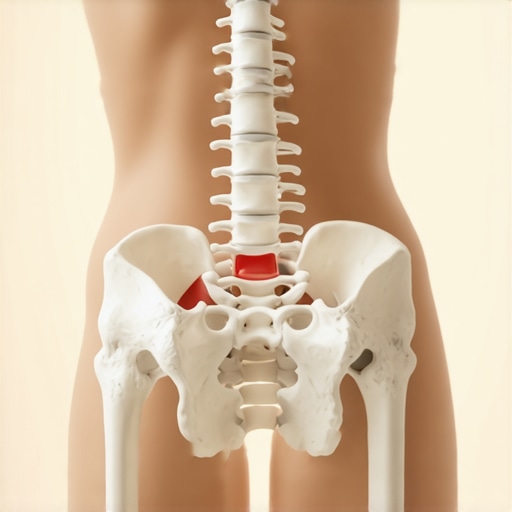
When the ground doesn’t move, the joint must. This puts an immense strain on the labrum (the cartilage ring around the hip socket) and the surrounding musculature. If your body isn’t prepared to handle this, the hip joint begins to pinch. This is why Why Your Glute Medius Is More Important Than Your Abs for Back Health is a critical concept for golfers; if the glute medius cannot stabilize the hip against these forces, the joint itself takes the brunt of the impact.
“The lead hip is the brakes of the golf swing,” I often tell my patients. “When you hit off a mat, you’re essentially slamming those brakes on concrete.” Without the natural displacement of turf, the internal rotation of the hip is forced to happen more abruptly, leading to increased friction and pressure within the acetabulum (the hip socket).
Why Repetitive Simulator Use Leads to Injury
The problem isn’t just the surface; it’s the volume. When you go to a traditional driving range near me, there is a natural rhythm to the session. You hit a ball, watch it land, perhaps walk a few steps to pull another ball from the bucket, and reset your stance. This “down time” allows the tissues in your lead hip to recover slightly between high-stress events. You might hit 100 balls in 45 to 60 minutes.
At an indoor golf simulators near me, the pace is radically different. There is no walking, no waiting for the wind to die down, and often, an automated tee system that places a new ball in front of you the moment you finish your follow-through. It is very easy to hit 100 balls in just 20 minutes. This rapid-fire delivery doesn’t allow for any tissue recovery. This is precisely How to Hit 100 Balls at the Driving Range Without Your Lower Back Giving Out – by managing volume and intensity – but many golfers ignore this when the trackman golf session is on a timer.
This high-volume, high-impact environment is a recipe for three specific injuries:
- Labral Tears: The repetitive “slamming” and twisting can fray or tear the cartilage that lines the hip socket.
- Femoroacetabular Impingement (FAI): This occurs when the ball of the hip pinches against the rim of the socket, often exacerbated by the lack of ground “give” during rotation.
- Trochanteric Bursitis: Inflammation of the fluid-filled sacs that cushion the hip joint, caused by the repetitive friction of the IT band snapping over the hip during the simulator swing.
Identifying the “Mat-Induced” Hip Ache
How do you know if your indoor golf sessions are causing damage? The symptoms of a “mat-induced” hip injury often start subtly. You might notice a deep, dull ache in the groin area after a session at the indoor golf near me. This pain often worsens when you try to sit in a car or a low chair immediately after practicing.
Other warning signs include:
- A “clicking” or “popping” sensation in the front of the hip during the downswing or follow-through.
- Stiffness in the lead leg when getting out of bed the morning after a long golf sim session.
- A loss of power or a “pinching” feeling when you try to fully rotate onto your lead side.
Perhaps most importantly, a compromised lead hip creates a dangerous chain reaction. When the hip loses its ability to rotate internally due to pain or inflammation, the body looks for that rotation elsewhere. Usually, it finds it in the lumbar spine. This is a primary reason Why Practicing at an Indoor Golf Simulator Often Leads to Mid-Back Stiffness and lower back pathologies. If your lead hip is locked up because it’s being hammered by a hard mat, your back will eventually pay the price.
How to Protect Your Hips Without Quitting the Sim
I am not suggesting you cancel your membership at the indoor golf simulators. For many of us, it is the only way to stay competitive. However, you must change your approach to protect your longevity in the sport.
1. Seek Out Better Mats
Not all mats are created equal. If you are looking for golf lessons near me, ask the pro what kind of mats they use. “Divot-action” mats, such as those made by Fiberbuilt or TrueStrike, feature long fibers or gel inserts that allow the clubhead to move *through* the surface rather than bouncing *off* it. This significantly reduces the shock transmitted to your lead hip.
2. Reconsider Your Footwear
On a natural golf driving range, aggressive spikes help you maintain traction in the grass. On a synthetic mat, those same spikes can “lock” your lead foot into the carpet-like fibers. If your foot is glued to the floor and your upper body is rotating at 100 mph, that torque has to go somewhere – and it usually goes straight into the lead hip joint. Consider wearing spikeless shoes or even cross-trainers when hitting at an indoor golf facility to allow for a tiny bit of “slip” that can save your labrum.
3. Prioritize Mobility
If you are going to subject your hip to the rigors of a golf simulator, your mobility must be impeccable. You cannot afford to have “stiff” joints. Interestingly, Why Your Ankle Mobility Is Secretly Destroying Your Squat Form also applies to your golf swing. If your lead ankle is stiff, your lead hip has to work even harder to find a stable base, increasing the vertical pressure on the joint during impact.
4. Quality Over Quantity
Understand that Why Your New Golf Lessons Won’t Fix the Back Pain You Get at the Driving Range often comes down to how you practice. Instead of hitting 100 7-irons in a row, use the trackman golf software to play a “simulated” round. Hit a driver, wait 60 seconds, hit an iron, then “putt.” This mimics the natural cadence of the game and gives your lead hip the breaks it desperately needs.
Conclusion: Play Smarter, Not Harder
The golf simulator is a double-edged sword. It offers unparalleled data and year-round access, but it also presents a physical environment that our bodies weren’t necessarily designed to handle at high volumes. By understanding the physics of mat-based practice and the biomechanics of the lead hip, you can enjoy the benefits of indoor golf without ending up on my treatment table with a labral tear.
If you have been frequenting a golf driving range near me and have started to feel that tell-tale “pinch” in your lead groin or a persistent ache in your hip after practicing, don’t ignore it. Your swing is only as good as the joints that support it. Play smarter, monitor your volume, and ensure your body is as “tour-ready” as the technology you’re using. If the pain persists, it may be time for a professional physical assessment to ensure your indoor golf simulators sessions aren’t doing permanent damage.