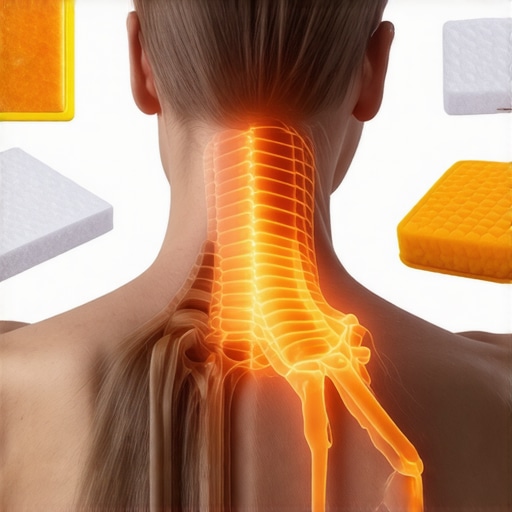
Why You Feel Dizziness After a Neck Strain
I was reaching for a heavy bag of groceries—the kind where you overstuff the paper handles—and I felt that sharp, hot ‘zip’ in my neck. Within an hour, I couldn’t just ‘walk it off.’ Every time I turned my head to the left, the room did a slow, nauseating barrel roll. It felt like I was permanently stuck on a boat in choppy water. I spent three days staring at the floor because looking up made me feel like I was going to pass out. That’s the scary part about neck strain that nobody warns you about: it’s not just about the ache; it’s about losing your sense of where you are in space. If you’re feeling that weird, floaty, ‘off-balance’ sensation right now, I want you to take a deep breath. You aren’t losing your mind, and you probably don’t have a mysterious brain virus. Today, I’m peeling back the curtain on why your neck and your balance are basically roommates who won’t stop fighting. We’ll look at how your nerves get confused and what you can do to get your feet back under you.
Your Neck Is the GPS for Your Brain
When I first started dealing with this, I made a massive mistake: I assumed my ears were the problem. I bought every over-the-counter motion sickness pill I could find. None of them worked. It wasn’t until I learned [the hidden link between neck pain and spinal health](https://quackersspinal.com/the-hidden-link-between-neck-pain-and-spinal-health) that I realized my neck muscles were actually lying to my brain. You see, your neck is packed with tiny sensors called proprioceptors. Their only job is to tell your brain exactly where your head is sitting. When a strain makes those muscles tight or inflamed, they start sending ‘garbage’ data to your central nervous system. Imagine trying to navigate with a GPS that thinks you’re three blocks away from where you actually are—that’s why you feel dizzy. [IMAGE_PLACEHOLDER] I also noticed that [why your neck hurts more when you are stressed](https://quackersspinal.com/why-your-neck-hurts-more-when-you-are-stressed) plays a huge role here, as that tension just adds more noise to the signal. When your brain gets conflicting info from your eyes, your ears, and your neck, it hits the panic button.
Is this really just my neck or am I actually sick?
It’s the most common fear I hear from people who are currently clutching the wall just to walk to the kitchen. You wonder if it’s something neurological. While you should always get checked out, ‘cervicogenic dizziness’ is a very real, documented phenomenon. Research published in the Journal of Manual & Manipulative Therapy suggests that a staggering number of people with chronic neck issues experience some form of lightheadedness because the upper cervical spine is so intimately tied to our balance centers. Once I understood [how to tell if your headache is starting in your neck](https://quackersspinal.com/how-to-tell-if-your-headache-is-starting-in-your-neck), I stopped panicking and started focusing on the real issue: mechanical alignment. Does your dizziness strike mostly when you’re staring at your phone, or is it a constant swaying feeling? Sometimes, even something as simple as [the 30-second fix for a pinched nerve in the neck](https://quackersspinal.com/the-30-second-fix-for-a-pinched-nerve-in-the-neck) can start to clear the fog, but we need to dig deeper into the ‘why’ before we can fix the ‘how.’
Reset Your Internal GPS with Target Tracking
The most effective way to stop the ‘floaty’ feeling is to retrain the communication between your eyes and your upper cervical spine. When I was at my worst, I tried to force myself to stay perfectly still, thinking that movement was the enemy. I quickly learned that stillness actually makes the brain more sensitive to bad data. Instead, you need to perform what I call ‘Target Tracking.’ Hold your thumb out at arm’s length and keep your eyes locked on your nail. Slowly turn your head five degrees to the right while keeping your eyes fixed on that thumb, then five degrees to the left. If you feel a surge of dizziness, stop and let it settle. This simple drill forces your brain to recalibrate the input from your neck muscles against the visual data from your eyes. Using chiropractic secrets to boost neck comfort and function often involves these neurological resets because your neck doesn’t live in a vacuum. 
Stop Looking at Your Feet to Find Your Balance
One of the biggest mistakes we make when we feel off-balance is staring at the ground. This actually creates a feedback loop of tension in the suboccipital muscles at the base of your skull. I remember a specific afternoon when I was trying to walk down a hallway; I was so focused on not falling that I stared at my toes, and within ten feet, I felt like I was tilting at a 45-degree angle. The moment I looked up at a picture on the far wall, the swaying stopped. This is why we often find that we must why we look at your feet to solve your neck issues during a consultation. If your gait is off or your arches are collapsing, your neck has to work overtime to keep your head level. You can actually how to fix your gait for better spinal alignment by focusing on a point at eye level while you walk, which takes the mechanical pressure off those delicate upper neck sensors.
Realign the Entire Chain from the Ground Up
Your dizziness might feel like it’s located in your head, but the solution often starts much lower. If your pelvis is tilted or your mid-back is locked up, your neck becomes the ‘whipping boy’ that absorbs all the secondary stress. I’ve seen cases where a simple 30-second reset for tech neck fatigue provided temporary relief, but the dizziness didn’t truly vanish until we addressed the stiffness in the thoracic spine. Think of your spine like a mast on a ship; if the base is wobbly, the top is going to sway the most. This is why neck and back pain solutions are rarely about just one single bone. We have to look at how you transition from sitting to standing and even how to improve your balance by strengthening your toes to create a stable foundation. When your brain trusts the signals coming from your feet and your lower back, it stops panicking about the ‘garbage’ data coming from a strained neck.
The Towel Support Trick for Constant Recalibration
While you are working on the long-term fix, you need immediate mechanical support to keep those proprioceptors quiet. I found that using a small, rolled-up hand towel placed right in the curve of the neck while sitting can drastically reduce the ‘swaying boat’ sensation. It provides a physical ‘anchor’ for the brain to reference. It’s similar to how some people find relief when they learn how to use a rolled-up towel to fix your cars lumbar support; it’s all about giving the nervous system a consistent point of contact. This tactile feedback tells your brain exactly where your neck is, even if the muscles are too inflamed to do the job themselves. Unlocking neck pain relief is often about these small, consistent wins that lower the overall ‘noise’ in your nervous system.
Here’s the part where I might lose some of the ‘yoga-only’ crowd, but it’s the truth: most of the stretching you’re doing for your neck is actually keeping you dizzy. When people feel that tightness at the base of their skull, their first instinct is to pull, twist, and elongate the muscle. However, if your neck is already sending ‘garbage data’ to your brain, aggressive stretching is like screaming at someone who is already confused—it just adds more noise to an already frantic signal. I call this the ‘Stretching Trap.’ We see the same phenomenon in the lower body, which is exactly why stretching your hamstrings won’t fix your back pain. Often, that ‘tight’ feeling isn’t a short muscle that needs lengthening; it’s your nervous system’s way of putting on the brakes because it doesn’t feel stable. If you keep stretching those brakes, your brain will only tighten the muscles further to compensate, creating a cycle of dizziness and tension.
Stop pulling on your neck like a rubber band
The common belief is that a ‘tight’ neck needs to be loosened, but I challenge that. In my experience, a tight neck often needs to be strengthened and stabilized, not stretched. When the deep stabilizers of the cervical spine—the tiny muscles that live right next to the bone—go on strike, the big postural muscles like your traps have to clock in for overtime. They get tight because they are doing a job they weren’t designed for. If you stretch them out, you take away the only thing holding your head up! This is why professional intervention is about finding the balance between mobility and control. A 2017 study in the Journal of Manipulative and Physiological Therapeutics highlights that chronic neck pain sufferers often have an impaired ‘position sense,’ and simple static stretching does nothing to fix this underlying neurological glitch. We have to restore your range-how chiropractic care enhances movement by teaching the joints how to communicate with the brain again, rather than just forcing them to be loose.
Does my brain prioritize stability over actual comfort?
In short: Yes, every single time. Your brain is a survival machine, not a comfort machine. If the small sensors in your neck aren’t firing correctly, the big ones will ‘lock down’ the entire area to protect your spinal cord from perceived instability. This is also why the old advice to ‘sit up straight’ often backfires and leaves people in more pain. I’ve found that why your perfect posture is actually making you stiff is a very real reality for desk workers; you are essentially holding your breath and tensing your entire spine to maintain a ‘look,’ rather than allowing for natural, fluid movement. True stability comes from the inside out, not from a rigid external pose.
The dangerous trap of the self-crack habit
The biggest ‘oops’ I see—and I’ve been guilty of it too in the past—is what I call the DIY Adjustment. You know the move—you tilt your head or use your palm to shove your chin until you hear that series of satisfying ‘pops.’ While it gives you a momentary rush of endorphins, you are likely just moving the hypermobile joints that are already moving too much. You are completely bypassing the ‘stuck’ segments that are actually causing the vestibular confusion. This self-manipulation actually destabilizes the neck further, making your dizziness more frequent over time. To get neck pain no more-expert chiropractic solutions that work, we have to target the specific, precision segments that are truly frozen. By focusing on chiropractic secrets to boost neck comfort and function, we can stop the ‘cracking’ cycle and finally get your internal GPS back online. Have you ever fallen into this trap? Let me know in the comments.
Once you stop the self-cracking cycle, you have to replace that habit with actual mechanical support. I tell everyone that my most vital tool isn’t a fancy gadget; it’s a simple measuring tape. I use it to ensure my eye level hits the top third of my screen. If you haven’t done it yet, you need to learn how to adjust your monitor to avoid eye and neck strain because even a two-inch discrepancy forces your suboccipital muscles to stay in a state of ‘high alert.’ This constant low-grade tension is what eventually leads to that floaty, disconnected feeling. I also have a strict rule about my sleep environment. I personally swap my cervical support pillow every 14 months, because even the best foam loses its structural integrity before you realize it. Understanding why your pillows should be replaced every eighteen months is non-negotiable if you want to wake up without your internal GPS feeling scrambled.
How do I keep my neck from locking up again?
Maintenance isn’t about doing more; it’s about doing the right things consistently. I rely on the ’20-20-20-20 rule’—adding a fourth ’20’ for twenty degrees of head rotation. Every 20 minutes, look 20 feet away for 20 seconds, and rotate your head 20 degrees to each side. This keeps the fluid in your joints moving and prevents the ‘stuck’ sensation. You can also enhance mobility naturally with chiropractic care by focusing on these micro-movements between visits. Dr. James Elliott, a leading researcher in musculoskeletal management, has noted in his work on cervical spine trauma that muscle fat infiltration can occur when we remain static for too long. Essentially, if you don’t use those deep stabilizing muscles, your body literally starts to replace them with fat. That is a terrifying thought, but it’s a great motivator to keep moving.  In the next few years, I predict we’re going to see a massive shift toward biofeedback wearables that live behind the ear. These won’t just track steps; they will monitor the electrical activity in your traps and alert your phone when your muscle tension exceeds a certain threshold. It’s about ‘pre-habilitation’—fixing the signal before it becomes a scream. For now, you can mimic this by practicing the 20-20-20 rule for desk workers and neck health religiously. If you’re feeling that sway today, I challenge you to set a timer on your phone for every hour. When it goes off, don’t just stretch—simply look at the furthest point on the horizon you can see and breathe. It forces your brain to recalibrate using long-range data, which is the ultimate ‘reset’ for a dizzy neck. Getting unlock neck pain relief essential chiropractic tips for 2025 means staying ahead of the tech curve and the physical strain.
Dealing with cervicogenic dizziness is a marathon, not a sprint, and it requires a shift in how you view your body’s communication style. I used to think my body was failing me, but I realized it was just speaking a different language that I hadn’t learned yet.
The Hardest Lesson I Learned While Chasing My Own Center of Gravity
The most profound realization I had was that you cannot heal a noisy nervous system with more noise. I spent years trying to ‘power through’ the dizziness, but true recovery only started when I embraced these lightbulb moments:
- The Symmetry Myth: I discovered that my left side was doing all the heavy lifting. I had to investigate why your dominant leg is causing your pelvic imbalance before my neck could finally relax.
- Grounding Starts at the Bottom: It sounds counterintuitive, but the secret to better balance starts with your big toe. If your feet aren’t gripping the floor, your neck muscles will tighten up to compensate for that perceived instability.
- Rest is a Skill: I learned that sitting still isn’t enough; you have to actively decompress. Learning the 5-minute reset for a stiff lumbar spine helped take the global tension off my entire spinal cord.
[IMAGE_PLACEHOLDER]
My Essential Kit for a Grounded Spine
You don’t need a gym full of equipment to fix your internal GPS, but a few specific tools made a world of difference in my recovery. Here is what I keep in my daily toolkit:
The humble Hand Towel: I don’t go anywhere without one. I use it to practice the correct way to use a lumbar roll in your office chair. Providing that small tactile ‘anchor’ for my lower back immediately calmed the dizziness signals in my neck. I also trust the philosophy of ‘The Spinal Engine’ by Serge Gracovetsky; it’s a deep-dive book that explains why we look at your ribcage movement for better mobility. Once I understood that my neck followed my ribs, everything clicked. Finally, I invested in a high-quality cervical support pillow and committed to the rule of why your pillows should be replaced every eighteen months to ensure my neck never loses its structural support while I sleep.
Take the First Step Toward Solid Ground
Feeling like the world is constantly shifting beneath your feet is exhausting and isolating, but you don’t have to live in the fog forever. Your body has an incredible capacity to recalibrate once you remove the mechanical interference and stop the cycle of ‘garbage data’ flowing to your brain. By focusing on precision alignment and functional movement, you can reclaim your confidence and your stride. It is time to stop guessing and start implementing real neck and back pain solutions that address the root cause. Have you ever felt like you were ‘walking on a boat’ even when you were on solid ground? Let me know your story in the comments below.