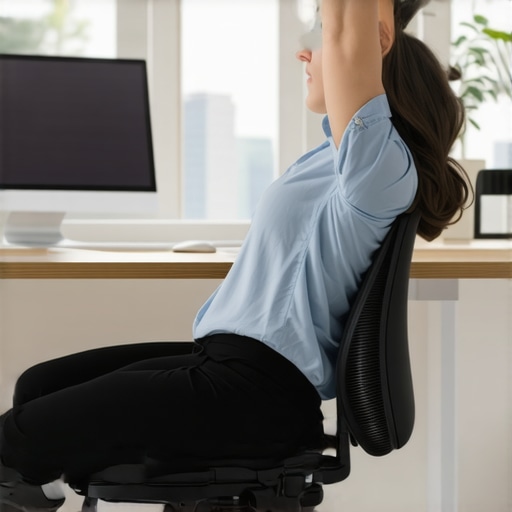
The 5-Minute Reset for a Stiff Lumbar Spine
I remember one specific Tuesday morning when I dropped a sock. Just a regular, cotton sock. I reached down to grab it, and my lower back let out a silent scream that froze me mid-lean. I stayed there, hovering over my laundry basket like a broken hinge, wondering how my body had become so brittle. I felt like a rusty tin man. If you have ever spent your first twenty minutes out of bed moving like a statuesque penguin, you know exactly what I am talking about. It is frustrating, it is limiting, and frankly, it is exhausting to start every day in a fight with your own skeleton. For years, I made the classic rookie mistake of thinking I just needed to ‘stretch’ it out. I would spend twenty minutes cranking on my legs, but why stretching your hamstrings wont fix your back pain became painfully clear when the stiffness returned by lunch. Today, I want to share the five-minute lumbar reset that actually changed the game for me. It is not about brute force; it is about working with your nervous system to let go of that protective guarding.
Stop Fighting Your Body Every Morning
The real reason your back feels like it is made of solid oak isn’t necessarily because your muscles are short. Often, it is because your brain is trying to protect a spine it perceives as unstable. I spent a long time thinking I was ‘tight,’ when really I was just poorly aligned. I used to sit for hours in a soft chair, not realizing why your couch is the worst place for your spine until the chronic ache became my permanent shadow. The secret to restore your back mobility is to use movements that rehydrate those discs after a long night of stillness. Research published in the Journal of Physical Therapy Science confirms that even short bouts of targeted movement can significantly reduce the internal pressure on your lumbar discs. It is like greasing the gears before you try to drive the car. Instead of long, boring static holds, we need to focus on gentle, rhythmic motion. Have you ever felt that terrifying ‘tweak’ just from doing something simple like brushing your teeth or putting on shoes?
Will five minutes really make a difference?
I know what you are thinking. I was a skeptic too. I thought if an hour of yoga didn’t fix me, five minutes of ‘resetting’ was a joke. But the magic isn’t in the intensity; it is in the frequency and the timing. By doing the 30-second morning move to hydrate your spinal discs and following it up with a few specific activation drills, you tell your nervous system that it is safe to move again. We aren’t trying to become gymnasts here. We are just trying to get you through your morning coffee without a heating pad. Before we dive into the specific movements, we need to understand why your current ‘posture’ might actually be part of the problem. [image placeholder]The first thing you have to do—before you even think about caffeine—is change how you exit the mattress. I used to lunge out of bed like I was escaping a fire, putting an immediate 500-pound load on my cold, dehydrated discs. Instead, you need to learn the proper way to get out of bed to protect your discs by rolling onto your side and using your arms to push up. It sounds small, but it stops the ‘micro-tearing’ sensation that ruins your day before it starts. Once you are on your feet, we move into the actual reset.
Gently Tilt Your Pelvis to Wake Up Your Discs
Think of your spine like a sponge that has been squeezed dry all night. You can’t just yank it; you have to let it soak up movement slowly. I start with standing pelvic tilts. I stand with my knees slightly bent and imagine my pelvis is a bucket of water. I tilt the bucket forward, then backward, using only my core. When I first tried this, I was so stiff I looked like a glitching video game character. I remember one morning in February, I was so frustrated that I tried to force a deeper range of motion. I felt a sharp ‘zip’ in my hip and realized why stretching a tight muscle isnt always the answer. Brute force creates more guarding. Instead, keep the movement small—less than an inch—to encourage the joints to lubricate. This is part of the 3-minute morning routine to lubricate your joints that signals to your brain that the ‘danger zone’ has passed.
Stop Rolling Your Lower Back on a Hard Foam Roller
This is a hard truth for many fitness enthusiasts: stop rolling your lower back on a hard foam roller. Your lumbar spine is designed for stability, and smashing those vertebrae against a plastic tube often causes the muscles to seize up even tighter to protect the bone. If you want to use a tool, focus on the glutes and mid-back. When your glutes are stuck, your lower back has to pick up the slack. I realized that why tight hip flexors are the real cause of your lower back arch was the missing piece of my puzzle. If your hips are tight, they pull your pelvis forward, putting your spine in a permanent ‘tug-of-war.’
The Bird-Dog Variation for a Stable Foundation
After we have ‘greased the gears’ with tilts, we need to lock that mobility in with stability. My favorite tool is the bird-dog variation that fixes wobbly core muscles. Most people do this by flinging their limbs around, which just arches the back further. The trick is to keep your back so flat you could balance a hot cup of coffee on it. Reach out with your opposite arm and leg, but only go as far as you can without your lower back dipping. The goal is to build ‘anti-rotation’ strength. I used to think I had a ‘weak’ back, but really, I had a ‘noisy’ back that didn’t know how to stay quiet while my hips moved. By following these steps, you transition from a brittle, protective state into a functional one, preparing your body for the day’s demands without the fear of a sudden tweak.
We often think of ‘stability’ as being an immovable object, but true spinal health is about being a ‘controlled’ and adaptable one. Many of my patients arrive with the mindset that they need to brace their core 24/7 to protect their discs. This is where the common advice fails. Everyone tells you to brace your abs like you’re about to get punched, but why your strong core might actually be too rigid is a nuance that most fitness influencers miss. When you create excessive tension, you stop the natural micro-movements required for spinal fluid to circulate. If you have been told to ‘sit up straight’ at all times, you might be surprised to learn why sit up straight is actually bad advice for some people, particularly those who already have an overactive lumbar curve. It’s about fluidity, not just being a block of ice.
Why does my back feel tighter after a core session?
This is the number one question I get from people who are trying their best but getting worse. The ‘trap’ here is something called co-contraction. While you might be performing the isometric hold that builds a bulletproof core, you might also be holding your breath and locking your diaphragm. A study published in the Journal of Biomechanics indicates that excessive trunk stiffness can actually increase joint load rather than decrease it if the movement isn’t balanced with appropriate relaxation. If your core routine involves constant ‘crunching’ or ‘sucking in,’ you are likely compressing your own vertebrae. This is why I always emphasize why we look at your ribcage movement for better mobility. If your ribs can’t expand, your lower back has to act as a secondary respirator, which it is absolutely not designed to do.

The ‘Oops’ factor usually happens when we try to isolate parts of the body as if they were separate machines. I’ve seen athletes with incredibly strong legs who suffer from chronic lower back issues because they have poor ankle range. There is a direct link between ankle mobility and lower back stability that most people ignore. If your ankle doesn’t bend when you walk, your pelvis has to tilt to compensate, and that tilt eventually turns into a ‘tweak’ in your lumbar spine. Instead of just hammering the area that hurts, we have to look at the joints above and below. This is the difference between temporary relief and actual recovery. Have you ever fallen into this trap of over-bracing and feeling even stiffer the next day? Let me know in the comments. We need to move away from the idea of ‘brute force’ fitness and toward a model of ‘intelligent’ movement that respects how the nervous system actually functions. When we stop fighting our own skeletons and start working with the natural mechanics of the body, the pain often resolves itself much faster than you’d expect.
Stop guessing and start using the right tools
I used to buy every gadget advertised on social media, thinking a vibrating massage gun would magically fix my years of poor movement. It didn’t. What actually worked was moving toward simplicity and precision. Personally, I never travel without a specific, firm lumbar roll. It’s not just about comfort; it is about maintaining the natural lordotic curve of your lower back when you are forced into chairs that weren’t designed for humans. If you’re working a 9-to-5, learning the correct way to use a lumbar roll in your office chair is non-negotiable. I also keep a high-density lacrosse ball in my desk drawer. It is the only tool small and firm enough to hit the deep hip rotators that, when tight, pull my pelvis out of alignment. If you are struggling with a tight budget, how to set up your home office on a budget is a great starting point for finding ergonomic fixes without the premium price tag.
#IMAGE_PLACE_HOLDER_D#
How can you keep your spine healthy for the long haul?
Maintenance is where most people fail because they stop their routine as soon as the pain disappears. I’ve learned the hard way that the absence of pain is not the presence of health. True mobility mastery expert tips for back pain prevention and recovery revolve around consistency over intensity. I’ve found that the best exercises to keep your spine young aren’t the ones that leave you sweating; they’re the ones that maintain joint space and keep the nervous system calm. Dr. Stuart McGill, a world-renowned biomechanics expert and author of ‘The Back Mechanic’, emphasizes that building ‘proximal stiffness’—the ability of your core to stay stable while your limbs move—is the ultimate insurance policy against injury. This is a life-long commitment, not a six-week program. Even with a rock-solid home routine, professional insight is vital to catch subtle imbalances, which is why boost mobility ease pain chiropractic techniques unveiled during a clinical assessment can reveal hidden issues before they become full-blown flares.
The future of back health is moving into your pocket
As we look toward 2025 and beyond, I predict we will see a massive shift toward wearable biomechanical sensors that provide real-time feedback on spinal loading. Imagine a shirt that gently vibrates when you’ve been slumping over your phone for too long. Until those become mainstream, you have to be your own sensor. Developing a high level of proprioception—the internal sense of where your body is in space—is the ultimate goal. You can start building this today by using the 10-second posture check you can do anywhere. It’s about creating a feedback loop between your brain and your spine. My challenge to you today is to stop waiting for the ‘perfect’ time to start. Pick one specific tool, like a lumbar roll or a lacrosse ball, and commit to using it for just five minutes this evening. Start tonight by implementing the 5-minute routine to decompress your spine after work and see how much lighter you feel tomorrow morning.
The Truth About Being ‘Bulletproof’ That I Had to Learn the Hard Way
After years of treating my body like a construction project rather than a living ecosystem, I finally realized that my spine wasn’t ‘broken’—it was just over-protective. The biggest shift wasn’t in my muscles; it was in my mindset. I stopped looking for the one ‘magic stretch’ and started focusing on revitalize your mobility proven strategies for back pain relief that prioritize safety over intensity. I learned that a little bit of movement done often is worth more than a grueling hour-long session once a week.
Here are the three lightbulb moments that finally clicked for me: First, pain is a signal, not a command to stop moving entirely. Second, your breathing dictates your tension; if you can’t breathe through a movement, your brain won’t let your muscles relax. And third, boost your back health simple yet effective chiropractic hacks like shifting your weight while standing can prevent the ‘static fatigue’ that leads to those morning screams.
The Only Tools That Actually Stayed in My Gym Bag
I have a closet full of abandoned foam rollers and ‘posture correctors,’ but only a few things have stood the test of time. I always recommend a simple high-density lacrosse ball for those deep glute releases and a reliable lumbar support. If you spend most of your day at a computer, utilizing the 5-minute desk reset for busy professionals is far more effective than any expensive gadget. These tools don’t ‘fix’ you; they simply provide the environment your body needs to heal itself. I trust these methods because they focus on mechanical alignment rather than temporary numbing.
Your Spine is More Resilient Than You Think
It is easy to feel fragile when your back is acting up, but your body is incredibly adaptable. By applying mobility mastery expert tips for back pain prevention and recovery, you are giving your nervous system the green light to let go of that protective guarding. You don’t have to be perfect; you just have to be consistent. Start small, listen to your body’s subtle whispers before they become shouts, and trust the process of gradual improvement. Your journey to a pain-free morning starts with that first, gentle tilt tonight.
Have you ever found that a specific daily habit—like the way you sit or a certain pair of shoes you wear—was secretly the culprit behind your back stiffness? I’d love to hear your ‘aha’ moments in the comments below!