The 5-minute doorway stretch for rounded shoulders
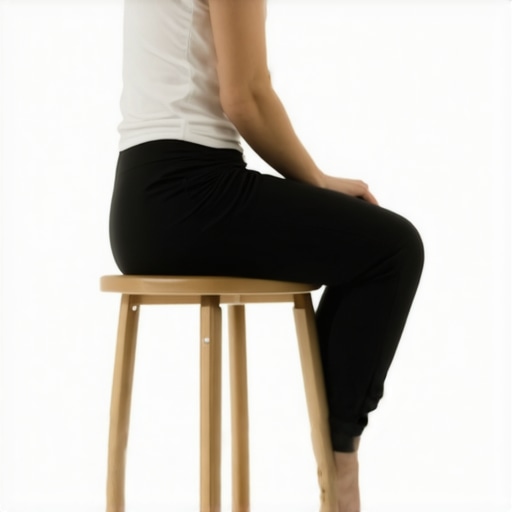
I was standing in line at the grocery store when I caught a glimpse of my profile in the window. I didn’t recognize the person staring back. My shoulders were rolled so far forward I looked like I was permanently bracing for a cold wind that wasn’t there. It wasn’t just about looking “un-athletic”—it was the constant, dull throb at the base of my skull and that annoying shoulder blade burn that just wouldn’t quit. For years, I thought the answer was more expensive ergonomic chairs or fancy back braces. I was wrong. I wasted hundreds of dollars on gadgets when the real solution was literally standing right in front of me: my bedroom door. Today, I am going to show you how a simple five-minute doorway stretch can reclaim your posture and finally provide that lasting neck comfort you have been chasing. Have you ever caught your reflection and realized your posture was much worse than you felt? It is a gut-punch, isn’t it?
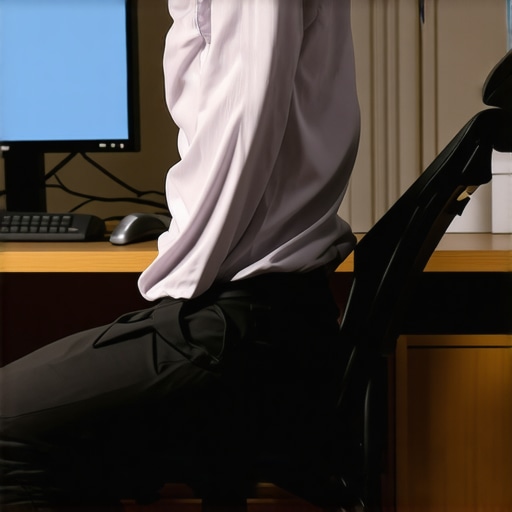
Stop Letting Your Computer Monitor Win the War for Your Spine
Most of us spend our days in what I call the “fetal position for the modern age.” We lean into our screens, our chests tighten, and our upper back muscles simply give up the ghost. My early mistake was thinking I could just “will” myself into better posture. I would sit bolt-upright, stiff as a board, only to find myself slumped over again ten minutes later. That is because your muscles aren’t just lazy; they are physically shortened. When your pectoral muscles become tight from hours of typing, they act like a drawstring, pulling your shoulders forward and putting immense strain on your neck. In fact, research shows that for every inch your head moves forward, it gains significant functional weight. According to a landmark study in Surgical Technology International, a 60-degree tilt—typical for checking a phone—can place 60 pounds of pressure on the neck. No wonder your traps feel like they are made of concrete! Using a 60-second move to open up your chest throughout the day is a great start, but we need something more sustained to truly move the needle.
Can five minutes really undo eight hours of sitting?
It sounds too good to be true, doesn’t it? If you are anything like I was, you are skeptical that a doorframe can do what a expensive chair could not. But the secret isn’t in the equipment; it is in the mechanical leverage. By using the doorway, we can isolate those stubborn chest muscles and allow the spine to decompress without the interference of our own muscle fatigue. We are essentially hitting the “reset” button on your alignment. This isn’t just about looking better; it is about seeking expert chiropractic solutions that treat the root cause rather than just the symptoms. You need to stop fighting your body and start working with its natural geometry. If you have been doing a 10-second posture check and finding yourself failing every time, this is the deep-dive fix you have been waiting for.
Find a Doorway and Claim Your Space
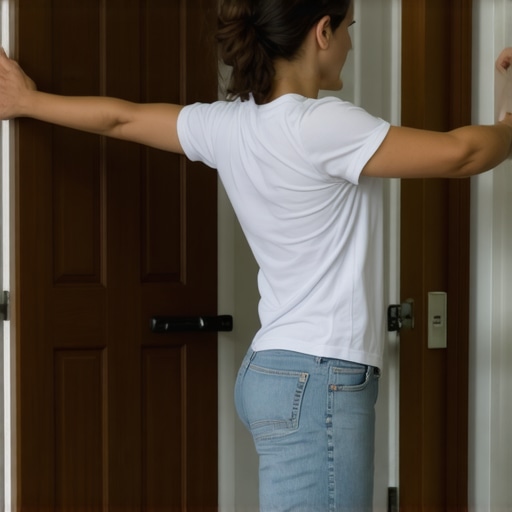
To start, you aren’t just stretching; you are recalibrating your entire skeletal system. Stand in the center of a standard doorframe. This isn’t just a piece of wood; it is your best tool to relieve neck and back discomfort using these expert methods. Think of your pectoral muscles like the tension wires on a suspension bridge. When those wires are too tight, the whole structure—your spine—starts to buckle and bow. By placing your forearms against the frame, you are creating a fixed point of leverage that your own muscles cannot override. This is the foundation of the 5-minute routine to decompress your spine after work that I swear by. I remember a Tuesday last March when my neck felt like it was stuck in a vice after a twelve-hour editing session. I stepped into my laundry room doorway, threw my arms up, and leaned. At first, it actually hurt; my chest was so tight I could barely move an inch forward. But as I breathed, I felt a literal pop of tension release that felt better than any massage I had ever paid for. It was the first time in weeks I didn’t feel the need to aggressively crack my own neck just to find a second of peace.
Where You Put Your Hands Changes Everything
Most people fail because they just throw their hands up and lean randomly. You need to be surgical. Position your elbows at a 90-degree angle, level with your shoulders. This creates a “W” or “Y” shape with your upper body. If your hands are too low, you’re only stretching the lower fibers of the chest. If they are too high, you might pinch a nerve. You want that sweet spot where you feel a pull directly across the front of your shoulders. This is a much more effective version of the 10-second stretch for people who type all day. Once your arms are set, take one small step forward with your dominant leg. Do not lean with your lower back! If you arch your spine to get deeper, you are just trading one problem for another. Keep your core engaged to boost your back health with simple yet effective chiropractic hacks that protect your discs while you open your chest.
Stop Rushing the Release
The biggest mistake is the “bounce.” Your muscles have a protective reflex; if you jerk them, they tighten up to prevent a tear. You have to sneak past that guard. Lean in slowly until you feel a 7-out-of-10 stretch, then stop. Hold it for 30 to 60 seconds. This is where the magic happens. You are telling your nervous system that it is safe to let go. If you’ve been struggling with forward head carriage, combining this with a simple wall drill to reverse forward head posture will double your results. I used to rush this, doing ten-second bursts, and wondered why I still had that mid-day shoulder burn. The breakthrough came when I actually stayed in the doorway long enough for my muscles to physically lengthen. It’s about patience, not force. When you finally step away from the frame, you will notice your shoulders naturally sit back and down, without you having to think about it at all. It feels like someone took a heavy backpack off your shoulders that you didn’t even know you were wearing.
Why Pulling on That Tight Muscle Might Backfire
Here is the hard truth that most fitness influencers won’t tell you: sometimes, the tighter a muscle feels, the last thing you should do is stretch it. I spent years obsessively lengthening my upper traps because they felt like piano wires, only to realize I was actually making the problem worse. This is the common ‘stretching trap.’ If a muscle is feeling tight because it is over-lengthened and weak—which is exactly what happens to your mid-back when you slouch—stretching it further just increases the strain. You are essentially pulling on an already frayed rope. This is a core reason why stretching a tight muscle isn’t always the answer. Instead of mindlessly pulling, you need to understand the difference between a muscle that is physically short and one that is just screaming for stability. Real mobility mastery involves knowing when to lean into the doorway and when to step back and strengthen the foundation.
Does Your Pelvis Hold the Key to Your Neck Pain?
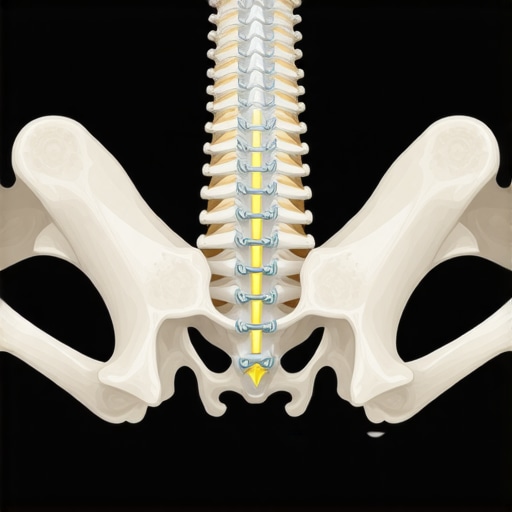
It sounds counterintuitive, but your neck is often just the messenger for a crisis happening in your basement. If your pelvis is tilted—perhaps because you spend all day with a wallet in your back pocket—your entire spine has to compensate. This creates a zigzag effect that ends right at the base of your skull. According to a study published in the Journal of Manipulative and Physiological Therapeutics, researchers have found a significant correlation between pelvic misalignment and compensatory cervical spine strain. This is precisely why we look at your pelvis when your neck hurts. If we only focus on the ‘tech neck,’ we are ignoring the root cause. You can stretch your chest in a doorway until you are blue in the face, but if your hips are locked and your pelvis is hiked, the tension will return before you even finish your morning coffee.
The Hidden Trap of the ‘Perfect’ Posture
Another nuance people miss is the danger of ‘military posture.’ We have been told since kindergarten to ‘sit up straight,’ so we pin our shoulders back and puff out our chests. This is actually a recipe for disaster. This rigid, forced position creates massive amounts of static tension in the paraspinal muscles. In fact, why your perfect posture is actually making you stiff is one of the most eye-opening realizations for my clients. True spinal health isn’t about being a statue; it’s about ‘dynamic neutrality.’ You want a spine that can move, breathe, and adapt. When you force a ‘perfect’ look, you stop using your diaphragm to breathe, which in turn tightens your neck even more. This is where chiropractic secrets to boost neck comfort come into play—it’s about restoring the natural curves, not creating a straight line. Have you ever fallen into this trap of trying to ‘force’ your posture only to feel tighter the next day? Let me know in the comments; I’d love to hear your experience and help you navigate the ‘oops’ factors that might be holding you back from lasting neck comfort.
The Three Low-Tech Tools I Actually Use Every Day
I have spent thousands of dollars on fancy gadgets that now collect dust in my garage, but only three items have earned a permanent spot in my daily routine. First is a simple McKenzie-style lumbar roll. For years, I assumed my expensive office chair’s built-in support was sufficient, but it was actually positioned too high for my frame. Learning the correct way to use a lumbar roll in your office chair changed my energy levels by mid-afternoon because my spine wasn’t fighting to stay upright. Second is a standard tennis ball. It might look low-tech, but how to use a tennis ball to release upper back tension is my secret weapon for those localized knots that a doorway stretch simply cannot reach. Finally, the foam roller. But please, stop using those aggressive knobby ones on your lower back; the proper way to use a foam roller on your upper back is strictly for the thoracic region to encourage extension. If you roll your lumbar spine, you are often just bruising your vertebrae without addressing the underlying mechanics.

Stability Beats Flexibility Every Single Time
Beyond the tools, I’ve shifted my focus from just ‘stretching’ to building true stability. This approach was heavily influenced by Dr. Stuart McGill, a world-renowned spine biomechanics expert at the University of Waterloo, who developed the ‘Big 3’ exercises for core endurance. He argues that most back issues aren’t caused by a lack of flexibility, but by a lack of muscle endurance that allows the spine to buckle under micro-loads. This is exactly why your core routine is failing your spine if you are only focused on crunches. You need the isometric hold that builds a bulletproof core to keep your spine supported during a long work week. When your muscles can hold your spine in a neutral position for hours, the ‘tightness’ you feel in your neck and shoulders often disappears because the muscles are no longer overworking to prevent a collapse.
How do I keep my spine feeling young for the next twenty years?
It is not about one-off ‘fix-it’ sessions; it is about micro-habits and smart scaling. I predict the future of spinal health will move toward ‘smart ergonomics’—wearable tech that uses haptic feedback to vibrate when your cervical spine reaches a dangerous tilt, similar to the 60-degree angle that creates 60 pounds of pressure on your neck. Until those become mainstream, you have to be your own sensor. You need revitalize your mobility proven strategies for back pain relief that fit into your five-minute coffee breaks. To restore your range how chiropractic care enhances movement, you have to stop seeing spinal health as a destination and start seeing it as a daily maintenance ritual. If you want to truly level up, try this today: set a timer for every 50 minutes. Don’t just stand up—perform one 30-second isometric hold and then hit the doorway stretch. This combination of stability and opening is the holy grail for an effective neck pain management a step-by-step guide that actually works in the real world.
The Lessons My Sore Traps Taught Me the Hard Way
Reflecting on my journey from a chronic sloucher to a mobility advocate, I’ve realized that the physical stretch is only half the battle. The first breakthrough was accepting that the difference between muscle soreness and spinal pain is vital to understand; I spent far too long ignoring the latter while obsessing over the former. Secondly, I had to stop the ‘manual correction’ habit. Every time I noticed my posture was bad, I would jerk myself into a rigid state, not realizing that why sit up straight is actually bad advice for some lies in the tension it creates. Lastly, I learned that my neck was the victim, not the criminal. Real progress only happened when I started investigating why we adjust the pelvis to fix neck tension. It turns out, my foundation was tilted, and my neck was just trying to keep my eyes level with the horizon.
My Minimalist Toolkit for Daily Spinal Resilience
You don’t need a gym membership or a thousand-dollar chair to fix your frame. I’ve narrowed my daily maintenance down to three non-negotiables. First, a simple tennis ball or lacrosse ball for myofascial release—it’s the most cost-effective way to hit those trigger points between the shoulder blades. Second, I revamped my workspace by learning how to set up your home office on a budget, focusing on monitor height rather than expensive upholstery. Finally, I rely on a structured approach to movement. I highly recommend checking out mobility mastery expert tips for back pain prevention and recovery if you want to understand the ‘why’ behind the ‘how.’ These resources shifted my perspective from seeking a quick fix to building a lifestyle of mastering back and neck pain relief tips from the pros.
#IMAGE_PLACEHOLDER_E#
Stop Waiting for the Perfect Time to Move
If you take away only one thing from my experience, let it be this: your body is incredibly forgiving if you just give it a chance to reset. You don’t need to spend an hour a day on corrective exercises. The five-minute doorway stretch, a few mindful breaths, and an occasional overcoming chronic neck discomfort insight from top chiropractors will do more for your long-term health than a monthly massage ever could. Your journey toward lasting neck comfort starts the next time you walk through a doorframe. Don’t let another hour of screen time pass without claiming that space for your spine. Have you tried the doorway stretch yet, or do you have another favorite move that helps you reset during a long workday? Let me know in the comments below!