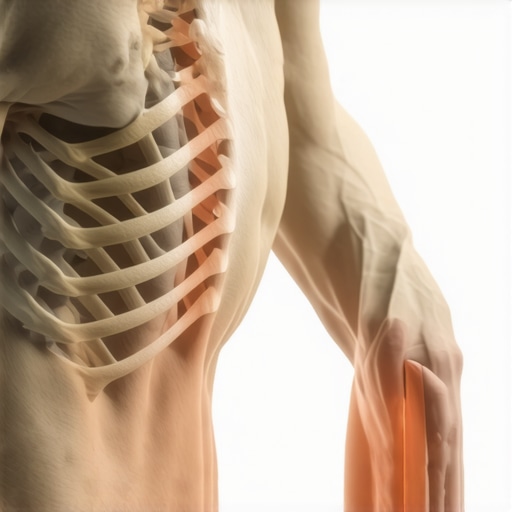
The connection between shallow breathing and back pain
I remember sitting at my desk three years ago, gripped by a dull, throbbing ache in my lumbar spine that just wouldn’t quit. I’d done the stretches. I’d bought the fancy ergonomic chair. I’d even tried walking in flat shoes, thinking my posture was the sole culprit. But there I was, popping ibuprofen like candy and wondering why my body felt like a rusted gate. It wasn’t until a chiropractor pointed out that I was ‘chest breathing’—taking short, shallow sips of air—that the lightbulb finally flickered on. I realized my back wasn’t just weak; it was exhausted from doing the work my diaphragm was supposed to handle. [image_placeholder]
Your Lungs Might Be Sabotaging Your Spine
When we breathe shallowly, we rely on ‘accessory muscles’ in the neck and shoulders instead of the diaphragm. This creates a cascade of tension. If you’ve ever felt that sharp pain when turning your head, you know exactly what I mean. But the real damage happens lower down. A locked diaphragm prevents the natural pressure changes that stabilize your core from the inside out. Today, I’m going to show you how to reconnect your breath to your movement so you can finally revitalize your mobility without over-complicating things. I’m talking about real, sustainable relief that doesn’t involve expensive equipment.
Does changing how I breathe actually fix a physical ache?
I get it—it sounds a bit ‘woo-woo.’ I used to think the same thing. In fact, my biggest mistake early on was ignoring my breath and doubling down on core routines that were actually failing my spine because I was bracing my abs so hard that I couldn’t actually inhale. But the science is hard to ignore. According to research published in the Journal of Physical Therapy Science, diaphragmatic breathing exercises significantly improve spinal stability and reduce chronic low back pain by properly managing intra-abdominal pressure. It’s not just about relaxation; it’s about mechanical efficiency. Have you ever noticed your back pain flaring up during a high-stress week when your breathing feels tight? Drop a comment and let me know—I bet you’re not alone. In the next section, we’re going to dive into the simple breath move that relaxes a seizing lower back and the best ways to breathe through your diaphragm to reduce lower back pressure.Think of your torso as a pressurized canister. To protect your spine, you need to fill that canister evenly. Most people just push their bellies out, but that’s like only inflating one side of a tire—it’s still going to wobble. You need to breathe through your diaphragm to reduce lower back pressure by expanding laterally into your ribs and even into your lower back muscles. I remember a specific Tuesday at the gym, trying to power through a set of squats when a sharp, familiar twinge shot across my belt line. I was bracing my abs like I was preparing for a punch, but I wasn’t actually breathing. I was literally suffocating my spine’s natural support system. My chiropractor later explained that by holding my breath, I was creating ‘dead zones’ of pressure. When I started practicing the 360-degree expansion, that ‘heavy’ feeling in my lumbar vanished. It felt like I’d finally turned on the internal shocks of a car.
Expand Your Ribs Like an Accordion
To get this right, sit in a chair and wrap your hands around your waist so your thumbs are on your back and your fingers are on your sides. When you inhale, your goal isn’t to puff out your chest or just move your belly. You want to feel your fingers and thumbs being pushed outward simultaneously. This is the simple breath move that relaxes a seizing lower back because it forces the diaphragm to drop down fully, creating stable internal pressure from within. If your shoulders move up toward your ears during this process, you’re failing the test. You’re just feeding into neck comfort and function issues by overworking your scalenes. 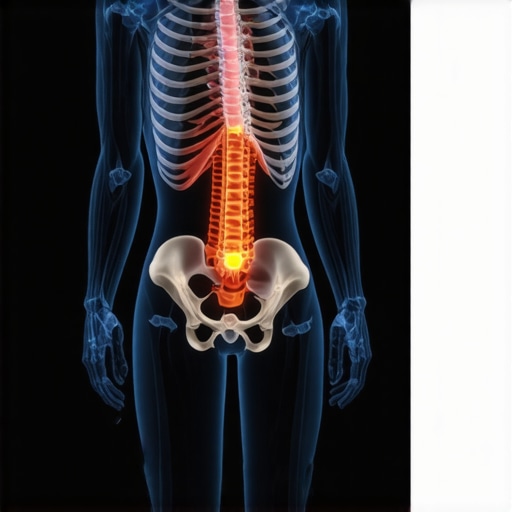
Why Belly Breathing Alone Won’t Save Your Back
A common trap is ‘crocodile breathing’ where you only focus on moving the stomach. While it’s better than chest breathing, it often leads to a ‘flared rib’ posture where the lower ribs angle upward. This posture puts a shearing force on your vertebrae rather than a stabilizing one. To fix this, try to keep your lower ribs ‘tucked’ toward your pelvis as you inhale. This creates a powerful isometric hold that builds a bulletproof core without you ever having to do a single crunch. You are essentially using air to splint your spine from the inside out.
Stop Shouldering the Burden of Your Breath
If you find yourself constantly rubbing your traps or neck, your breathing pattern is likely the culprit. When the diaphragm is stuck or underutilized, the body recruits the neck muscles to lift the ribcage just so you can get enough oxygen. This is why so many neck pain no more strategies involve more than just stretching the neck. You have to boost mobility and ease pain by retraining the primary engine of respiration. When I finally mastered this, the chronic tightness in my upper back—the kind that felt like a hot coal between my shoulder blades—simply dissipated because those accessory muscles could finally go ‘off duty.’But even if you master the 360-degree breath, there is another myth I had to unlearn the hard way: the ‘perfect posture’ fallacy. For years, I tried to sit like a soldier at my desk, thinking that a rigid, straight spine was the gold standard. I was wrong. In fact, why sit up straight is actually bad advice for some becomes clear once you realize that rigidity is the enemy of spinal health. When you force a ‘perfect’ position, you create static muscle tension that actually chokes off blood flow to your discs. I see people all the time who are incredibly disciplined about their setup, yet they can’t understand why your perfect posture is actually making you stiff. The reality is that the best posture is your next posture. Movement variability is what keeps the spine hydrated and happy. 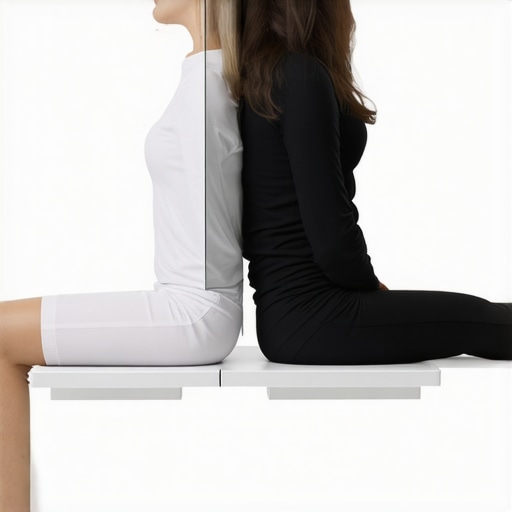
Stop Stretching Your Tight Hamstrings
This is where I usually lose people, but hear me out: that tightness in your hamstrings is likely a symptom, not the cause. If your brain senses that your pelvis is unstable—often due to that shallow breathing we talked about—it will ‘lock’ your hamstrings to act as secondary stabilizers. If you keep pulling on those hamstrings, you are essentially trying to rip away the only thing keeping your lower back from collapsing. This is a classic case of why stretching a tight muscle isnt always the answer. I spent months doing toe touches only to find my back pain getting sharper. It wasn’t until I stopped the static stretching and focused on pelvic stability that the ‘tightness’ simply vanished on its own. Have you ever fallen into this trap of stretching a muscle for weeks with zero long-term relief? Let me know in the comments—I suspect many of you are currently in that cycle.
How can a stiff ankle lead to a herniated disc in my back?
This brings us to the concept of ‘Regional Interdependence.’ A study published in the Journal of Manual & Manipulative Therapy highlights how clinical outcomes for back pain often depend on treating joints away from the site of pain. For me, the missing link was my feet. I didn’t realize how a single tight ankle can cause chronic back pain until a specialist showed me how my lack of ankle dorsiflexion was forcing my lower back to round every time I took a step. You can’t just look at the part that hurts. To truly revitalize your mobility, you have to look at the whole kinetic chain. If you only treat the symptom, you’re just putting a band-aid on a structural leak. To get lasting results, you need to boost mobility and ease pain by addressing these hidden mechanical bottlenecks. It’s about working smarter, not harder, with your body’s natural design.Once you’ve identified the mechanical leaks in your system—the shallow breathing or the frozen ankles—the challenge shifts from recovery to maintenance. In my experience, the biggest threat to long-term success isn’t a lack of effort, it’s the slow, creeping return to old habits. To combat this, I’ve refined a ‘spinal hygiene’ toolkit that keeps me from sliding back into the cycle of pain. I’m not talking about spending an hour at the gym; I’m talking about the gear and habits that protect your spine while you’re actually living your life.
Stop trusting your office chair’s lumbar support
If you look at high-end ergonomic chairs, they all boast about ‘integrated support.’ But here is the problem: the truth about built-in lumbar support in modern chairs is that it’s rarely positioned correctly for your unique spinal curvature. I personally swear by a firm D-section McKenzie roll. Unlike round pillows that push your entire spine forward, the D-shape sits flat against the chair and only supports the lordotic curve of your lower back. However, you have to be careful; I’ve seen people use these and end up with more pain because they don’t know how to use a lumbar roll without making your back stiffer. You want it at the belt line, not tucked into the small of your back, to truly restore your back mobility. #IMAGE_PLACE_HOLDER_D#
How can I stay pain-free without daily hour-long exercises?
The secret isn’t doing more; it’s doing ‘micro-dosings’ of movement throughout your day. I use a concept called ‘movement snacks.’ Every 30 minutes, I perform a 10-second reset to offload the pressure. This is how you master mobility and back pain prevention without it becoming a second job. It’s about maintaining that internal expansion we talked about earlier.
The future of spinal health is in biofeedback
Looking ahead to 2025 and beyond, I predict we will move away from static furniture and toward wearable biofeedback. We are already seeing the emergence of ‘smart’ shirts that use sensors to track your ribcage expansion. This is a game-changer for anyone working on regaining full mobility after injury because it provides real-time data on whether you are chest breathing or using your diaphragm. We won’t have to guess anymore; our phones will vibrate when our spinal stability drops.
Is movement variability more important than perfect posture?
Absolutely. A key study in the Journal of Orthopaedic & Sports Physical Therapy (JOSPT) suggests that movement variability—the ability of the body to distribute loads across different tissues by slightly changing positions—is far more protective against chronic pain than maintaining a rigid ‘correct’ posture. This reinforces why I tell my clients to keep your spine young by moving often rather than moving ‘perfectly.’ If you’ve been struggling with long-term stiffness, I want you to try this one advanced tip tonight: when you sit down to eat dinner, place a small, folded towel behind your lower back and focus on breathing ‘into’ the towel for just five minutes. It’s a simple way to relieve neck and back discomfort by retraining your nervous system to accept support while under load.
Lessons I Learned While Fighting My Own Body
My journey from chronic stiffness to fluid movement wasn’t about finding a magic stretch; it was about unlearning the habits that were keeping me in a state of high alert. One of my biggest lightbulb moments was realizing that back pain recovery isn’t a linear path, but a series of small adjustments in how we manage internal pressure. I used to think my back was ‘fragile,’ but the truth is it was just ‘confused’ by my shallow breathing patterns. Another realization was that my neck pain was often just a reflection of how I was bracing my core—when I stopped trying to hold myself in a rigid ‘perfect’ posture, the tension finally started to melt away. I also learned that consistency beats intensity every time; doing five minutes of 360-degree breathing is more effective than an hour of aggressive stretching once a week. Finally, I discovered that I had to trust my body’s signals instead of trying to silence them with ibuprofen, treating pain as a messenger rather than an enemy. [image_placeholder]
Tools to Keep Your Movement Fluid
You don’t need a gym full of equipment to maintain a healthy spine, but having a few specific items can make a world of difference. I always recommend the McKenzie D-section lumbar roll because it focuses specifically on supporting the natural curve without pushing the whole spine forward. For those days when the tension between my shoulder blades feels like a knot that won’t untie, knowing how to use a tennis ball to release upper back tension has been a total lifesaver. I also keep a firm foam roller nearby, but I make sure to follow the proper way to use a foam roller on your upper back to avoid rib irritation. These aren’t just gadgets; they are extensions of the neck and back pain solutions that top experts use to keep their patients mobile and pain-free.
Take Back Your Freedom to Move
Recovery is about more than just the absence of pain; it’s about the presence of possibility. When you start to implement these breathing techniques and movement snacks, you’re not just ‘fixing’ a problem—you’re building a more resilient version of yourself. Don’t be discouraged if you don’t feel a massive shift overnight. The goal is to gradually rewrite the software your brain uses to control your muscles. True, lasting back pain relief comes when you stop fighting your body and start working with its natural mechanics. You have the tools now, and you have the knowledge to move beyond the cycle of chronic discomfort. Have you ever felt that strange sensation of your back finally ‘opening up’ after a deep, diaphragmatic breath? Let me know in the comments below!