
Strengthening your glutes to take the pressure off your spine
It happened while I was reaching for a dropped pen. Just a simple, everyday movement, but my lower back decided it had finally had enough. A sharp, hot wire of pain shot through my lumbar spine, leaving me breathless and gripping the edge of the desk. For months, I’d been convinced that my problem was just “tightness.” I spent every morning on the floor, but I eventually learned why stretching your hamstrings won’t fix your back pain on its own. The real culprit was much further back—and much lazier. My glutes had essentially gone on permanent vacation, leaving my spine to handle every ounce of pressure from my daily life.
Stop Letting Your Lower Back Carry the Load
We live in a world that wants us to sit. We sit to work, we sit to eat, and we sit to relax. This constant compression causes a phenomenon often called “gluteal amnesia.” When these massive muscles stop firing, your lower back has to step in as a backup generator. It is not designed for that. I spent years making the mistake of focusing on “abs” while my backside remained soft and inactive. I thought a strong core was just about a six-pack, but why your core isn’t engaging during your workouts often comes down to the fact that your glutes aren’t supporting your pelvis. Today, I am going to show you how to wake those muscles up so your spine can finally stop screaming for help.
Are these exercises actually worth the effort?
I get it. You are tired, your back hurts, and the last thing you want to do is more rehab. You might even be skeptical that a few butt squeezes can fix a structural spine issue. But consider this: according to a study in the Journal of Physical Therapy Science, gluteus maximus strengthening is directly correlated with a reduction in chronic low back pain because it stabilizes the sacroiliac joint. It is not just fitness; it is mechanical necessity. When I finally embraced the hinge move that protects your spine while gardening and other daily tasks, my bad back days almost vanished. I want that same relief for you. Have you ever noticed your back getting stiff after just a few minutes of standing? That is your first sign that your glutes are checking out early.
Force Your Glutes to Take the Hit Instead of Your Back
Think of your spine as a flagpole and your muscles as the guy-wires. If the wires on one side—your glutes—are slack and loose, the pole starts to lean, and the wires on the opposite side—your lower back—have to pull twice as hard just to keep it upright. This constant tension is why your lumbar spine feels like a guitar string about to snap. To fix this, you don’t need a gym membership; you need to reconnect the brain-to-butt circuit. This starts with a conscious effort to engage these muscles during mundane moments, like standing in line or washing dishes. By performing the 10-second posture check you can do anywhere, you can ensure your pelvis is neutral rather than tilted into a position that shuts your glutes down.
Start With the Simple Standing Reset
The easiest way to wake up a ‘lazy’ glute is through isometric activation. While standing, keep your feet hip-width apart and imagine you are trying to screw your feet into the floor without actually moving them. Your right foot turns clockwise, your left counter-clockwise. You will immediately feel your glutes tighten and your arches rise. I remember the first time I did this while waiting for my coffee; I felt a weird ‘release’ in my lower back almost instantly. It was like a pressure valve had been turned. This the isometric hold that builds a bulletproof core isn’t just about strength; it is about teaching your body that the glutes are the primary stabilizers for your upright posture.
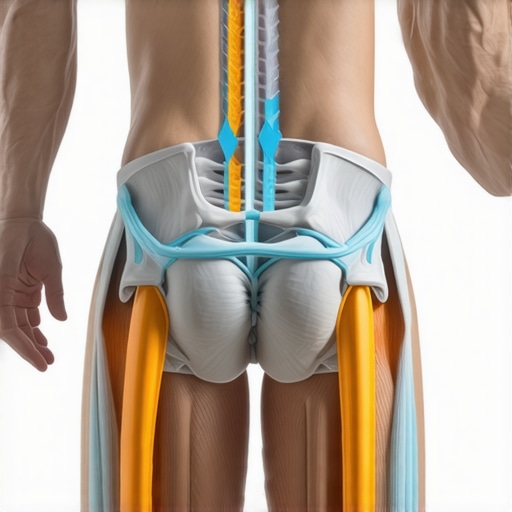
Master the Hip Hinge to Save Your Discs
If you want to stop the cycle of pain, you have to stop bending from your waist. Imagine your hips are a heavy hinge on a gate. When you reach for something on the floor, your butt should move backward, not your shoulders moving down. This is the ‘hip hinge.’ When I was moving a heavy box of vinyl records last year, I felt that familiar warning twinge in my lumbar. I stopped, reset my feet, and focused on the hip-hinge trick for pain-free gardening and lifting. By shifting the weight into my hips, the box felt significantly lighter because my glutes were finally doing the heavy lifting they were evolved to do. If you find this movement difficult, remember that why stretching a tight muscle isn’t always the answer; often, the tightness you feel in your hamstrings is just your nervous system trying to stabilize a pelvis that has no glute support.
Create an Internal Airbag With Your Breath
Your glutes and your core need a pressurized environment to work effectively. Most people breathe shallowly into their chest, which actually increases the tension in the neck and upper back. Instead, you need to learn how to breathe through your diaphragm to reduce lower back pressure. Think of your torso as a canister. When you inhale into your belly, you create 360-degree pressure that acts like an internal airbag, supporting your spine from the inside out. When you combine this diaphragmatic breathing with glute activation, you create a rigid ‘pillar’ of support. This is the difference between a spine that collapses under the weight of daily life and one that remains resilient and mobile. If you are struggling with stiffness, you might also find that the correct way to use a standing desk without hip strain involves this exact combination of breathing and glute engagement to prevent your pelvis from dumping forward.
While the internal airbag concept is a game-changer, I see so many people take it to an extreme that actually backfires. They become “rigid.” They walk around with their abs perpetually braced like they’re about to take a punch. This is one of the biggest hidden nuances: why your strong core might actually be too rigid for its own good. If your muscles never relax, they never truly recover, and they certainly don’t move with the fluid grace your spine requires. It is a common trap to think that more tension equals more safety, but a truly functional spine needs to be able to oscillate between tension and relaxation.
Can you actually have a core that is too strong for your own good?
Yes, absolutely. High-level athletes often struggle with this. When you over-brace, you create a “shield” that prevents your joints from absorbing shock. This is where the contrarian view comes in: “perfect” posture is often a myth. We are told to sit like statues, but the British Journal of Sports Medicine highlights that there is no single “correct” posture; rather, the best posture is your next posture. Movement is the key. I have found that why your perfect posture is actually making you stiff is usually because you have stopped shifting your weight. Your body craves variability, not a rigid 90-degree angle.
Another nuance people miss is how the bottom of the chain affects the top. I have had patients come in for chronic neck tension, only to realize we needed to look at their hips. We often discover that why we adjust the pelvis to fix neck tension is because a tilted foundation forces the head to migrate forward to maintain balance. It is all connected. If you are only treating the spot that hurts, you are just chasing shadows. You might also be surprised to learn how the link between ankle mobility and lower back stability dictates how your glutes fire when you walk. If your ankles are stuck, your glutes cannot do their job effectively, no matter how many squats you perform.
The danger of the ‘stretch it out’ mentality
We need to talk about the “oops” factor of static stretching. When your back feels tight, your instinct is to pull on it. But if that tightness is actually protective—meaning your brain is tightening those muscles to protect a vulnerable disc—stretching it out is like cutting the brakes on a car parked on a hill. I have seen people go from a dull ache to a full-blown spasm because why static stretching might be prolonging your back pain is often misunderstood. Instead of long, passive holds, focus on active mobility. You need to know the difference between muscle soreness and spinal pain before you go chasing a deep stretch. Have you ever fallen into this trap of over-stretching or over-bracing? Let me know in the comments—I would love to hear how you have adjusted your routine.
Consistency is the boring part of recovery that no one wants to talk about. We want the “magic pop” or the one-hour massage that fixes everything, but long-term mobility is built in the tiny gaps between your meetings and chores. I’ve realized that my back health isn’t a destination; it’s a managed state. If I stop paying attention, the old patterns of stiffness creep back within forty-eight hours. This is why I treat my spine like a high-performance vehicle that needs daily fluid checks rather than waiting for the engine light to blink. I’ve started implementing the 3-minute morning routine to lubricate your joints before I even touch my phone. It’s non-negotiable.
Don’t Let Your Living Room Become a Pain Trap
Your environment is usually working against you. Most modern furniture is designed for aesthetics, not for the human S-curve. I spent years wondering why my lower back throbbed after a movie night until I realized my sofa was essentially a giant marshmallow that swallowed my pelvis. Now, I use a specific lumbar roll whenever I’m sitting for more than twenty minutes. But you have to be careful; I’ve seen people use them incorrectly and actually shove their spine into an unnatural arch. Learning how to use a lumbar roll without making your back stiffer is the difference between relief and a new set of problems. I personally prefer a firm, cylindrical roll over those flat “ergonomic” cushions because it allows for more precise placement at the L3-L4 level.
How do I keep these results for the long haul?
The secret is “spinal hygiene,” a term popularized by Dr. Stuart McGill, a leading expert in spine biomechanics. He argues that we have a “pain budget” for the day. Every time you slouch or lift with a rounded back, you spend some of that budget. To maintain results, you need to stop spending your budget on movements that don’t matter. I keep a tennis ball in my desk drawer specifically for myofascial release. A study in the Journal of Bodywork and Movement Therapies suggests that targeted self-myofascial release can significantly increase range of motion without decreasing muscle force, which is exactly why I prioritize it. Whenever I feel that familiar burn between my shoulder blades, I know how to use a tennis ball to release upper back tension by pinning it against a wall and breathing into the pressure. It’s a tool that provides immediate biofeedback—if it hurts that much, you’ve been holding too much stress in your traps.
The Future of Moving Without Pain
I predict that in the next five years, we are going to move away from generic “back exercises” and toward wearable biofeedback. We are already seeing the rise of smart clothing that vibrates when your shoulders round or your pelvis tilts. While this tech is exciting, it shouldn’t replace your internal awareness. I still rely on the 5-minute desk reset for busy professionals because it forces my brain to re-map my body’s position in space. We are seeing a massive shift in chiropractic care as well, where we focus less on just the “crack” and more on boost mobility ease pain chiropractic techniques unveiled through functional movement assessments.
Why I swapped my shoes to save my neck
It sounds crazy, but the shoes you wear to the grocery store affect the tension in your jaw. If your heels are too cushioned or too high, your center of gravity shifts forward, and your neck muscles have to work overtime to keep you from falling on your face. I’ve transitioned to footwear with a wider toe box to allow my feet to actually grip the ground. When your foundation is stable, your spine doesn’t have to work as hard to stay upright. If you’re ready to take the next step, I challenge you to try the “short foot” exercise today—it’s the ultimate advanced tip for stabilizing your entire kinetic chain. Don’t just read this; stand up right now and try to pull the ball of your foot toward your heel without curling your toes.
Hard-Won Lessons From My 500-Day Recovery
The journey back from chronic stiffness taught me that our bodies are incredible storytellers. I used to think a flare-up was a failure, but now I see it as vital data. I realized that why your core isn’t engaging during your workouts usually comes down to ‘sensory-motor amnesia’—your brain has simply forgotten how to use the right muscles at the right time. I also learned that intensity is often the enemy of healing; I saw much better results from the 30-second morning move to hydrate your spinal discs than I ever did from hour-long sessions of heavy lifting. Most importantly, I discovered that ‘guarding’—that subconscious clenching we do when we’re afraid of pain—actually creates more tension than the original injury ever did.
The Three Tools That Saved My Lumbar Health
I don’t believe in magic pills, but I do believe in the right equipment for a resilient foundation. First, I never travel without a firm lumbar support; it sounds simple, but maintaining that natural curve during a flight or long commute is a non-negotiable. Second, I finally spent the time to learn how to choose the right pillow height for your body type, which surprisingly solved a recurring mid-back ache I’d had for years. Lastly, I keep a consistent schedule for professional maintenance. I’ve seen firsthand how back pain recovery how chiropractic care transforms lives by resetting the nervous system when home exercises hit a plateau. These aren’t just gadgets; they are the foundation of my daily spinal hygiene.
Your Path to Rediscovering Effortless Movement
If you’re reading this while leaning over a screen or feeling that familiar throb in your hips, know that change is possible. You are not ‘broken,’ and your spine isn’t ‘fragile.’ It is a dynamic, living structure that adapts to the demands you place on it. By incorporating restore your back mobility proven chiropractic strategies and staying mindful of your daily habits, you can shift from surviving to thriving. Chronic back pain might have been part of your past, but it doesn’t have to define your future. Start small, be patient with your progress, and listen to the whispers of your body before they become screams. Have you ever felt like your core exercises were actually making your stiffness worse rather than helping? Let me know your experience in the comments below!