
Why Heat Packs Are Better Than Ice for Chronic Muscle Tension
I remember one Tuesday morning three years ago when I tried to roll out of bed and felt like my lower back had been replaced by a rusted, unyielding iron hinge. It was a sharp, biting reminder that I’d ignored my posture for too long. My first instinct? Reach for the ice. I sat there on the sofa with a bag of frozen peas pressed against my lumbar, shivering and waiting for the magic to happen. But it didn’t. In fact, my back felt even stiffer. It was a classic rookie error that many of us make when understanding back pain for the first time. The cold was actually causing my already-tense muscles to contract further, guarding against the chill instead of letting go. It wasn’t until I visited a pro and realized why icing isn’t always the best move for chronic issues that I finally found relief. Today, I’m going to show you exactly why heat is your best friend for melting away that persistent tension and how to use it without making things worse. Have you ever felt like ice just makes your stiff joints feel like they’re encased in concrete? Let me know, because I’ve been there too.
Heat Actually Speaks the Language of Your Muscles
When we talk about chronic tension—that dull, heavy ache that follows you from your morning coffee to your 10 p.m. Netflix binge—we are usually dealing with restricted blood flow and tight trigger points. Applying heat increases the temperature of your soft tissues, which dilates your blood vessels. This process, known as vasodilation, floods the area with oxygen and nutrients that help those stubborn fibers finally relax. According to research published in the Journal of Clinical Medicine Research, therapeutic heat can significantly improve the extensibility of soft tissues compared to cold therapy, making it a powerhouse for mobility. This is why revitalize your mobility strategies often prioritize warmth over freezing. It’s about coaxing the body into a state of safety, not shocking it with cold.
Won’t heat just make the inflammation worse?
This is the number one question I get. We’ve been told since middle school gym class to ice everything. While ice is great for a brand-new injury—like if you just tripped and rolled your ankle—it’s often the wrong choice for the chronic stiffness that comes from the morning spinal hygiene routine we all struggle with. If there is no heat, redness, or fresh swelling, you aren’t fighting acute inflammation; you’re fighting a muscle that’s forgotten how to let go. I made the mistake of icing a tired back for weeks, only to find my range of motion shrinking. Learning how to use heat and ice for maximum relief changed the game for me. It’s time to stop punishing your body with cold and start nurturing it with warmth.
Wet Heat Beats a Dry Heating Pad Every Time
Think of your muscles like a dried-out kitchen sponge. If you try to bend a dry sponge, it might crack or resist. But once it’s damp and warm, it becomes perfectly pliable. Most people reach for a standard electric heating pad, which provides ‘dry’ heat. This can sometimes dehydrate the skin and doesn’t always penetrate as deeply as we need. Instead, I always recommend moist heat. You can get this by using a microwaveable grain pack that has a moisture-absorbing cover, or even simpler, by taking a warm bath or shower. I remember one specific Saturday when I was prepping for a long hike and my neck felt like it was stuck in a vice. I swapped my usual electric pad for a heavy, moist clay pack. Within fifteen minutes, the heat felt like it was actually reaching the deep stabilizers near my spine rather than just sitting on the surface. This is one of the most effective ways to relieve neck back discomfort using these expert methods that pros use behind closed doors. 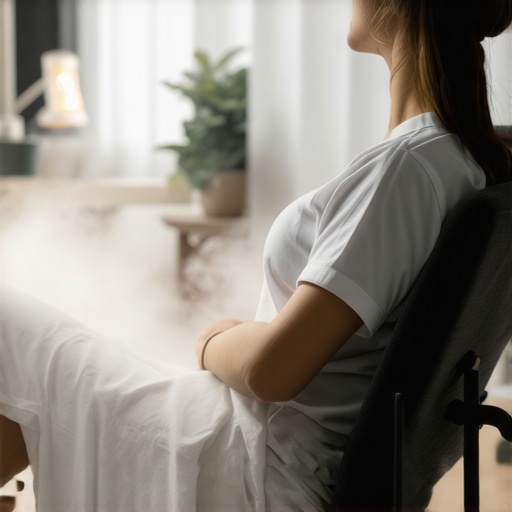
Don’t Just Sit There—Move While You Are Warm
The biggest mistake I see—and one I’ve made more times than I’d like to admit—is treating heat like a ‘set it and forget it’ solution. If you just lay on a heating pad for thirty minutes and then immediately go back to your desk, you’re missing the window of opportunity. Heat is a primer; it prepares the tissue for change. While the area is warm and the blood vessels are dilated, you need to introduce gentle, controlled movement. This is the perfect time to perform the pelvic tilt trick for instant lumbar relief. By moving the joints while the surrounding muscles are relaxed by the heat, you are teaching your nervous system that it is safe to move through a larger range of motion. It’s like stretching warm taffy instead of cold taffy—the results are smoother and much more permanent. This active approach helps to restore your range and ensures the stiffness doesn’t just come roaring back the moment you cool down.
The Twenty-Minute Sweet Spot
You might think that if twenty minutes of heat is good, two hours must be better. I learned the hard way that this isn’t true. During a particularly bad flare-up last year, I fell asleep on a high-heat setting. I woke up with what’s known as ‘toasted skin syndrome’—a mottled, red rash—and my back actually felt more inflamed because the prolonged heat had caused too much fluid to rush to the area. Your body needs a cycle. Apply heat for 15 to 20 minutes, then remove it and let your body return to its natural temperature. This ‘pulsing’ effect encourages better lymphatic drainage. If you find the area is still tender after heating, you might want to learn how to use a massage gun on your lower back safely to further break up those stubborn knots without overdoing the temperature.
Layering Your Defense
For those of us dealing with tech-neck or desk-related slouching, heat is most effective when applied to the ‘source’ rather than just the ‘symptom.’ If your neck hurts, try placing the heat across the tops of your shoulders and the base of your skull. This targets the upper trapezius and suboccipital muscles, which are usually the primary culprits behind that heavy-headed feeling. By warming the base, you allow the entire neck column to decompress naturally. It’s a small tweak that makes a massive difference in how long your relief actually lasts.
Stability Wins Where Flexibility Fails
Most people think that if their back hurts, they just need to become more flexible. I used to be the poster child for this approach, spending twenty minutes every morning trying to touch my toes. But here is the nuance that most beginners miss: chronic pain is often a cry for stability, not a request for more length. When we over-stretch a joint that is already unstable, we’re essentially pulling on a loose hinge. In my experience, it’s not about how far you can bend, but how well you can control the bend you already have. This is a core pillar of mobility mastery that few talk about until they’ve spent years in the cycle of stretching and re-injury.
Is your daily stretching routine actually feeding your pain?
This is the advanced question that separates temporary relief from a lifelong fix. If you find yourself stretching the same muscle every single day and it still feels ‘tight,’ the brain is likely keeping that muscle in a state of high tension to protect a vulnerable joint. A study published in the Journal of Biomechanics highlights that excessive spinal flexion can significantly increase intradiscal pressure, often negating the perceived benefits of the stretch. When I stopped forcing my spine to fold in half and started focusing on back pain recovery through bracing and control, the ‘tightness’ vanished on its own. Have you ever fallen into the trap of stretching a muscle for months without seeing any real change? Let me know in the comments.
Stop Aggressively Pulling Your Hamstrings
The most common ‘oops’ factor I see is the obsession with hamstring length. We’ve been conditioned to believe that tight hamstrings cause back pain. While they are connected, why stretching your hamstrings wont fix your lower back pain is because the tightness is usually a secondary symptom. If your core isn’t firing correctly, your hamstrings will tighten up to act as ‘anchor lines’ for your pelvis. If you stretch them out, you’ve just removed your body’s last line of defense. This is why why your glutes wont fire is often the real problem you need to solve. 
The Trap of the Lazy Bird Dog
Even when we try to do the right ‘corrective’ exercises, small technical errors can turn a good move into a bad one. Take the Bird Dog exercise, for instance. It’s a staple for spinal health, yet most people arch their back too much, turning a stability drill into a lumbar-straining mess. Avoiding the bird dog mistake that puts stress on your spine is about keeping a neutral pelvis and moving from the hip, not the low back. It’s these tiny, expert-level adjustments that determine if you are actually getting better or just going through the motions. If you want to truly restore your range, you have to prioritize the quality of your movement over the quantity of your reps. Let’s dig deeper into how we can refine these patterns for a spine that feels solid, not just loose.
Manage Your Environment to Save Your Spine
After years of trial and error, I’ve realized that the real magic happens in the hours between my active sessions. If you spend one hour doing mobility work and eight hours slumped over a laptop, the math just doesn’t work in your favor. I’ve started looking at my daily environment as a piece of medical equipment. One of the best investments I ever made wasn’t an expensive ergonomic chair, but a simple, firm lumbar roll that I take everywhere. Whether I’m commuting or flying, knowing how to set up your car seat for a four-hour road trip with proper support is the difference between arriving ready for an adventure or arriving as a human pretzel.

One Tool I Never Leave Home Without
For those of us chained to a screen, I live by the 20-20-20 rule for desk workers and neck health. It’s not just about eyes; it’s a full nervous system reset. When you combine these small environmental tweaks with professional guidance, you start seeing neck pain no more expert chiropractic solutions that work for the long haul. I’ve found that boost mobility ease pain chiropractic techniques unveiled in clinical settings only stick if you have the daily habits to support them. Dr. Stuart McGill, author of Back Mechanic and arguably the world’s leading expert on spine biomechanics, calls this spinal hygiene. He argues that it’s not just about the gym, but how you brush your teeth, tie your shoes, and sit. If you aren’t protecting your discs during those mundane moments, the structural damage slowly outpaces the recovery.
How can I keep my mobility from slipping away?
The secret to long-term maintenance is frequency over intensity. I used to think I needed a grueling 60-minute session every Sunday to reset my back. Now, I focus on 2-minute micro-breaks every hour. This approach is central to mobility mastery and ensures the body never enters that state of permanent freeze. I also recommend keeping a lacrosse ball in your desk drawer. Using it to release the tissue in the arches of your feet can surprisingly unlock tension in your lower back—it’s all connected through the posterior chain. If you are struggling with a specific spot, mastering back neck pain relief tips from the pros often involves these small, repeated interventions rather than one big miracle fix.
The Wearable Revolution is Coming
Looking ahead, I predict we are moving toward a world where AI-integrated workspace tools will nudge us in real-time when our scapula starts to wing or our chin drifts forward. Wearable biofeedback that vibrates when you lose your neutral spine is already hitting the market, and it’s going to be a game-changer for anyone who loses track of their posture when they’re in a flow state. This kind of passive coaching will likely become the gold standard for back pain recovery. For now, try this tonight: place a small, rolled-up hand towel under the base of your skull while lying on a firm surface for 5 minutes. This passive decompression is one of the best ways to let gravity do the work for you.
Lessons My Spine Taught Me the Hard Way
Looking back on my journey, I realize that I spent way too much time treating my symptoms and not enough time listening to what my body was actually trying to tell me. Here are a few lightbulb moments that changed everything for me:
- Pain is a Signal, Not Just a Nuisance: I used to think my back was “betraying” me. Now I know that sharp twinge is just my nervous system sounding an alarm that I’ve been sitting in a slumped position for too long.
- Consistency Beats Intensity: I used to think I needed an hour-long “fix-it” session. In reality, five minutes of revitalize your mobility drills spread throughout the day is what actually moved the needle.
- Your Glutes are Your Best Friends: I didn’t realize how much of my back pain was coming from “sleepy” glutes. Once I learned to engage them during my daily walk, the pressure on my lumbar spine vanished.
My Daily Survival Kit for a Pain-Free Spine
I’ve tried every gadget under the sun, but these are the three things that I genuinely use every single week to stay ahead of the stiffness. First, a firm lumbar roll is non-negotiable for my car and office chair—it forces my spine into a natural curve without me having to think about it. Second, I highly recommend picking up a copy of Back Mechanic by Dr. Stuart McGill; it’s the most evidence-based guide I’ve ever found on mastering back neck pain relief tips from the pros. Finally, a simple lacrosse ball in my desk drawer allows me to work out knots in my hips before they turn into a full-blown flare-up.
#IMAGE_PLACEHOLDER_E#
Your Body is Ready to Heal
The road to a resilient spine isn’t about finding a miracle cure; it’s about building a lifestyle that respects your structural limits. It’s easy to feel frustrated when progress feels slow, but remember that every mindful movement and every minute of proper support counts toward your back pain recovery. You don’t have to live in a state of constant tension. By applying the heat, movement, and environmental tweaks we’ve discussed, you are giving your body the permission it needs to let go of the guard and start moving with ease again.
Which of these strategies are you going to try first today? Let me know in the comments below!