How to Use a Massage Gun on Your Lower Back Safely
I’ll never forget the first time I held a massage gun. I felt like a DIY superhero, ready to fix years of stiff muscles with one battery-powered hammer. I’d spent the previous weekend [gardening for hours](https://quackersspinal.com/why-your-lower-back-throbs-after-gardening) and my lumbar was screaming. I figured if a little vibration was good, a lot of pressure at the highest setting must be better. I jammed that vibrating head right into the center of my lower back. Big mistake. I woke up the next morning feeling like I’d been hit by a freight train. It wasn’t just the usual stiffness; it was a deep, angry inflammation that made me realize I had absolutely no idea what I was doing. If you’ve ever tried to ‘fix’ a nagging ache yourself only to wake up feeling ten times worse, have you felt that same frustration?
Treat your lumbar spine like a person, not a piece of wood
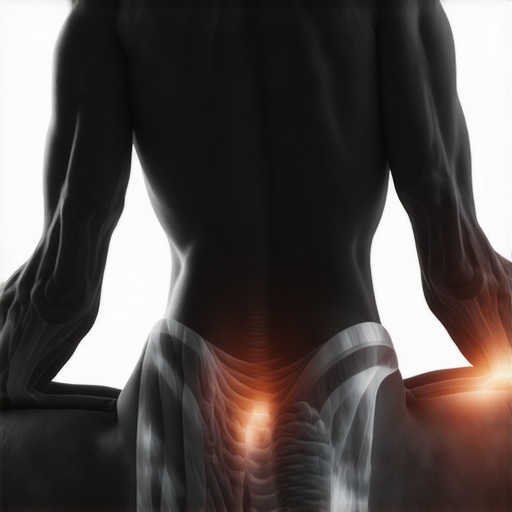
Here is the hard truth: your lower back is a delicate ecosystem of nerves, vertebrae, and ligaments. It is not a slab of meat like your quads or glutes. When we use these percussive tools improperly, we risk bruising the bone or irritating the sciatic nerve. I had to learn the hard way that [back pain recovery](https://quackersspinal.com/back-pain-recovery-how-chiropractic-care-transforms-lives) requires finesse, not just force. Nowadays, I use a massage gun as a tool for circulation and gentle relaxation rather than a jackhammer for deep-seated knots. You really have to [understand back pain](https://quackersspinal.com/understanding-back-pain-a-guide-to-better-posture-and-mobility) as a balance of mobility and stability. If you just hammer away at a muscle that is tight because it’s trying to protect your spine, your body will fight back every single time. It’s the same reason [why your foam roller might be hurting your lower back](https://quackersspinal.com/why-your-foam-roller-might-be-hurting-your-lower-back) if you’re rolling directly on the lumbar curve.
Is a massage gun actually better than a professional hand massage?
Some people are skeptical that a machine can do what a human does, and they aren’t entirely wrong. While these devices are fantastic for convenience, they lack the ‘feel’ a professional has for tissue density. However, they are incredibly effective when used correctly. A study published in the Journal of Clinical Medicine (https://www.ncbi.nlm.nih.gov/pmc/articles/PMC10143152/) highlights that while percussive therapy effectively increases local blood flow and can improve range of motion, improper use over bony structures can aggravate existing inflammation and cause micro-trauma to the soft tissue. My goal today is to show you how to get those blood-flow benefits without the ‘day-after’ regret. We want to [restore your back mobility](https://quackersspinal.com/restore-your-back-mobility-proven-chiropractic-strategies) using these tools as a supplement to healthy movement, not a replacement for it. You might find that [your back feels better when you keep moving](https://quackersspinal.com/why-your-back-feels-better-when-you-keep-moving) gently after a session, rather than just sitting back on the couch. Let’s look at the specific angles and settings that will keep you safe.
Work the perimeter instead of the pain
To get real results, you have to stop thinking of your lower back as the target and start seeing it as the victim of tight neighbors. When I first started using percussive therapy, I would hunt for the sharpest pain in my lumbar and stay there like a laser. It was a disaster. Instead, aim for the ‘big three’ supporters: your glutes, your hip flexors, and the erector spinae muscles running alongside your spine, but never the actual bone. By strengthening your glutes to take the pressure off your spine, you create a foundation that allows the gun to do its job. I spent a month focusing only on my glutes and outer hips with the massage gun, and my morning stiffness vanished because I stopped attacking the symptoms and started helping the stabilizers.
Let the tool float over your skin
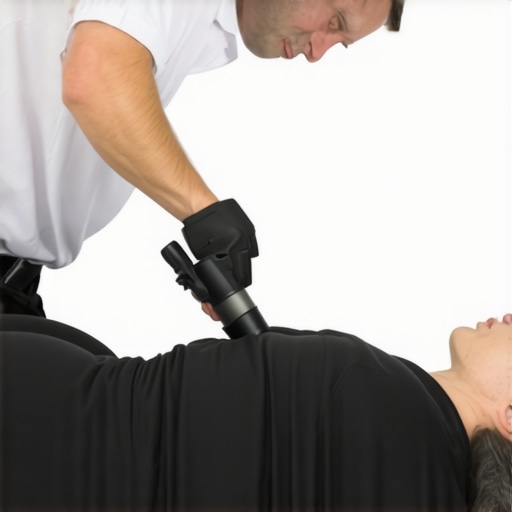
You don’t need to lean into the device like you’re trying to drill for oil. Most people make the mistake of pushing hard to ‘get deep,’ but the percussive motor is already doing that work for you. Think of it like a plane landing on a runway; you want to glide. If you press too hard, you’re just creating micro-trauma. This is especially true if you are trying to restore your range after an injury. I once tried to force the gun into my upper glute to fix a ‘pinch’ during a gym session, and I ended up with a bruise the size of a grapefruit that hurt worse than the original knot. Now, I keep the head moving at about an inch per second, never staying in one spot for more than a few heartbeats.
Why the softest attachment is your best friend
Most kits come with a hard plastic ball and a ‘fork’ attachment that looks like it belongs in a toolbox. Throw those aside when working on your lower back. Use the ‘dampener’—the soft, squishy one. Your lumbar spine is surrounded by complex structures, and your ribcage movement and pelvic tilt are easily disrupted by heavy, focused vibration. By using a softer head, you get the blood flow benefits without the bone-rattling impact.
The two-minute limit you should not cross
More is not better when it comes to nerve sensitivity. I limit myself to 60 seconds per muscle group, total. If you spend ten minutes on one spot, you’re essentially tenderizing the tissue, which leads to inflammation. This is why you still feel that morning back twinge even after a long session. Focus on the hips instead. You’ll find that a 3-step morning routine for hip mobility combined with a quick 30-second pass on the glutes is far more effective than a marathon session on your actual back muscles. When you hit the right spots, you might even notice why you feel taller after a chiropractic adjustment—it’s because those peripheral muscles have finally stopped pulling your spine into a defensive, rigid crouch.
People often assume that if a muscle feels tight, it’s because it is short and needs to be beaten into submission with a massage gun. But here is the nuance most people miss: tightness is often a neurological ‘brake’ applied by your brain because it feels a lack of stability elsewhere. If you keep hammering a muscle that’s trying to protect a vulnerable joint, you’re just fighting your own survival instincts. In fact, why your strong core might actually be too rigid is a real concern; excessive stiffness can actually lock up your movement patterns and increase the load on your discs. I’ve seen athletes spend hours on percussive therapy only to realize their pain was coming from the floor up. We often have to look at your feet to solve your neck issues or chronic back tension because the body is one continuous kinetic chain.
What if your ‘knot’ isn’t a muscle at all?
This is the biggest ‘oops’ factor in DIY recovery. If you have a sharp, shooting sensation or a dull ache that doesn’t change with pressure, you might be dealing with neural tension rather than a simple muscle knot. Using a massage gun directly over an irritated nerve is like poking a hornet’s nest with a stick. Research in the Journal of Sports Science and Medicine (https://www.jssm.org/jssm-20-175.xml) suggests that while percussive therapy can reduce muscle soreness, it doesn’t necessarily improve the underlying neuromuscular control or joint proprioception. This is why you need to understand back pain as a communication issue between your nerves and muscles. You might think you’re helping, but if you’re hitting a spot that is guarding a disc, you’re just delaying the back pain recovery you actually need.
Stop stretching your hamstrings to save your back
It sounds like heresy, doesn’t it? Every trainer tells you to stretch your hamstrings for back relief. But if your pelvis is tilted anteriorly, those hamstrings are already over-lengthened and under constant tension. Stretching them further just makes the problem worse and increases the instability in your lumbar spine. Instead, focus on strengthening your glutes to take the pressure off your spine. I used to fall into this trap every single morning until I realized my ‘tightness’ was actually my muscles screaming for help, not for a stretch.
When you finally restore your range, it’s usually because you addressed the stability in your hips and the mobility in your mid-back. We frequently find that we must adjust your mid-back to help your lower back recover because the lumbar spine shouldn’t be doing all the heavy lifting. Have you ever fallen into this trap of over-massaging a spot only to have it feel worse the next day? Let me know in the comments.
I’ve tried every gimmick under the sun, from gravity boots to vibrating foam rollers that sounded like a jet engine in my living room. But if you want to scale your recovery, you need to be picky about your arsenal. While the massage gun is great for a quick hit of blood flow, I eventually realized that for deep, stubborn tension in the psoas, I needed something that didn’t move. I started using the Pso-Rite, a hard plastic tool designed to mimic the pressure of a therapist’s elbow. It is brutal, but it works because it allows for static pressure that a percussive motor simply can’t provide. When you combine this kind of targeted work with expert methods to relieve neck and back discomfort, you stop just managing pain and start changing your tissue quality. You might even find that you finally revitalize your mobility by reaching the spots a massage gun just skims over.
How do I maintain my spinal health without a daily two-hour routine?
Consistency beats intensity every single time. My personal rule is the ‘Minimum Effective Dose.’ I don’t spend an hour on the floor anymore. Instead, I use a lacrosse ball for exactly two minutes on my upper glutes before I head out the door. This small habit prevents the compensations that lead to a flare-up. If you can’t commit to a full session, at least learn how to handle a sudden back spasm when you are alone so you don’t panic and make it worse. Maintaining your spine is about ‘stacking’ small wins throughout the day rather than one massive recovery session on Sunday. This approach is what leads to true mobility mastery. I’ve found that using a tool like the Theragun G5, which has a 16mm amplitude, is specifically effective because it reaches the muscle deep enough to actually affect the fascia, unlike the cheaper ‘vibration’ guns that just tickle the skin.
As we look toward the future, I predict we are going to see a massive shift toward ‘Bio-Feedback Wearables.’ We already have watches that track our heart rate, but soon we’ll have shirts with built-in sensors that alert us when our spinal shear is too high during a lift or when our posture has crossed the ‘fatigue threshold.’ This will take the guesswork out of recovery. A study in the Journal of Bodywork and Movement Therapies (2021) notes that self-myofascial release tools significantly improve joint range of motion without a decrease in muscle performance, but only when used as a precursor to active movement. This means the tool is just the key; the movement is the door. If you want to restore your range permanently, you have to follow your massage gun session with active stability work. I challenge you to try this today: spend 60 seconds on each glute with a massage gun or lacrosse ball, then immediately do ten slow air squats. You’ll feel the difference in how your hips sit immediately. For more advanced guidance on keeping your spine in check, you can always contact us to see how these tools fit into a broader clinical plan.
Stop Chasing the Knot and Start Looking for the Brake
After years of self-experimentation, I’ve realized that the sensation of ‘tightness’ is rarely a muscle that needs to be beaten into submission. It is almost always a neurological brake pedal being pushed by your brain. If you don’t address the stability of your pelvis, that brake stays on no matter how many times you hit it with a percussive tool. You must prioritize back pain recovery by looking at the whole picture. Another hard lesson? The ‘numbing’ effect of a massage gun isn’t a cure; it’s temporary sensory overload. If you use that window of numbness to go lift heavy or push through pain, you’re asking for a massive flare-up once the vibration wears off. Use that quiet moment to relieve neck and back discomfort through gentle, mindful movement instead.
The Gear I Actually Use When the Gun Stays in the Box
While I love my percussive tools, they are only one part of the puzzle. If you want to truly revitalize your mobility, you need a diverse toolkit. I swear by a high-density lacrosse ball for the lateral glutes—it provides a targeted static pressure that a motor simply can’t replicate. I also highly recommend the book ‘Foundation Training’ by Dr. Eric Goodman; it changed how I understand the posterior chain more than any vibrating gadget ever could. Finally, if you are going to buy a gun, go for high amplitude models like the Theragun G5 rather than cheap high-speed vibration units; you want a ‘thud’ that reaches the fascia, not a ‘buzz’ that just irritates the skin. #IMAGE_PLACEHOLDER_E#
Reclaiming Your Life One Safe Movement at a Time
Recovery is not a linear path, and it’s certainly not something you can just buy at a sporting goods store. It takes patience, awareness, and a willingness to listen to what your body is actually telling you. Don’t let a bad experience with a massage gun stop you from seeking better movement. When you combine these tools with understanding back pain as a complex system, you move from surviving the day to thriving in it. You have the power to change how you feel, provided you treat your spine with the respect it deserves. Have you ever tried a massage gun on your back and felt worse the next day, or did it finally give you the relief you were looking for? Let me know below.