The posture fix for people who spend hours behind a steering wheel
I pulled into my driveway after a three-hour slog through rain and gridlock, and I just sat there. My lower back felt like it had been fused into a permanent C-shape, and my neck was screaming. When I tried to turn my head to check the mailbox, I had to rotate my entire body like a rusty robot. It was a wake-up call. I realized then that my commute wasn’t just a waste of time—it was actively wrecking my spine. If you spend your mornings and evenings gripped to a steering wheel, you know exactly that heavy, dull ache I am talking about. We are going to fix that today. I am going to show you how to set up your driver seat so you step out of the car feeling like a human being again, not a folded lawn chair.
Stop fighting your car seat and start driving pain-free
The biggest mistake I made early on was trying to force myself into what I thought was perfect posture. I would sit bolt upright, shoulders pinned back, basically hovering away from the seat. I quickly learned that why sitting up straight is actually bad advice for some situations, especially when your seat is designed to support you. By fighting the car’s ergonomics, I was just fatiguing my muscles twice as fast. You need to work with the machine, not against it. According to research published in the Journal of Physical Therapy Science, prolonged sitting in a non-neutral driving position significantly increases intradiscal pressure, which is essentially putting a heavy load on your spinal discs. We need to find that neutral sweet spot where the seat does the heavy lifting for your skeleton. Have you ever felt that burning sensation between your shoulder blades halfway through a road trip?
Is a car seat adjustment really enough to stop the ache?
It sounds too simple, right? You might be thinking that unless you buy a luxury sedan with massage seats, you are stuck with the pain. I used to think I needed a chiropractor on speed dial just to survive my weekly miles. But the truth is, most of us haven’t even touched the lever that controls seat tilt or lumbar depth since we bought the car. We just adapt our bodies to the car’s default settings. By understanding back pain as a result of sustained pressure rather than just bad luck, you can start making small, tactical changes. Even something as simple as using a rolled up towel to fix your cars lumbar support can be a total game-changer for your lower spine comfort.
The common seat height error that kills your hips
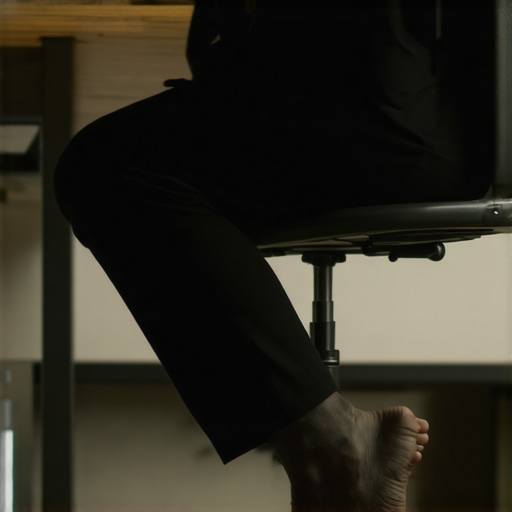
One thing I see constantly—and I was guilty of this for years—is sitting too low. We want to feel sporty, so we drop the seat to the floor. This forces your knees higher than your hips, which rounds your lower back and puts a massive strain on your hip flexors. It is a recipe for disaster. Instead, you want your hips at least level with your knees. This opens up the pelvis and allows for a more natural curve in the lumbar spine. Once you get the base right, the rest of the puzzle—your neck and shoulders—starts to fall into place.
Slide your seat until your knees find relief
Once you’ve nailed the height, it’s time to look at the distance to the pedals. Slide the seat forward until your knees have a soft, comfortable bend when you’re pressing the brake or clutch all the way down. If your leg is locked out straight, you’re essentially turning your femur into a crowbar that is prying at your pelvis with every bump you hit. This structural stress is why the danger of sitting with a wallet in your back pocket becomes so obvious in the car; that tiny tilt in your hips, combined with a straight-leg impact, ruins your alignment within miles. Keep that bend to act as a shock absorber.
Stop the 90-degree spine trap
Most of us were told to sit up straight, so we crank the backrest to a perfect 90-degree angle. This is a mistake. It forces your lumbar spine to carry too much of your upper body weight without any help from the seat. Instead, aim for a recline of about 100 to 110 degrees. This subtle tilt allows you to revitalize your mobility because it redistributes the pressure across the entire backrest rather than concentrating it on your tailbone. If your car seat feels like a flat board, you can always learn how to use a rolled up towel to fix your cars lumbar support to fill that hollow space in your lower back. 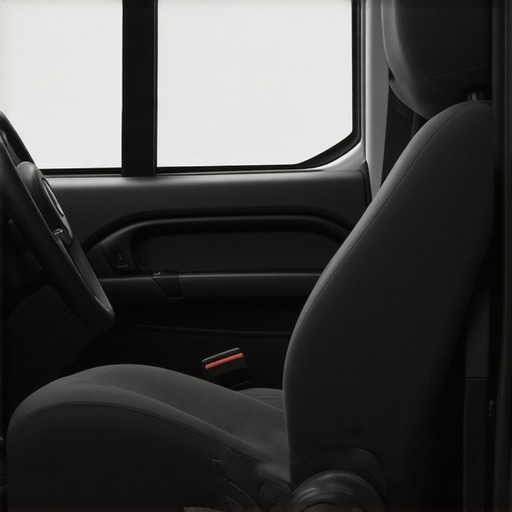
The wrist test for effortless steering
The steering wheel should come to you, not the other way around. If you have to lean your shoulders forward to reach the top of the wheel, your upper back is doing overtime. I once drove a rental car from Phoenix to Vegas with the wheel set way too far away. By the time I hit the Strip, I felt like I needed the 5-minute reset for a stiff lumbar spine just to uncurl my torso. To fix this, extend your arm and rest your wrist on the very top of the steering wheel. Your shoulders should stay firmly against the seat back. If they lift, pull the wheel closer. This setup is a massive chiropractic secrets to boost neck comfort and function because it keeps your arms from pulling on your neck muscles for three hours straight.
Align the headrest to protect your neck
Finally, don’t treat your headrest like an optional accessory. It should be centered with the back of your head, not your neck. If you find your head is consistently leaning forward and away from the support, you’re training your body for tech neck on wheels. Use the simple wall drill to reverse forward head posture to get a feel for where your skull should sit in relation to your shoulders. In the car, if you start feeling that familiar fire between your shoulder blades, try the 10-second reset for when your shoulder blades start burning to get through the final stretch of your commute.
The “stretching” trap that is keeping you in pain
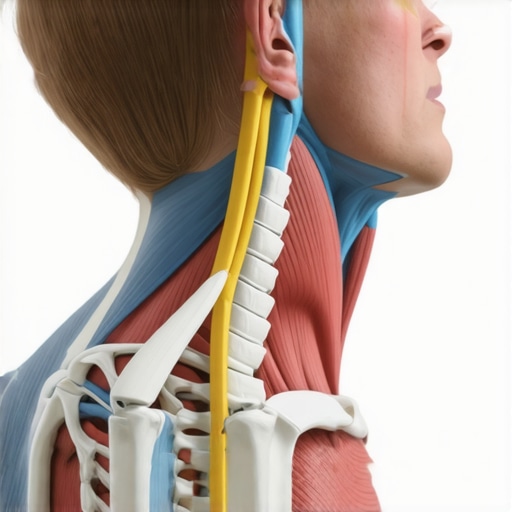
Here is the hard truth that most ‘posture experts’ won’t tell you: that tightness you feel in your hamstrings or lower back after an hour of driving is often a signal, not a symptom. Everyone says to pull over and stretch, but in my experience, why stretching a tight muscle isn’t always the answer. If a muscle is tight, it is often because your brain has ‘locked it down’ to protect a vulnerable joint or a misaligned vertebrae. When you force a stretch on a muscle that is acting as a biological seatbelt, you are actually increasing your risk of injury once you get back behind the wheel. Instead of mindless stretching, you need mobility mastery expert tips for back pain prevention and recovery that focus on resetting the joint position first. This is especially true for the neck; sometimes the ‘tight’ feeling is actually neural tension, and stretching it just irritates the nerves further.
Does bracing your core actually protect your spine on the highway?
This is the ‘Oops’ factor I see most often with my more athletic patients. They take their gym habits into the driver’s seat, thinking that a braced, ‘on’ core will shield their back. However, why your strong core might actually be too rigid is a real problem during long-duration sitting. Research published in The Spine Journal indicates that static loading—even in an ‘ideal’ posture—leads to significantly higher rates of muscle fatigue and disc pressure than positions that allow for micro-movements. If you are too stiff, you are preventing the natural ‘pump’ that moves nutrients into your spinal discs. You want to be stable, not solidified. This rigidity often travels up the kinetic chain, which is the hidden link between neck pain and spinal health. 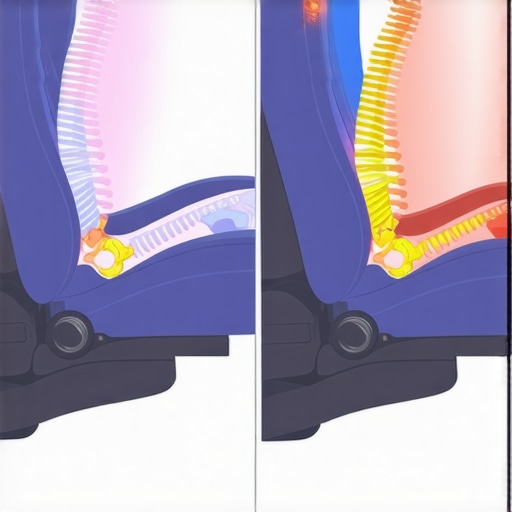
We also need to look at the ‘foundation’ of your seat. Many drivers focus solely on the backrest while ignoring their feet and pelvis. Many people don’t realize that their seat pan—the part you actually sit on—is often tilted too far back, creating a ‘bucket’ effect. This forces the sacrum into a posterior tilt, which essentially turns off your core stabilizers and puts all the weight on your ligaments. This is a mistake because we often find why we adjust the pelvis to fix neck tension; if your base is tilted, your neck has to compensate to keep your eyes level with the road. It’s an exhausting game of biological tug-of-war. Have you ever fallen into this trap of trying to sit ‘perfectly’ only to end up stiffer than when you started? Let me know in the comments. Real relief comes from functional movement and proper alignment, not just holding a static pose. If you’re ready to stop the cycle, it might be time to look into chiropractic secrets to boost neck comfort and function that address these complex mechanical nuances before they become chronic issues.
For years, I thought my car’s built-in lumbar support was enough, but the truth about built-in lumbar support in modern chairs and car seats is that it is often placed too high or too low for the average human frame. I now swear by a dedicated McKenzie Lumbar Roll. Unlike the flimsy pillows you find at big-box stores, a high-density foam roll provides a consistent tactile cue that keeps your lower back from ‘melting’ into the seat. If your seat is particularly deep, adding a firm wedge cushion can also prevent your pelvis from tilting backward. This is a crucial part of mobility mastery expert tips for back pain prevention and recovery because it forces the spine to maintain its natural curve without you having to consciously think about it. 
How do I maintain my spinal alignment during 50-mile commutes?
Consistency is the only way to avoid the cumulative damage of road vibrations and micro-shocks. I use what I call ‘The Mirror Hack.’ Adjust your rearview mirror only when you are sitting in your absolute best, most tall posture at the start of your drive. The moment you start to slouch or your pelvis tilts, the mirror will be out of alignment, serving as a visual alarm that you are slipping into a pain-inducing position. To keep your joints fluid, you need the best exercises to keep your spine young incorporated into your morning routine before you even hit the ignition. When you finally arrive at your destination, don’t just jump out and start lifting heavy gear or sitting at another desk. Give yourself the 5-minute routine to decompress your spine after work to let the discs rehydrate. This long-term approach is how you restore your range how chiropractic care enhances movement through years of heavy driving. According to standards set by SAE International (specifically the J1100 standard for motor vehicle dimensions), the ‘H-point’ or hip point is the pivot center of the human torso and thigh. If your car isn’t designed perfectly around your specific H-point, you have to create that alignment yourself using these tactical tools. I predict that in the next decade, we’ll see ‘active’ seating technology that micro-adjusts seat pressure in real-time to prevent blood pooling and muscle stasis. Until then, the responsibility is on us. My challenge to you: try the rearview mirror hack tomorrow morning. It’s the simplest way to see exactly how much you settle into a slouch without realizing it.
The Painful Lessons I Learned After 50,000 Miles
One of the biggest realizations I had was that ‘fixing’ my posture wasn’t a one-time event I could do in the driveway; it is a constant negotiation with gravity. I used to think I could just ‘set it and forget it,’ but your body naturally settles and compresses as the miles tick by. Another lightbulb moment was realizing that why your strong core might actually be too rigid for the highway. If you are bracing for impact like you are in the gym for two hours, you are actually starving your spinal discs of the micro-movements they need to stay hydrated. I also learned that my choice of footwear was sabotaging my seat settings—driving in thick-soled boots versus flat sneakers changes your hip angle by several degrees, which is why understanding back pain requires looking at the whole chain, from your heels to your head.
My Non-Negotiable Kit for Long Hauls
If you are serious about ending the post-drive shuffle, I recommend three specific tools that helped me reclaim my comfort. First, get a high-quality McKenzie Lumbar Roll; it is vastly superior to built-in car supports because you can move it to fit your unique H-point. Just make sure you know how to use a lumbar roll without making your back stiffer to avoid the common mistake of over-arching. Second, keep a tennis ball or lacrosse ball in the glove box. At rest stops, lean against a wall with the ball between your shoulder blades to hit those trigger points before they turn into a headache. Finally, I swear by the best exercises to keep your spine young as a pre-drive ritual to wake up your stabilizers before they have to hold you steady at 70 mph.
Your Commute Doesn’t Have to Be a Sentence
You don’t have to accept that a long drive means a week of neck pain or a stiff lower back. By making these small, tactical adjustments to your environment, you are choosing to prioritize your mobility every single morning. Whether it is through the rearview mirror hack or seeking out chiropractic insights to realign your foundation, the power to feel better is literally in your hands—and your seat levers. Your car should be a tool that gets you to your life, not a cage that keeps you from enjoying it. Stop letting back pain dictate your plans and start taking control of the cockpit. Which part of your car seat do you find hardest to get ‘just right’? Let me know in the comments below.