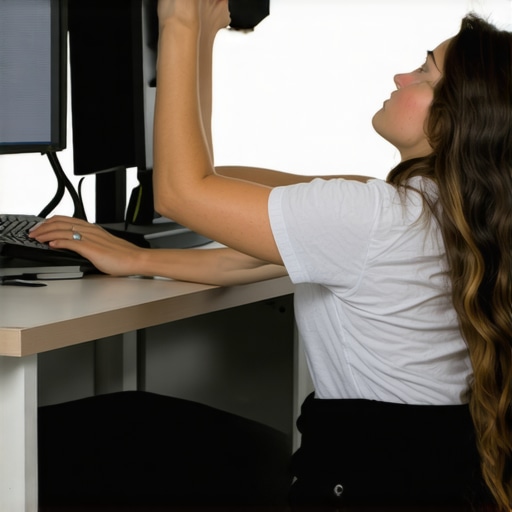
Why your phone is making your upper back round
I caught a glimpse of myself in a window last Tuesday, and for a second, I didn’t recognize the guy looking back. My shoulders were rolled forward, my head was jutting out like a turtle, and I had this distinct, soft curve at the base of my neck that definitely wasn’t there five years ago. It was a wake-up call. I was becoming the poster child for tech neck. If you’ve ever felt that burning between your shoulder blades after a long scroll session, you know exactly what I am talking about. Today, I am going to share how I stopped that rounded back from becoming my permanent reality and how you can reclaim your height and confidence.
The Heavy Price of Your 6-Inch Screen
When we hold our heads in a neutral position, they weigh about 10 to 12 pounds. But the second we tilt our heads forward to check a notification, the physics changes drastically. According to research published by Dr. Kenneth Hansraj of New York Spine Surgery, tilting your head at a 60-degree angle to look at a phone can put up to 60 pounds of pressure on your cervical spine. That is like carrying an eight-year-old child around your neck all day! I made the massive mistake early on of thinking I could just force myself into better posture for ten minutes a day and call it a win. It didn’t work because I was still spending hours in a slumped position. I had to address the real mechanics of my spine and stop the constant strain. This isn’t just about looking better in photos; it’s about avoiding chronic headaches caused by screen height and long-term joint wear. Have you noticed a persistent ache in your upper back after a long day of scrolling?
Will my back ever look normal again?
I get it. You are worried that the hump is permanent or that you have done too much damage to reverse it. For a long time, I felt the same way. I tried every gimmick, from posture braces that felt like straightjackets to weird vibrating sensors. Most of them were useless because they didn’t fix the underlying muscle imbalances. The truth is, your body is incredibly adaptable. By using a few simple wall drills and being mindful of how looking at your phone in bed impacts your alignment, you can start to pull those shoulders back where they belong. It is not about perfection; it is about giving your spine a fighting chance against gravity. We are going to look at the exact habit shifts that actually move the needle, starting with a doorway stretch that was a total game-changer for my mobility.
Stop Fighting Your Back and Start Opening Your Chest
I used to think my upper back was the problem because that’s where the pain lived. But your body is like a tent; if the front guy-wires are too tight, the back poles will eventually snap. Your pectoral muscles are those front wires. When they shorten from hours of typing, they physically haul your shoulders forward. I started using the wall stretch that opens up tight chest muscles instantly to give my spine some slack. When I first tried this, I pushed so hard I felt a sharp zing down my thumb. That was a mistake. I learned that you don’t need to rip the muscle; you just need to breathe into the tension. By standing in a doorway and letting gravity pull your torso through your anchored arms, you’re resetting the baseline length of your chest.

Stop the Bowling Ball Effect with a Simple Chin Tuck
Think of your head as a 12-pound bowling ball. In a neutral position, your neck handles it fine. But for every inch that ball drifts forward, the perceived weight doubles. To counteract this, you need the chin tuck. It feels ridiculous—you’re basically giving yourself a massive double chin—but it’s the only way to re-engage the deep neck flexors that have gone dormant. I used to do these while sitting in traffic. My first attempt was a mess; I kept tilting my head back like I was looking at the ceiling, which actually makes the problem worse. You have to slide your head straight back, as if it’s on a kitchen drawer track. This is the ultimate 10-second reset for when your shoulder blades start burning during a long work session.
The Wall Slide is Your New Posture Lie Detector
If you want to know how far gone your mobility actually is, stand with your back against a flat wall. Your heels, butt, shoulders, and the back of your head should all touch. Now, try to lift your arms into a “goalpost” position without anything leaving the wall. I couldn’t even get my elbows back when I started. It felt like my ribs were trying to pop out of my skin just to compensate. This is where you find out if your strong core might actually be too rigid or if you lack the thoracic extension to stand up straight. Combining these slides with the proper way to use a foam roller on your upper back creates a one-two punch that forces the vertebrae to un-stiffen.
Fix the Environment Before You Fix the Body
You can do all the drills in the world, but if you go back to a desk that is six inches too low, you’re pouring water into a leaky bucket. I learned this the hard way after three months of diligent stretching with zero results because I was still looking down at my laptop on a coffee table. You have to implement a 4-point check for a healthier home office setup. Raising my monitor to eye level was the single biggest change for me. It stopped the visual trigger that caused my head to crane forward in the first place. This isn’t just about ergonomics; it’s about essential chiropractic tips that protect your cervical discs from unnecessary wear and tear.
Most people think they just need to stand up straight to fix years of slouching. But here is the contrarian truth: trying to force yourself into a rigid, military-style posture is often just as damaging as the slouch itself. I used to walk around with my chest puffed out and my shoulder blades squeezed together, thinking I was winning the battle against gravity. In reality, I was just creating a massive amount of isometric tension that led to mid-back exhaustion. Why your perfect posture is actually making you stiff comes down to the fact that healthy spines are meant to be dynamic, not locked in place. When you force a position, you stop your ribs from moving naturally when you breathe, which can actually trigger more neck tension.
Should you really be stretching that tight muscle?
This is the ‘Oops’ factor that traps even the most dedicated fitness enthusiasts. We are conditioned to believe that tight equals needs stretching. However, tightness is often a neurological defense mechanism. If your brain senses instability in your spine, it will lock down the surrounding muscles to act as a natural splint. If you go in and aggressively stretch those muscles, you are removing the only thing keeping that joint stable. Research by spine expert Dr. Stuart McGill indicates that for many people, increasing spinal flexibility actually correlates with a higher risk of recurring back issues. This is why stretching a tight muscle isn’t always the answer. Often, what you actually need is stability, not more length. This is also why static stretching might be prolonging your back pain by repeatedly irritating the sensitized tissues. The same logic applies to your core. The fitness world has obsessed over bracing the abs 24/7. But why your strong core might actually be too rigid is a nuance that is rarely discussed. A core that cannot relax is a core that cannot absorb shock. I see patients who have six-pack abs but have completely lost the ability to move their pelvis independently of their ribcage. This rigidity forces the lower back to take all the stress of walking and bending. It is a common reason why your core routine is failing your spine—you are building a cage instead of a support system. Have you ever fallen into the trap of trying to stretch away a pain that just keeps coming back? Let me know in the comments. True recovery requires looking far beyond the spot that hurts. Your body is a kinetic chain where a problem at the bottom can manifest at the very top. For instance, why we look at your feet when your neck hurts isn’t just a gimmick; it is an acknowledgment that flat feet or a stiff ankle can change how your pelvis tilts, which eventually forces your neck to overcompensate. Reclaiming your mobility isn’t about one magic stretch; it is about how chiropractic care enhances movement by addressing these hidden links across the entire body.
The Gear That Actually Saved My Neck
I spent years thinking I needed a $1,200 chair to fix my life. I didn’t. I needed a $5 lacrosse ball and a monitor arm that cost less than a fancy dinner. When you are trying to scale your recovery from a week of work-from-home slouching to a lifetime of pain-free movement, you have to be surgical with your tools. I personally swear by a firm lacrosse ball for pinpointing that spot right under the medial border of the scapula. It’s significantly more effective than those vibrating massage guns for getting into the deep tissue without bruising your ribs. If you’re not sure where to start, learning how to use a tennis ball to release upper back tension is a much gentler entry point that provides immediate relief.

Beyond the DIY tools, your environment needs a hard reset. I used to be a laptop-only guy, but that is a recipe for a fused neck. Now, I use a mechanical keyboard and a high-quality monitor arm that keeps my screen high enough that I have to look slightly up, not down. As Dr. Kelly Starrett emphasizes in his work on human performance, ‘the best position is your next position.’ This means even a perfect desk setup is a failure if you stay in it for four hours straight. I now use a simple Pomodoro timer not for productivity, but as a movement cue to engage in chiropractic techniques unveiled for desk workers. If you can’t change your desk, at least look at your sleep environment; I found that learning how to choose the right pillow height for your body type was the final piece of the puzzle that stopped me from waking up with a stiff neck every morning.
How do I keep my spine happy without turning into a full-time athlete?
The secret isn’t a 90-minute yoga session every morning. It’s ‘greasing the groove.’ I’ve integrated micro-doses of movement throughout my day. For instance, while my coffee is brewing, I do the 3-minute morning routine to lubricate your joints. It’s non-negotiable. Consistency beats intensity every single time when it comes to spinal health. You are fighting the cumulative load of gravity, so you need cumulative wins to stay ahead of it. I’ve found that how chiropractic care enhances movement is most effective when the patient does the boring, small stuff at home between visits. This is about building a body that can handle the modern world, not just a body that can survive a workday.
Look Forward to a World Where Your Desk Tracks You
I predict that within the next five years, we are going to see a massive shift in ‘smart’ ergonomics. We are already seeing the beginning of AI-driven webcam software that alerts you the moment your head drifts more than two inches forward. Instead of relying on your own fading awareness, your workspace will become a biofeedback loop. This is going to revolutionize how we handle tech neck because it addresses the problem in real-time before the muscle strain even begins. Until then, you have to be your own sensor. I challenge you today to try one thing: raise your monitor or laptop by three inches using nothing but a stack of books. Notice how your breathing changes instantly. For more advanced help, you can always contact us to get a professional assessment of your current alignment.
The Three Truths My Spine Had to Teach Me the Hard Way
My biggest realization was that the pain in my neck was often just the messenger. I spent months focusing on the spot that hurt, only to find out that my stiff ankles were throwing off my entire kinetic chain. Another lightbulb moment was discovering that ‘perfect posture’ is a myth that leads to more stiffness. True ways to relieve neck back discomfort come from movement, not from staying frozen in a military pose. Finally, I learned that my brain was using tightness as a protective shield. If I didn’t address the stability of my core, my neck would never feel safe enough to let go of that tension.
My Everyday Essentials for a Resilient Spine
You don’t need a gym membership to start. I keep a firm lacrosse ball under my desk to tackle knots between my shoulder blades throughout the day. I also swear by a high-quality monitor arm; it’s the most effective way to find a 30-second morning move to hydrate your spinal discs by keeping your head in a neutral position naturally. I’ve also found that focusing on the floor up is vital, which is why stretching your hamstrings won’t fix your back pain if you aren’t looking at your foot mechanics. These small, tactile tools are my daily reminders that I’m in charge of my own comfort.
The First Step Toward a Taller and More Confident You
Reversing years of slouching won’t happen overnight, but it is entirely possible. It starts with one conscious decision to raise your phone to eye level or spend three minutes in a doorway stretch. Seeing how chiropractic care transforms lives by restoring lost range of motion gave me the hope I needed to stay consistent. Your spine is the pillar of your health; treat it with the respect it deserves, and your body will reward you with energy and ease. Reclaiming your mobility and ending back pain is a journey of small, daily wins. Are you ready to stop the slouch? Have you ever felt like your ‘perfect’ posture was actually making you feel stiffer and more exhausted? Let me know in the comments below.