How to Fix Your Posture While Washing Dishes
I spent years thinking that my post-dinner back ache was just a price I had to pay for a clean kitchen. I’d stand there, hands in the suds, and by the third pot, my lower back would start that familiar, throbbing protest. I wasn’t just washing dishes; I was punishing my vertebrae. I’d lean my stomach against the counter for “support,” unknowingly crushing my lumbar spine and letting my shoulders roll forward like a gargoyle. It wasn’t until I had a realization during a particularly painful session of back pain recovery that the problem wasn’t the dishes—it was my total lack of awareness of how I was standing. We spend hours every week at the sink, and that cumulative stress is exactly why your lower back aches after standing for 10 minutes or more. Today, we’re going to fix your “sink-lean” once and for all, so you can finish the chores without needing a heating pad afterward.
Stop Letting Your Kitchen Sink Ruin Your Mobility
The kitchen sink is a biomechanical nightmare if you aren’t careful. Most counters are just a little too low for the average person, forcing a slight forward hinge that puts an incredible amount of torque on the lower back. I used to make the classic mistake of locking my knees and “hanging” on my joints, thinking I was relaxing. In reality, I was just starving my muscles of blood flow and stressing my ligaments. According to research from the Journal of Occupational Health, prolonged static standing—especially when combined with a forward tilt—is a primary contributor to chronic musculoskeletal disorders. It’s not just about the pain in the moment; it’s about the long-term spinal health you’re trading away for a clean bowl. Have you ever felt that burning sensation between your shoulder blades halfway through the drying rack? You aren’t alone, and it’s actually a sign that your mid-back is working way too hard to keep your head from falling into the soapy water.
Is changing my stance really worth the effort for such a quick chore?
You might think that for a ten-minute task, it doesn’t matter how you stand. I used to tell myself that too. But think about it: if you do dishes twice a day, that’s over 120 hours a year spent in a compromised position. That is more than enough time to develop chronic neck discomfort or a permanent slouch. Early on, I thought I could just “power through” it by doing more crunches at the gym, but core strength isn’t always the magic bullet people think it is if your daily habits are working against you. The “secret” isn’t about being stronger; it’s about being smarter with your alignment. We need to look at the sink as a workspace that requires an ergonomic setup, just like an office desk. By the time we’re done here, you’ll know how to pivot and position yourself with the same precision as emptying the dishwasher without twisting your spine. Tell me, have you ever found yourself leaning your whole weight against the counter just to get through the silverware? If so, we need to talk.The first physical change you need to make is the most counter-intuitive: stop standing with both feet parallel. When you stand like a soldier at the sink, your lower back muscles are forced to fire constantly to keep you upright. I remember a Sunday night after a huge family roast; I was elbow-deep in grease and my back was screaming. I finally opened the cabinet doors under the sink and rested one foot on the base of the cabinet. The relief was almost instant. By elevating one foot, you take the tension off your psoas and lower back muscles, essentially using the pelvic tilt trick for instant lumbar relief without even trying. This simple staggered stance is one of the most effective chiropractic techniques unveiled for home ergonomics. 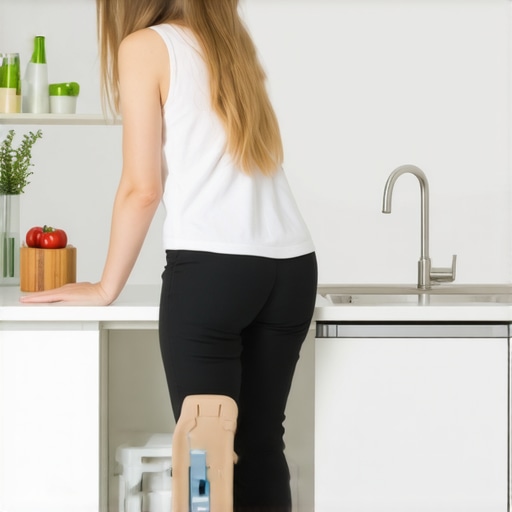
Transform Your Sink into a Spine-Friendly Workspace
Put One Foot Up to Save Your Lower Back
If your cabinets do not have a comfortable ledge, invest in a small six-inch step stool. Switch your lead foot every few minutes. This simple rotation keeps the blood flowing and prevents your joints from locking in a way that leads to that familiar, deep-seated throbbing. It is a biological pressure release valve for your lumbar discs.
Get Closer to the Action to Reduce Torque
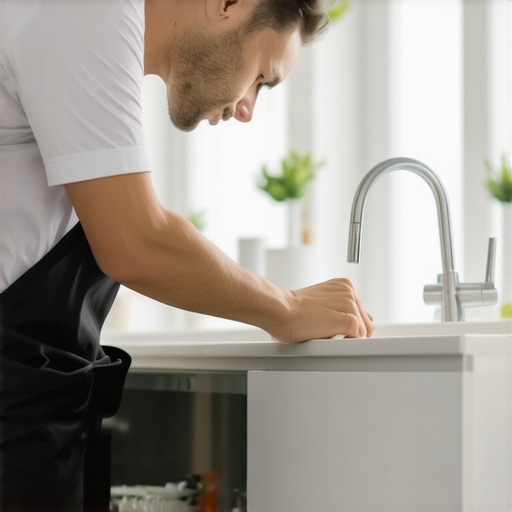
Most of us stand a few inches back from the counter to avoid getting water on our shirts. This is a biomechanical mistake. When you stand back, you have to reach forward, and that reach turns your upper body into a long lever. The further you reach, the more weight your lower back has to support. It is basic physics—like trying to hold a bowling ball at arm’s length versus holding it against your chest. Lean your hips gently against the counter edge. This transfers some of the weight of your torso directly into the cabinetry rather than through your spine. Learning how to stand in one place for hours without back pain often comes down to reducing this lever arm effect.
Protect Your Neck from the Vulture Hunch
While your back is suffering, your neck is likely in a vulture position—poking forward to see if that pan is really clean. This puts massive strain on the delicate muscles at the base of your skull. Instead of jutting your chin out, try to keep your ears aligned over your shoulders. If you find yourself straining, perform the scapular squeeze that relieves mid-back tension to reset your shoulder girdle. Be careful not to over-correct, though; many people make the chin tuck mistake that is making your neck pain worse by forcing their head back too aggressively. Think about growing tall through the crown of your head while your hands do the work. By bringing the dishes slightly higher up—closer to your natural eye level—rather than bending your face down to meet them, you save your cervical spine from hours of unnecessary wear and tear.But here is where most people get it wrong: they try to ‘fix’ their posture by becoming a statue. In my years of clinical observation, the biggest mistake people make when addressing understanding back pain is the belief that ‘rigid’ is the same as ‘right.’ We’ve been told to stand up straight and pull our shoulders back, but when you do this at the sink, you’re actually creating a state of high-threshold muscle activation. This constant tension prevents the very micro-movements your discs need to stay hydrated. According to a study published in the Journal of Electromyography and Kinesiology, the ‘stability’ we crave often comes at the cost of muscle oxygenation when we hold ourselves too rigidly. This is exactly why your core strength isnt stopping your back from hurting; you are over-bracing instead of allowing your body to be dynamic.
The Stretching Trap That Keeps You Stiff
One of the most common myths I see is the idea that if your back feels tight after chores, you should just stretch your hamstrings. This is often a trap. For many, that tight sensation isn’t muscle length at all—it’s neural tension. If you feel a sharp pull behind your knee or a zinging sensation while leaning over the sink, your sciatic nerve is likely being sensitized. When you aggressively stretch, you aren’t lengthening a muscle; you’re pulling on a nerve that is already irritated. This is a primary reason why stretching your hamstrings wont fix your lower back pain. Instead of traditional static stretches, you should look into the nerve flossing technique for stubborn leg pain to gently slide the nerve through its pathway without further inflaming it. 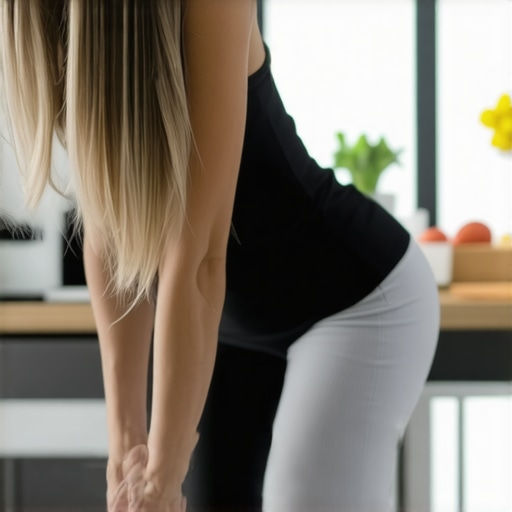
Why Rigid Posture Is Actually Starving Your Muscles
Another ‘oops’ factor is the obsession with ‘flat’ feet. I’ve seen patients spend hundreds on cushioned mats, thinking the softness will save them. However, if your foot arch collapses while you stand, it creates a kinetic chain reaction that rotates your femur and tilts your pelvis, putting immediate pressure on your L5-S1 disc. You can have the best upper-body form in the world, but how your foot arch affects your lower back pain is a variable you cannot ignore. If your foundation is crumbling, your spine has to compensate. This is often the root of the hidden connection between your feet and mid-back pain.
Is it possible that your feet are the real reason your neck feels tight?
It sounds radical, but the body is a single functional unit. When your arches collapse or you shift your weight onto your toes to reach the back of the sink, your center of gravity moves forward. To prevent you from falling into the soapy water, your suboccipital muscles at the base of your skull have to contract to keep your eyes level with the horizon. This is a high-level nuance of mobility mastery. If you only treat the neck, you’re just treating the symptom of a foot and pelvic problem. Real revitalize your mobility strategies involve looking at these distal connections. Have you ever fallen into the trap of trying to stand ‘perfectly’ only to feel even more exhausted? Let me know in the comments.When I finally stopped trying to look like a mannequin, I started looking for tools that actually supported my biology. The first thing I bought was a simple, sturdy 6-inch step stool. I don’t just use it for the dishes; I use it whenever I’m stationary. It’s the easiest way to find the simple way to sit on a stool without pain even when I’m actually standing. But the real game-changer was what I did after the dishes. I started keeping a lacrosse ball in the kitchen drawer. While the kettle boils, I use it to work on my psoas. Learning how to use a massage ball to release hip flexor tension has done more for my standing endurance than any ‘posture corrector’ ever could.
The Two Tools That Saved My Lumbar Spine
I also recommend investing in a high-quality anti-fatigue mat, but with a caveat. Don’t get the squishiest one you can find. You want something with ‘rebound.’ If the mat is too soft, your stabilizer muscles stop working entirely, which can lead to the very issues we’re trying to avoid. In my journey to restore your back mobility, I’ve found that firm support is always superior to marshmallow softness. 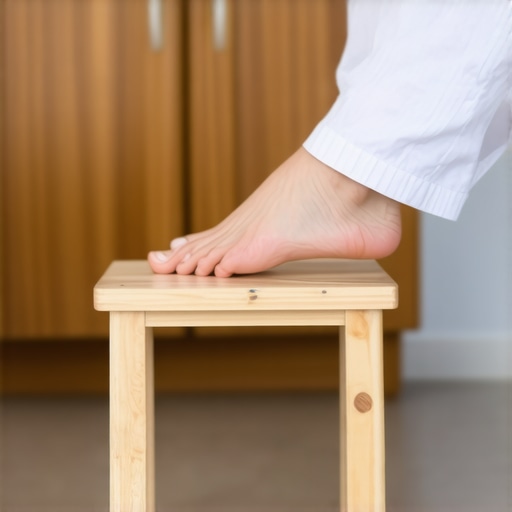
How do I maintain my spinal health over time?
Consistency beats intensity every single time. You don’t need a grueling hour-long gym session to fix your back; you need sixty seconds of mindful movement every hour. Dr. Stuart McGill, a world-renowned spine biomechanics expert, notes in his work Back Mechanic that ‘maintaining the natural curve of the lumbar spine’ is less about a single position and more about managing the cumulative load over time. This is why I focus on the ‘micro-break’ method. Every time I finish a task, I perform a quick reset to boost your back health. This habit prevents the ‘creep’ effect—where your ligaments slowly stretch and lose their ability to support your joints under load.
Where Spinal Health Is Heading in 2025 and Beyond
I predict that by 2030, we won’t be guessing about our alignment. We’ll see the rise of haptic-feedback wearables—small sensors integrated into our clothing that gently vibrate when our center of mass shifts dangerously far from our base of support. This will turn unlocking neck pain relief into a real-time data exercise rather than a nightly struggle. Until those high-tech shirts are affordable, we have to be our own sensors. Use the tools I’ve mentioned to revitalize your mobility and stop the cycle of chore-induced pain. My challenge for you today is simple: try the staggered stance during your very next load of laundry or dishes. Go to your sink right now, open the cabinet, and put one foot up. Feel that immediate release in your lower back and tell me if it doesn’t change the game for you.
Three Hard Lessons I Learned About Spinal Resilience
After years of treating my own discomfort and helping others, I realized that the kitchen is actually the best place to practice spinal hygiene. First, I learned that ‘holding it together’ is the enemy. If you find yourself gripping the edge of the sink or clenching your jaw, you are likely bracing too hard, which is a key part of understanding back pain and how to stop it. Second, movement is medicine. Even while scrubbing, a tiny shift in weight or a gentle pelvic tilt can keep your discs from compressing. Lastly, your environment dictates your health. If your sink setup makes you hunch, you will hunch. It’s that simple. By implementing boost your back health strategies, you turn a chore into a rehab session.
My Recommended Gear for a Pain-Free Home
I don’t believe in buying every gadget on the market, but three things made a massive difference in my personal journey. A firm anti-fatigue mat provides the rebound your muscles need to stay active without over-taxing your joints. A simple 6-inch step stool is the ultimate tool for that staggered stance we discussed. Finally, keeping a lacrosse ball nearby allows for quick soft-tissue work while you wait for the kettle to boil. These tools are the foundation for mobility mastery in your daily life. If you find these steps aren’t enough, don’t hesitate to reach out via our contact us page for a more personalized assessment.
#IMAGE_PLACEHOLDER_E#
Start Your Journey Toward Lasting Comfort
Your back pain doesn’t have to be a permanent houseguest. By making these small adjustments—stepping up, leaning in, and staying dynamic—you are actively participating in back pain recovery every single day. The goal isn’t just to get the dishes done; it’s to finish them feeling as good as when you started. Take that first step today, quite literally, by trying the cabinet-door trick. Have you ever tried the cabinet-door trick while doing dishes? Let me know if it helped your back below!