
Why Your Desk Chair Height is Ruining Your Forearms
I spent three weeks convinced I was developing early-onset carpal tunnel. Every time I sat down to tackle my inbox, a sharp, buzzing heat radiated from my elbow down to my wrist, making every keystroke feel like a chore. I had the fancy chair and the ergonomic keyboard, yet I felt like I had just finished a grueling rock-climbing session instead of a morning of data entry. It wasn’t until I caught my reflection in a darkened monitor that I saw the problem: my chair was set way too low, forcing my wrists to hinge at a brutal angle just to reach the keys. I looked like a T-Rex trying to play the piano. That one realization changed everything about how I view my workspace.
Your chair height is the secret culprit behind forearm fatigue
For years, I made the classic mistake of setting my chair based on where my feet felt most comfortable. I thought as long as I was ‘sitting up straight,’ the rest would take care of itself. I was wrong. When your chair is too low or too high, your forearms pay the price by staying in a state of constant tension to compensate for the bad angle. This often leads people to search for how to stretch your forearms to prevent elbow and neck strain, but the real fix starts with the seat beneath you. If your elbows aren’t at a 90-degree angle, your muscles are working overtime just to hold your hands in place. According to the Occupational Safety and Health Administration (OSHA), maintaining a neutral wrist position where the forearm and hand form a straight line is the gold standard for preventing long-term strain. Have you ever noticed your wrists clicking or your forearms burning after just an hour of work?
Is a simple height adjustment really better than expensive gear?
Many of us assume we need a brand-new desk or a specialized mouse to find relief. I certainly did. I wasted money on gadgets before I finally learned how to set up your home office on a budget by simply using the levers already on my chair. Skeptics often wonder if such a minor change can fix a major ache, but the geometry of your body doesn’t lie. When you align your seat height so your forearms parallel the floor, you instantly drop the load off your brachioradialis muscle. It’s also worth checking if why your office chairs armrests are hurting your neck, as they often dictate where your arms land. We are going to dive into the exact measurements you need to save your tendons today.To get this right, you have to stop thinking about your feet for a second and focus entirely on your floating elbows. Imagine your arms are like a drawbridge; if the bridge is too steep, the traffic—those nerve signals and blood flow—gets backed up at the hinge of your elbow. I start by standing up and lowering my chair to the bottom setting, then I sit back and slowly raise it until my elbows are level with the desk surface. Your goal is to have your fingers resting on the home row of your keyboard with your forearms perfectly horizontal. If you are reaching up, you are inviting shoulder impingement. If you are reaching down, you are straining the small muscles in your hands. This is why many people find that why your perfect office chair is still making you slouch because they are trying to reach a desk that is too high.
Set Your Desk Height by Your Elbows Not Your Feet
Once I got my arms at the perfect height during my own setup, my feet were dangling two inches off the ground. Within an hour, my lower back started to throb because my legs were literally pulling my pelvis forward. I didn’t have a fancy footrest at the time, so I grabbed two massive hardcover biographies and shoved them under my desk. It looked ridiculous, but the relief was instant. When your feet aren’t supported, your hip flexors stay ‘on,’ which eventually leads to a dull ache in the lumbar region. This connection is vital because the hidden link between neck pain and spinal health often starts with how your base is supported. If your chair doesn’t let your feet hit the floor at your ideal typing height, find a box or a dedicated footrest immediately. 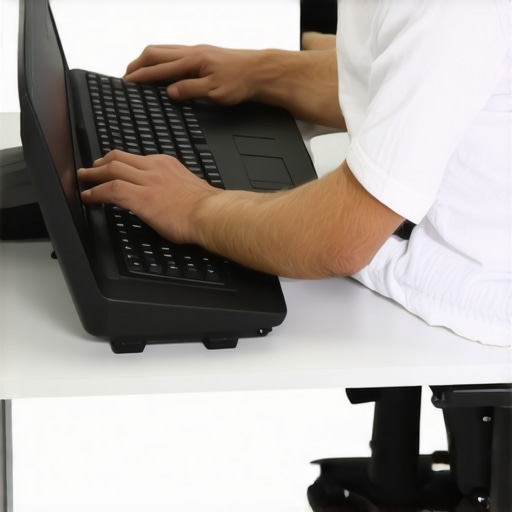
Keep Your Wrists From Diving Off a Cliff
Look at your wrists while you type. They should be neutral, not arched like a cat’s back or sagging into the desk edge. I used to rest my wrists on the hard corner of the table, which compressed the carpal tunnel and sent those ‘zapping’ sensations up my arm. Think of your wrist as a delicate garden hose; any kink in the line stops the water. Instead of leaning on the desk, try to let your wrists float slightly or use a very soft, low-profile pad that doesn’t force an upward bend. If you feel that burn starting, you might need the 10-second stretch for people who type all day to reset the tension before it locks up.
The Five-Minute Check for All-Day Comfort
Even a perfect setup can fail if you stay static. I now set a timer to perform the 5-minute desk reset for busy professionals every ninety minutes. During this time, I re-verify my elbow angle. It’s easy to slide down in your seat as the day goes on, turning your perfect 90-degree angle into a cramped 70-degree mess. If you find yourself leaning forward to see the screen, your chair height might be right, but your monitor is likely the new saboteur, pulling your neck out of alignment and causing unnecessary strain.While getting your chair and monitor heights right is the foundation, I see people fall into a secondary trap: they become ‘posture statues.’ Most people believe that once they find that 90-degree angle, they must freeze there like a royal guard. In my experience, why your perfect posture is actually making you stiff is one of the hardest concepts for patients to grasp. Your spine is designed for movement, not for being a pillar of marble. If you maintain a ‘perfect’ upright position for four hours without a break, you are still starving your spinal discs of the nutrient-rich fluid they get through movement. This is why why sit up straight is actually bad advice for some; it often leads to a rigid, over-extended lower back that creates its own set of problems.
The hidden danger of over-bracing your core
One of the biggest ‘oops’ factors I encounter with advanced office athletes is the over-active core. We are told a strong core protects the back, so people walk around with their abs constantly sucked in. However, why your strong core might actually be too rigid is a nuance that can lead to chronic shallow breathing and ribcage restriction. When you brace too hard, you lose the ability to perform a proper diaphragmatic breath.
Can a core that is too strong actually hurt your back?
It sounds like a paradox, but yes. According to spine biomechanics expert Dr. Stuart McGill, true spinal health comes from ‘stiffness on demand’—the ability to brace when lifting a heavy load—not constant tension. Constant bracing increases the compressive load on your discs even when you are just sitting. This tension is often the connection between shallow breathing and back pain. If you can’t expand your ribcage 360 degrees, your lower back muscles have to pick up the slack. I’ve seen countless people fix their ‘back’ pain simply by learning how to breathe into your lower back to reduce muscle spasms. 
Why your ribcage holds the key to neck relief
Another nuance is looking away from the site of the pain. If your neck is killing you, the culprit might actually be your mid-back. This is why we look at your ribcage movement for better mobility during an assessment. If your ribs are ‘stuck’ from slouching or over-bracing, your neck has to over-rotate to compensate. Have you ever fallen into this trap? Let me know in the comments. We often think we are helping ourselves by ‘trying harder’ at posture, but the real secret to how chiropractic care enhances movement is restoring the fluid, natural motion your body is craving.
To keep that fluid motion from turning back into a stiff, creaky mess by Monday morning, I rely on a few maintenance hacks that don’t require an hour-long yoga session. Most people get a taste of relief and then stop doing the very things that got them there. I call this the ‘comfort trap.’ Once the acute pain fades, the motivation to stay mobile usually follows it out the door. However, the real work is in the small, daily habits that prevent the next flare-up. For instance, I keep a single tennis ball in my desk drawer at all times. It is the most effective tool I own for releasing that stubborn knot that forms right between the shoulder blades. If you have ever felt that sharp, localized pinch, you should learn how to use a tennis ball to fix that spot under your shoulder blade because it allows you to self-mobilize the ribs from your own office chair.
How do I maintain my spinal health over the long term?
Maintenance isn’t about doing more; it’s about doing the right things consistently. I often tell my clients that spinal health is like dental hygiene; you wouldn’t wait for a cavity to start brushing your teeth, so why wait for a spasm to move your spine? The goal is to build ‘movement snacks’ into your day. This is why mobility mastery expert tips for back pain prevention and recovery are so critical. It involves understanding that your body is constantly adapting to the shapes you put it in. If you spend eight hours a day in a ‘C’ shape, your tissues will eventually remodel to stay that way. To combat this, I recommend a daily check-in with your thoracic spine. Using the proper way to use a foam roller on your upper back for just two minutes before bed can undo hours of desk-induced rounding. According to a study published in the Journal of Electromyography and Kinesiology, even short bouts of postural variation can significantly reduce muscle fatigue and improve proprioceptive awareness, which is your brain’s ability to ‘feel’ where your joints are in space.

Looking ahead, I predict we are going to see a massive shift toward wearable biofeedback in the next five years. We are moving away from passive ‘support’ gear and toward ‘active’ tech—think shirts with integrated sensors that vibrate when your mid-back loses tension or AI software that monitors your desk posture through your webcam. While tech is great, nothing replaces the fundamental need to chiropractic secrets to regain full mobility after injury and then keep it. If you want to see an immediate change in your posture today, try this one advanced tip: the doorway chest opener. Spend thirty seconds letting your chest sink forward with your arms on the doorframe. This is the wall stretch that opens up tight chest muscles instantly and it stops your shoulders from pulling your neck into that painful forward tilt. I want you to try this right now—literally, get up and do it—and notice how much deeper your next breath feels. When you open the front of your body, the back of your body can finally stop working so hard to hold you up.
The hardest lesson I had to learn during my recovery was that no piece of equipment can compensate for a lack of body awareness. I spent thousands on ‘ergonomic’ gear before realizing that the real magic happened in the subtle chiropractic secrets to boost neck comfort and function. I also realized that pain is a lagging indicator; by the time you feel that buzzing heat in your forearm, the strain has been accumulating for hours. Finally, I learned that my body doesn’t want to be ‘fixed’ into one static position, no matter how ‘perfect’ it is; it wants to be moved through many different ranges of motion throughout the day.
The Most Expensive Mistake I Made With My Desk Setup
I used to think that as long as I had a high-end chair, I was invincible. I learned the hard way that a $1,000 seat set to the wrong height is worse than a kitchen chair set correctly. If you aren’t checking your elbow-to-desk alignment weekly, you are inviting chronic tension. Another lightbulb moment was realizing that ‘trying’ to sit up straight was actually making my back stiffer. Real spinal health feels effortless, not like a military drill. I also found that performing the 30-second move to stop mid-day shoulder burn is far more effective than a once-a-week massage.
Tools That Keep Me From Slouching Like a Hunchback
To get you started on your own journey, I highly recommend keeping a standard lacrosse ball or tennis ball in your desk drawer for the localized releases we discussed. For a more structured approach, I’ve found that effective neck pain management a step-by-step guide provides the clarity most people are missing when they first start troubleshooting their workspace. I also trust the insights found in mastering back neck pain relief tips from the pros 300 because they focus on long-term lifestyle changes rather than quick, temporary fixes. These resources transformed my understanding of how my environment dictates my comfort.
#IMAGE_PLACE_HOLDER_E#
Your Journey Toward a Resilient Spine Starts Right Now
Don’t wait until you can’t turn your head to take these small, preventative steps. You can boost your back health with simple yet effective chiropractic hacks starting this very minute. Your future self, free from that distracting forearm pain and the heavy weight in your shoulders, will thank you for the five minutes you spent adjusting your chair height and checking your wrist angles today. Maintaining your mobility is the greatest gift you can give your career. Which of these chair adjustments surprised you the most? Drop a comment and let’s troubleshoot your setup together!