
How to Reset Your Posture While Driving
I remember the day I finally hit a breaking point. I was pulling into my driveway after a long slog on the interstate, and when I tried to stand up, my body just wouldn’t cooperate. I was stuck in a semi-permanent hunch, my lower back screaming and my neck feeling like it had been fused into a forward tilt. I looked in the rearview mirror and barely recognized my own posture. It was a visceral wake-up call. I’d spent years helping people with their movement, yet there I was, failing the most basic test of mobility. We’ve all been there, haven’t we? You start the drive feeling fine, but thirty minutes in, you’re slumping into the ‘commuter slouch’ that leads to chronic aches. Today, I’m going to share exactly how I fixed my own driving habits so you can arrive at your destination feeling human again. Have you ever had to literally peel yourself out of the driver’s seat because your back was so stiff? If so, you aren’t alone.
Stop Letting Your Car Seat Shape Your Spine
When I first started trying to fix this, I made a massive mistake: I thought ‘comfort’ meant sinking as deep into the seat as possible. I’d lean the backrest way back, thinking I was relaxing, but I was actually putting my spine in a vulnerable ‘C’ curve. This is why understanding back pain starts with how we spend our stationary hours. According to Harvard Health Publishing, sitting too far from the steering wheel forces your arms to reach forward, which rounds the shoulders and puts immense pressure on the cervical spine. I was basically inviting a nagging neck ache to move in permanently.
Is a Lumbar Support Really Worth the Hassle?
Most people think they need a high-tech car with twenty-way power seats to find relief, but that’s just not true. My ‘lightbulb moment’ came when I realized I could mimic the most expensive ergonomic seats with things I already had. I stopped chasing the perfect car and started focusing on how to set up my car seat for actual support rather than just cushion. Sometimes the best tool isn’t a gadget; it’s simply using a rolled-up towel to fill the gap between your lower back and the seat. It feels a bit clunky at first, but your discs will thank you by the time you hit the next exit. We’re going to dive into the three-second checks you can do at every red light to reset your frame before the damage sets in.
The Three-Second Red Light Reset
Instead of reaching for your phone the moment you hit a red light, use that window to perform a ‘Red Light Reset’ to keep your joints from seizing. I started doing this religiously during a three-hour crawl through construction last July, and it was the first time I didn’t need to limp to the front door after parking. Start with simple chin tucks: draw your head straight back as if making a double chin, which pulls your cervical spine out of that forward-leaning ‘tech neck’ position. This is one of the most effective neck and back pain solutions because it resets the muscles that are currently screaming under the weight of your head. Follow this with small pelvic tilts, arching and flattening your lower back against the seat. This ‘pumping’ action helps keep spinal discs hydrated and prevents the stiff, brittle feeling that comes from static sitting.
Turn Your Rearview Mirror into a Posture Alarm
This is my favorite biofeedback trick for long-distance driving. Once you have your towel roll in place and you are sitting with an upright, active spine, adjust your rearview mirror specifically for that ‘perfect’ height. As the drive continues and you inevitably begin to slump, you will notice that the traffic behind you disappears from view. That loss of visibility is your immediate cue to sit back up and re-engage your core. Understanding the hidden link between neck pain and spinal health means recognizing that where your eyes go, your head follows; by keeping your mirror high, you subconsciously keep your spine long.
Stop Sinking into Your Bucket Seat
Most people keep their driver’s seat as low as possible because it feels ‘sporty,’ but sitting with your hips lower than your knees creates a massive leverage point that strains the lumbar spine. I recommend jacking the seat height up until your hips are level with, or slightly higher than, your knees. This opens the hip angle and prevents the ‘posterior pelvic tilt’ that flattens your natural lumbar curve. It is a fundamental step to restore your back mobility because it allows the spine to stack naturally rather than forcing it into a stressed ‘C’ shape. 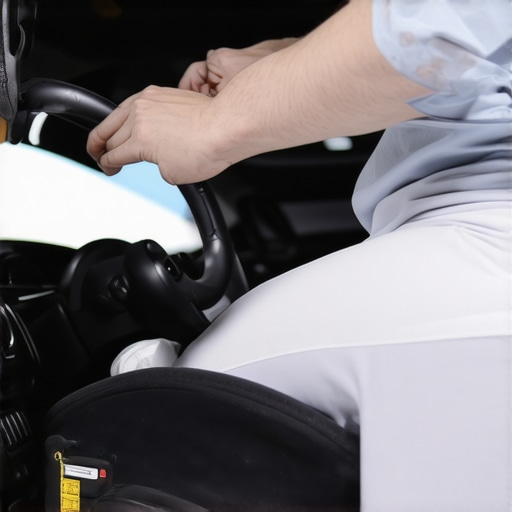
Reach Without Rounding Your Shoulders
I used to drive with my arms fully locked out, but I realized I was just inviting a nagging neck ache to take hold. Think of your arms as a suspension system; if they are locked out, every bump in the road travels directly into your neck and shoulders. Bring the steering wheel closer to your body so there is a soft, 20-degree bend in your elbows. This allows the larger muscles of your mid-back to support the weight of your arms, taking the pressure off your upper traps. Even learning how to use a lumbar roll won’t save you if your arms are constantly pulling your torso out of alignment. Keeping your limbs relaxed ensures that the road vibrations are absorbed by your muscles, not your joints.We often hear that ‘perfect posture’ is the holy grail of spinal health, but I’ve seen countless patients who sit like statues and still end up in my office with debilitating spasms. The truth is, your spine wasn’t designed to be a frozen pillar of marble. When you try too hard to maintain a rigid, upright position, you’re actually creating a different kind of stress on your connective tissues. This is exactly why your perfect posture is actually making you stiff. In fact, research frequently cited in the Journal of Biomechanics suggests that micro-movements and postural variability are far more effective at preventing muscle fatigue than holding one ‘correct’ position for extended periods. If you aren’t shifting your weight occasionally, you aren’t surviving the commute; you’re just enduring it.
Stop Trying to Be a Statue Behind the Wheel
The biggest ‘oops’ factor I see people fall into is the ‘bracing’ habit. Many well-meaning fitness enthusiasts drive with their abs clenched as if they’re about to take a punch, thinking they are protecting their discs. But there is a massive difference between stability and rigidity. This explains why your strong core might actually be too rigid, leading to a loss of the spine’s natural shock-absorbing capabilities. When your trunk is too stiff, every vibration from the road travels directly into your vertebrae instead of being dissipated by your muscular system. This is also a primary reason why sit up straight is actually bad advice for some; if you’re forcing a lumbar curve that your body isn’t ready for, you’re just trading a dull ache for a sharp spasm.
Why does your neck still hurt after fixing your ergonomics?
If you’ve adjusted your seat, your mirror, and your lumbar roll but still feel that burning sensation in your upper traps, you might be overlooking the ‘breath trap.’ When we focus intensely on traffic, we often switch to shallow chest breathing. This forces the accessory muscles in your neck to lift your ribcage thousands of times per hour. Recognizing the connection between shallow breathing and back pain is the real ‘pro level’ secret to long-distance comfort. If your diaphragm isn’t moving freely, your neck is doing the heavy lifting it wasn’t designed for, leading to chronic tension that no ergonomic chair can solve. 
The Movement Nuance Most Experts Skip
True mobility mastery isn’t about finding the one ‘magic’ seat setting; it’s about building a dynamic environment. I recommend a ‘micro-adjustment’ strategy: every 20 minutes, change your seat tilt by just one degree or shift your lumbar roll slightly higher. This keeps different muscle groups engaged and prevents any single ligament from bearing the full load until it reaches a breaking point. I’ve seen elite athletes fail this because they are too focused on the ‘right’ way to sit rather than the ‘active’ way to sit. Have you ever fallen into this trap of trying to stay perfectly still to ‘save’ your back? Let me know in the comments.
Keep a Tennis Ball in Your Glovebox
I never leave for a trip longer than an hour without a standard tennis ball in my center console. It sounds primitive, but it is the most effective tool I have found for self-myofascial release while parked. When that familiar burning sensation starts to creep into your mid-back, you can lean forward, drop the ball behind your shoulder, and lean back into it. This targeted pressure allows you to perform a solo version of the tennis ball trick for shoulder blade spots, releasing the rhomboids that get overstretched during long drives. I prefer the tennis ball over a lacrosse ball for driving because it has a bit of ‘give,’ which is safer when you are dealing with road vibrations and sudden movements. This simple hack is one of those effective chiropractic hacks that bridges the gap between your professional adjustments and your daily life. 
How do I maintain my spinal mobility over the long haul?
Maintenance isn’t about doing a two-hour yoga session once a week; it is about the ‘daily minimum dose.’ Dr. Stuart McGill, a world-renowned expert in spine biomechanics and author of Back Mechanic, notes that the spine’s tissues have a ‘memory’ for the loads they’ve endured. To counter the memory of a four-hour commute, you need to provide an opposing stimulus. I recommend a ritual of ‘un-sitting’ as soon as you get home. Spend five minutes on the floor using the Spider-Man stretch to open your hips. This prevents the temporary stiffness of a drive from becoming the permanent restriction of a sedentary lifestyle. Consistency in these micro-routines is how you achieve mobility mastery. Without this, even the best seat setup will eventually fail as your tissues lose their elasticity.
Ditch the Foam Roller for Your Lumbar Spine
One of the most common maintenance errors I see is people aggressively using a foam roller on their lower back after a long drive. Please, stop doing this. Rolling the lumbar spine can actually cause the vertebrae to shift into more extension than they are ready for, potentially irritating the facet joints. Instead, use the roller on your mid-back (thoracic spine) to restore your range of movement where you are actually stiff. If your lower back feels tight, it is often a secondary symptom of your hips being locked in a seated position for too long. Focus your maintenance on the areas above and below the pain. This nuanced approach is why chiropractic care transforms lives; it addresses the source, not just the scream.
The Future of Your Commute is Sentient Seats
Looking ahead, I predict we are less than a decade away from ‘active’ ergonomic car seats becoming standard. We are already seeing prototypes of seats with integrated sensors that detect pelvic tilt and muscle fatigue in real-time, subtly shifting the lumbar support or vibrating specific zones to encourage blood flow. This ‘sentient’ ergonomics will move us away from static sitting and toward the dynamic movement I’ve been preaching. Until then, you are the sensor. Listen to that first twinge of neck discomfort and treat it as a signal to move, not a nuisance to ignore. I want you to try one thing tomorrow: set a silent timer on your phone for every thirty minutes of your drive. When it goes off, do one ‘Red Light Reset’ even if you’re moving. It only takes five seconds to change your spinal health forever.
The One Realization That Changed My Commute Forever
It took me years to realize that the most expensive car in the world won’t save your back if you aren’t actively mastering back and neck pain relief through movement variability. I used to think I could just ‘power through’ the stiffness, but I learned that chiropractic techniques are most effective when they are paired with mindful daily habits. My biggest ‘lightbulb’ moment? Realizing that my car seat is a tool, not a couch. If I treat it like a workstation, I win. If I treat it like a lounge chair, my discs lose. I also stopped viewing my drive as ‘down time’ for my brain and ‘off time’ for my body. Instead, I treat it as a chance to practice micro-mobility. These tiny, five-second resets are the difference between needing a week of recovery and arriving ready to hit the ground running.
What I Keep in My Car for Spinal Longevity
I don’t leave for a long trip without my essential kit. First is a firm, adjustable lumbar support—I prefer a dedicated roll over a built-in seat mechanism because it offers more targeted pressure. Second, I always have a tennis ball tucked in the door pocket for overcoming chronic neck discomfort and shoulder tension during stops. I also highly recommend keeping a copy of Dr. Stuart McGill’s Back Mechanic in your home library; his insights on spinal load have fundamentally changed how I approach my daily movement. Finally, I use a simple sticky note on my dashboard that says ‘Tall Spine’ to remind me to reset my posture every time I look at my speedometer. These small items provide the effective neck pain management tools you need right at your fingertips.
#IMAGE_PLACEHOLDER_E#
You Deserve to Arrive Feeling Great
Your journey shouldn’t be defined by how much pain you can tolerate. By making these small adjustments, you’re not just fixing your posture; you’re reclaiming your quality of life. Driving is often a necessity, but chronic pain doesn’t have to be. As you integrate these habits, you’ll find that your body stays resilient even through the longest traffic jams. The future of your spinal health is literally in your hands every time you grip that steering wheel. Don’t be afraid to experiment with your seat settings until you find that ‘sweet spot’ where your spine feels supported and active. Have you tried the ‘Red Light Reset’ yet, or do you have a different trick for staying loose behind the wheel? Let me know in the comments below!