How to Set Up Your Laptop at a Coffee Shop Pain-Free
I remember the specific afternoon my neck finally gave up. I was tucked into a cozy corner of a local café, sipping a third latte and feeling incredibly productive. Three hours in, I tried to look up when the door opened, and a lightning bolt of pain shot from the base of my skull down to my shoulder blades. I was stuck in the ‘coffee shop shrimp’ position—hunched, rounded, and tight. My ‘office anywhere’ lifestyle had become a recipe for chronic discomfort. I’d spent months ignoring the dull ache, thinking I could just power through on those trendy but brutal wooden stools. It was a wake-up call that sent me searching for expert chiropractic solutions that work because, frankly, I couldn’t even turn my head to check my blind spot on the drive home. Have you ever felt that sudden, sharp reminder that your body isn’t meant to be folded into a pretzel for a deadline?
Why Your Favorite Café is Secretly Wrecking Your Spine
Working remotely feels like freedom until your mid-back starts screaming. The reality is that coffee shop tables are designed for eating croissants, not for eight hours of deep work. When you set your laptop on a standard-height table, your eyes naturally drop, your chin tucks, and your shoulders roll forward. According to the Mayo Clinic, this ‘tech neck’ posture can place up to 60 pounds of extra pressure on your cervical spine when your head is tilted at a 60-degree angle. That is like carrying a large bale of hay around your neck all afternoon. Early on, I made the mistake of thinking a fancy case was all I needed. I didn’t realize that why your laptop stand is still causing neck strain often comes down to where your hands are placed, not just the height of the screen. I was elevating the laptop but still reaching up to type, which just traded one type of strain for another.
Does an ergonomic portable setup actually look ridiculous in public?
I used to be terrified of being ‘that person’—the one who walks into a quiet shop and starts assembling a miniature command center. I worried it would look pretentious or just plain weird to pull out a riser and a separate keyboard. But here is the truth: nobody cares as much as you think they do, and even if they did, their opinion isn’t worth a week of physical therapy. I had to learn the simple way to sit on a stool without pain by focusing on my pelvic tilt and screen height rather than my self-consciousness. Today, I’m going to show you how to build a setup that fits in a backpack but keeps your spine aligned. We are going to fix your posture without sacrificing your caffeine fix. We will even touch on the the 20-20-20 rule for desk workers so you can keep your eyes as fresh as your back. It’s time to stop surviving your work sessions and start enjoying them.
Get Your Screen to Eye Level Without Looking Like a Mad Scientist
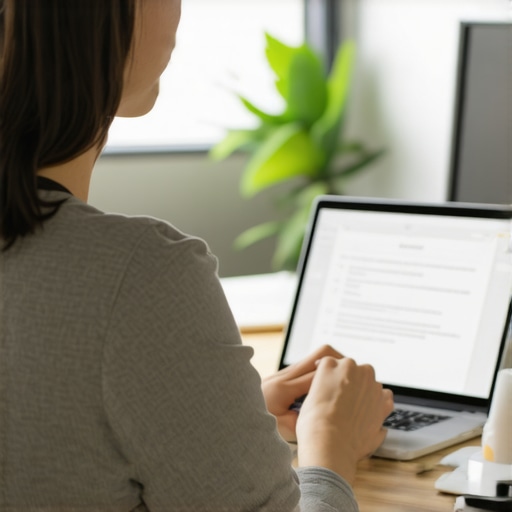
The most critical adjustment is height. Think of your eyes as the horizon line; if you are looking down, you are dragging your entire spinal column into a collapse. I once tried to prop my MacBook on a stack of empty pastry boxes at a busy airport terminal. It was a literal tower of instability, and every time I typed, the screen wobbled like a leaf in the wind. I looked ridiculous, but for those twenty minutes, my neck didn’t throb. That embarrassment was the catalyst for finally buying a foldable riser that weighs less than a notebook. You want the top third of your screen at eye level. This prevents the ‘forward head carriage’ that leads to effective neck pain management becoming a full-time job rather than a quick fix. 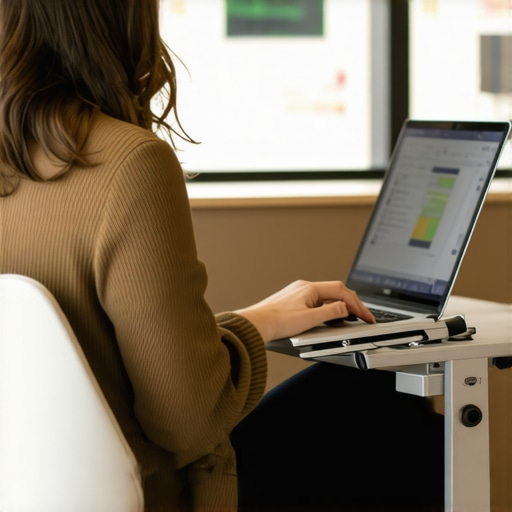
Keep Your Hands Low to Save Your Shoulders
If you raise your laptop, you must use an external keyboard and mouse. Reaching up to a raised laptop is a fast track to shoulder impingement and wrist fatigue. Your elbows should form a 90-degree angle, resting comfortably at your sides. When I first started using a portable slim keyboard, I noticed I stopped clenching my jaw. It turns out that why your desk chair height is ruining your forearms is often mirrored in the coffee shop environment where tables are too high for comfortable typing. If you feel a burn in your wrists after a long session, take a moment to learn how to stretch your forearms to prevent elbow and neck strain before the inflammation sets in. Working with your hands at the correct level keeps your upper traps from firing unnecessarily, which is the main cause of that ‘heavy shoulder’ feeling at the end of the day.
The Pelvic Tilt Trick for Instant Lumbar Relief
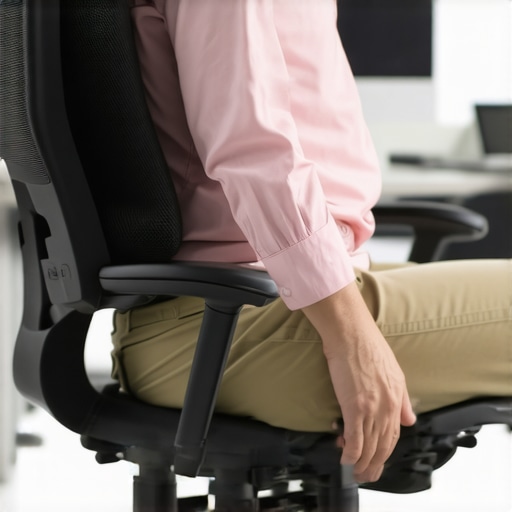
Most café chairs or stools encourage a ‘C-shape’ in the spine by letting your lower back sag. To fight this, scoot your sit-bones to the very edge of the chair. Imagine your pelvis is a bowl of water; you want to tilt it slightly forward so the water would spill out over your lap. This ‘anterior tilt’ naturally stacks your vertebrae and creates a stable base for your upper body. I used to think I needed a bulky lumbar pillow everywhere, but the pelvic tilt trick for instant lumbar relief proved that my own skeletal alignment was more powerful than any cushion. It’s the difference between fighting gravity and working with it. This position engages your core and keeps your head from drifting forward as you focus on your screen.
Reset Your Frame with the Scapular Squeeze
Every thirty minutes, you need to remind your body what ‘upright’ actually feels like. Pull your shoulder blades back and down as if you’re trying to tuck them into your back pockets. Hold this for five seconds. This scapular squeeze that relieves mid-back tension acts like a ‘reset button’ for your nervous system. Pair this with the Brueggers relief move to reverse hours of hunched sitting by opening your palms outward, squeezing your blades, and taking a deep belly breath. It takes ten seconds, but it prevents the cumulative micro-trauma that leads to chronic stiffness and that nagging ache between your shoulder blades.Most people assume that when a muscle feels tight, the solution is to pull on it until it gives up. I used to spend twenty minutes every morning cranking my neck to the side, thinking I was helping. The reality is often the opposite. According to spine biomechanics expert Dr. Stuart McGill, what we perceive as ‘tightness’ is often the brain’s way of creating stability where it’s lacking. If you have a ‘mobile’ segment in your spine that is moving too much, your nervous system will lock down the surrounding muscles to protect you. When you stretch those protective muscles, you are essentially pulling the emergency brake off a car parked on a hill. It is one of the reasons why icing isn’t always the best move for a stiff neck because you might be treating the symptom of protective guarding rather than the underlying instability. To truly revitalize your mobility, you need to identify where the lack of control is coming from instead of just attacking the tension.
The Core Strength Trap You Are Likely Falling Into
We have been told for decades that a strong core is the key to a healthy back, but most people interpret ‘core’ as just their six-pack muscles. This is a massive mistake. If you are doing endless crunches but ignoring your lateral stability, you are building a ‘tower’ on a shaky foundation. I found out the hard way that why your glute medius is more important than your abs for back health often boils down to how your pelvis is stabilized during movement. If your hips are weak, your lower back will try to compensate, leading to that chronic ache that never seems to go away regardless of how many planks you do. This is also where why your pelvic floor matters for spinal stability; it acts as the bottom of the ‘canister’ for your internal pressure. If one part of that canister is weak, the whole system fails.
Can your footwear choices affect how your neck feels?
It sounds like a stretch—no pun intended—but the connection between your feet and your skull is real. Every step you take sends a kinetic shockwave up your kinetic chain. If you are wearing shoes that don’t allow your big toe to engage or that force your weight onto your heels, your pelvis tilts, your ribcage flares, and your neck has to crane forward just to keep your eyes on the horizon. This is the hidden link between your feet and mid-back pain that many people overlook when they are focused only on their workstation. If your foundation is off, your ‘headlight’ alignment will be off too. 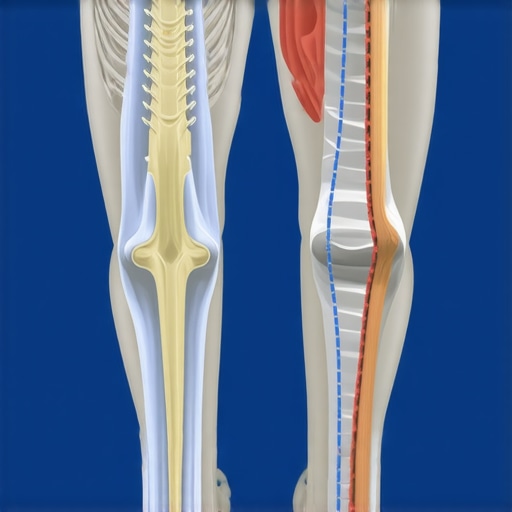
Don’t Ignore the Subtle Nerve Signals
The ‘Oops’ factor in many recovery journeys is ignoring the ‘light’ symptoms like a faint tingle or a thumb that feels slightly clumsy. I used to think a clicking neck was just ‘getting older’ until I realized that those micro-adjustments in my posture were actually compressing nerve roots. Seeing how back pain recovery transforms lives isn’t just about the big adjustments; it is about the subtle recalibration of the nervous system. Have you ever fallen into the trap of stretching a muscle that just won’t stay loose? Let me know in the comments—I’d love to hear if you’ve noticed this ‘tightness vs. instability’ battle in your own body.I fell into that trap for years, assuming I could just ‘stretch’ my way out of a poor environment, but true longevity comes from the tools you use every single day. I have refined my ‘go-bag’ down to three non-negotiables: a collapsible carbon-fiber riser, a separate trackpad to keep my wrists neutral, and a lacrosse ball for mid-day tissue work. The riser is the most important piece because it allows for the 5-second check to see if your monitor is too low regardless of whether I am at a standing desk or a low bistro table. By raising the top third of the screen to eye level, I am removing the constant eccentric load on my neck muscles. Dr. Kelly Starrett, author of ‘Becoming a Supple Leopard,’ often emphasizes that movement is a skill that requires a ‘stabilized’ environment to prevent micro-trauma. This is why I also carry a small mechanical keyboard with tactile switches; the physical feedback prevents me from ‘bottoming out’ my keys and sending unnecessary vibrations through my carpals, which eventually radiates up to the shoulders.
Your Gear Should Solve Problems Not Create Them
Most people buy a laptop stand and think the job is done, but they forget that stability is just as important as height. A wobbly stand causes your eyes to micro-adjust, which leads to sub-occipital tension and those nagging headaches at the end of a deadline. I prefer a stand with a wide tripod base because it mimics the stability of a real desk. When your workstation is rock-solid, your nervous system feels safe enough to let your shoulders drop. This is a foundational part of unlocking neck pain relief with essential chiropractic tips for 2025 that focus on ergonomics. If you are constantly fighting a shaky screen, you are essentially asking your neck to act as a stabilizer, which is a role it was never meant to play. 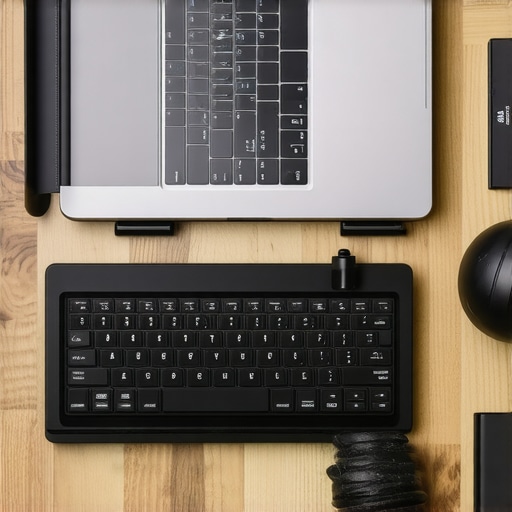
How can I keep my spine happy for the next decade?
Maintaining mobility is not about a single ‘miracle’ stretch; it is about scaling your habits to fit your life. I have found that how to stay mobile when you have a desk job often comes down to ‘greasing the groove’—performing small movements frequently rather than one long session at the gym. I set a timer every fifty minutes to perform one set of scapular retractions. Over months, this builds a ‘postural endurance’ that makes sitting upright feel effortless rather than like a chore. Looking ahead, I predict we will see a shift toward ‘active’ ergonomic gear—wearables that do not just buzz when you slouch but actually use bio-mechanical feedback to adjust your work-break intervals based on your muscle fatigue levels. We are moving away from static furniture toward dynamic environments that respond to our body’s needs in real-time. To get a head start on this, I want you to try the dead bug variation that actually fixes lower back instability tonight. It is the single most effective way to teach your core to protect your spine while your limbs are moving. It takes five minutes, but it provides the internal ‘bracing’ you need to handle even the worst coffee shop stools. If you are ready to stop guessing and start feeling better, mastering back and neck pain relief tips from the pros starts with these small, intentional shifts in how you interact with your technology.
The Hard Truth About Working From a Backpack
For years, I believed that if I could fit my life into a messenger bag, I was winning at the modern career game. But I learned the hard way that ‘minimalism’ shouldn’t apply to your health. The most expensive lesson I ever learned was that a thin laptop is a biomechanical nightmare when used in isolation. You can’t out-stretch a bad environment. I realized that why icing isn’t always the best move for a stiff neck is because the ice only numbs the symptom of a workstation that is actively crushing your discs. I also had to accept that ‘feeling tight’ was often a sign of weakness, not just lack of flexibility. If you find yourself constantly reaching for your neck to rub a sore spot, your body is likely crying out for stability, not just another stretch. Truly revitalizing your mobility requires you to stop the repetitive micro-trauma at the source. This means admitting that the local cafe’s aesthetic is secondary to your vertebral alignment.
The Survival Kit for Your Cervical Spine
Building a sustainable remote setup doesn’t require a suitcase of gear, but it does require intentionality. My daily toolkit is built on three pillars of support that I trust because they prioritize mechanical leverage over convenience. First, a high-quality riser is mandatory; I use a carbon fiber model because it prevents the ‘forward lean’ that ruins your thoracic curve. Second, a separate keyboard allows your shoulders to retract naturally rather than pinning them to your chest. Third, I always carry a simple mobility tool to address tissue quality on the fly. Learning how to use a tennis ball to fix that spot under your shoulder blade has saved me from dozens of potential tension headaches during long editing sessions. I also highly recommend the book ‘Built to Move’ by Kelly and Juliet Starrett; it completely reframed how I view my ‘desk time’ as an opportunity for movement rather than a period of stagnation. For those who feel overwhelmed, mastering back and neck pain relief tips from the pros can be as simple as changing one habit per week until your setup is optimized.
Your Body is Your Most Important Business Asset
At the end of the day, your productivity is tied directly to your physical comfort. You can’t do your best creative work when your brain is busy processing pain signals from your lower back or neck. Don’t wait for a major injury to take your ergonomics seriously. By making these small adjustments now, you are investing in a future where you can work from anywhere without paying for it in chronic discomfort. There is a profound sense of freedom that comes from knowing you can set up in a park, a library, or a bustling café and still protect your spine. As you move forward, focus on how to stay mobile when you have a desk job by integrating movement into the cracks of your day. It’s time to stop letting your laptop dictate your posture and start taking control of your physical longevity. You have the tools and the knowledge—now it is just about the daily execution. Unlocking neck pain relief with essential chiropractic tips for 2025 is a journey of consistency, not a one-time fix. Have you ever found a piece of gear that completely changed how your neck feels after a long day? Let me know your favorite setup hack in the comments below!