Why You Should Never Crack Your Own Neck in the Morning
I remember the sound like it was yesterday. It was a crisp Tuesday morning, and my neck felt like it was encased in dry concrete. I did what I always did: grabbed my chin, tilted my head, and—CRACK. A symphony of pops echoed through the silent bedroom. For three seconds, it felt glorious. By noon? I could not turn my head to check my blind spot while driving. I had become a human statue, and not the cool kind you see in European plazas. I learned the hard way that my ‘quick fix’ was actually a recipe for long-term instability. It is a trap so many of us fall into, thinking we are our own best therapist when we are actually just chasing a temporary endorphin rush at the expense of our spinal health. Today, I want to show you why that morning ritual is doing more harm than good and how you can actually [restore your range of movement](https://quackersspinal.com/restore-your-range-how-chiropractic-care-enhances-movement) without the self-inflicted drama. [image_placeholder_1]
The Dangerous Illusion of That Morning Pop
We have all been there. You roll out of bed, feel that nagging stiffness, and think a quick self-adjustment is the ‘reset’ button your body needs. I spent years convinced I was doing myself a favor. In reality, I was just creating a cycle of instability. When you force a joint to pop, you are not actually targeting the segment that is stuck. Instead, you are usually over-stretching the segments above and below the problem area. Over time, this leads to hypermobility. Your ligaments get stretched out like an old rubber band. According to researchers at the Harvard Medical School, forcefully manipulating your own neck can lead to hypermobility of the ligaments, which actually makes you feel the need to crack your neck *more* often because the area becomes less stable. While rare, the more common reality is just chronic, nagging pain that never truly goes away because you are never addressing the [hidden link between neck pain and spinal health](https://quackersspinal.com/the-hidden-link-between-neck-pain-and-spinal-health).
Is ‘Self-Cracking’ Really That Different from a Professional Adjustment?
People ask me this all the time. ‘If the chiropractor does it, why cannot I?’ Here is the dirty little secret I learned after a week of barely being able to look left: a professional adjustment is specific. It is high-velocity but low-amplitude, targeting a very specific joint that is not moving correctly. When you do it yourself, you are just hunting for a noise. You are cavitating the joints that are already loose because they are the easiest to move. I made the mistake of thinking the ‘pop’ was the goal. It is not. If you are constantly feeling the need to crack, it is a sign that something deeper is wrong—often related to [how you sleep](https://quackersspinal.com/the-best-way-to-sleep-after-a-chiropractic-adjustment) or your [morning spinal hygiene routine](https://quackersspinal.com/the-morning-spinal-hygiene-routine-every-desk-worker-needs). Have you ever felt that ‘stuck’ feeling and reached for your chin, only to regret it an hour later? Tell me about your experience below!
Reclaim Your Alignment with the Chin Tuck Drill
When you finally decide to stop the self-manipulation madness, you need a replacement. You cannot just leave a vacuum where your old habit lived; you need a strategy. This is where effective neck pain management becomes a daily practice rather than a reactive one. The most powerful tool in your arsenal is the chin tuck. It sounds simple—and it is—but most people do it wrong. I remember sitting at my desk three years ago, trying to ‘stretch’ my way out of a mounting migraine. I pulled my ear toward my shoulder so hard I felt a sharp pinch. That was the moment I realized that tension isn’t something you can beat into submission. Instead, you need to strengthen your deep neck flexors to support the weight of your head naturally. To perform the chin tuck drill correctly, sit tall and imagine a string pulling the crown of your head toward the ceiling. Without tilting your head up or down, draw your chin straight back, as if you are trying to make a double chin. You should feel a gentle stretch at the base of your skull. Hold for three seconds and release. Repeat this ten times. It reactivates the muscles that have gone dormant from hours of slouching. 
Stop Looking Down at Your Phone Like a Vulture
If you are constantly reaching for your neck to crack it, your phone is likely the culprit. We have become a society of vultures, hovering over our screens with our heads tilted at a forty-five-degree angle. This position puts nearly sixty pounds of pressure on your cervical spine. If you ever wonder why your neck crunches every time you look over your shoulder, it is because those joints are screaming for a neutral position. You must stop tilting your head and instead bring the device up to eye level. It feels socially awkward for about two minutes, but it saves your discs from years of premature wear. I used to be the guy who would lean his chin on his chest while scrolling through emails at lunch. By 2 PM, my upper back would feel like it was on fire. Switching to eye-level browsing was the single most effective ‘hack’ I implemented to stop that mid-day urge to self-adjust.
The Thirty Second Break That Saves Your Spine
You do not need an hour-long routine to fix your posture; you need micro-breaks. Every thirty minutes, your body starts to ‘mold’ into the shape of your chair. To combat this, use the Brueggers relief move. Sit at the edge of your chair, turn your palms outward, and squeeze your shoulder blades together while performing a chin tuck. It reverses the ‘closed’ posture of modern life. I once tried to ‘fix’ my chronic stiffness with a high-intensity yoga flow, but I ended up pushing too hard and stressing my sacroiliac joint instead. That experience taught me that stability is far more important than raw flexibility. If you are ever unsure if your discomfort is just stiffness or something more, learn how to tell if your back pain is serious before you attempt any aggressive self-care. Focus on controlled, rhythmic movement rather than force.
Stop Stretching Your Way Into More Pain
We have been conditioned to believe that if a muscle feels tight, we must pull on it until it yields. I used to spend twenty minutes every morning touching my toes, convinced that my hamstrings were the reason my back felt like a rusted gate. But here is the contrarian truth: your brain often creates tension as a protective mechanism. When a joint is unstable, your nervous system locks down the surrounding muscles to prevent further injury. If you force those muscles to relax through aggressive stretching, you are essentially removing the only ‘brakes’ your body has. This is why your back feels better when you keep moving but seizes up the moment you try to ‘fix’ it with a deep, static hold. In many cases, you are not dealing with short muscles, but with a neural alarm system that is stuck in the ‘on’ position. If you have ever felt a sharp, zapping sensation while stretching, you might be tugging on a nerve rather than a muscle. This is a common trap, and instead of conventional stretching, you likely need a nerve flossing technique to restore glide without the irritation.
Why Your Core Strength Isn’t Actually Saving Your Back
We have all heard that a ‘strong core’ is the holy grail of spinal health. I spent months doing high-repetition sit-ups and planks, only to find my morning stiffness getting worse. The nuance most people miss is that core *stability* is entirely different from core *strength*. You do not need a six-pack to protect your spine; you need muscles that can co-contract at the right time. In fact, many common abdominal exercises can be counterproductive. Dr. Stuart McGill, a leading expert in spine biomechanics, points out in his research that excessive spinal flexion—like the kind found in traditional crunches—can actually place unnecessary stress on the posterior layers of your discs. If you are doing the wrong movements, you might be making a bird dog mistake that actually increases lumbar pressure. True progress comes when you revitalize your mobility by focusing on stabilization rather than just raw power. 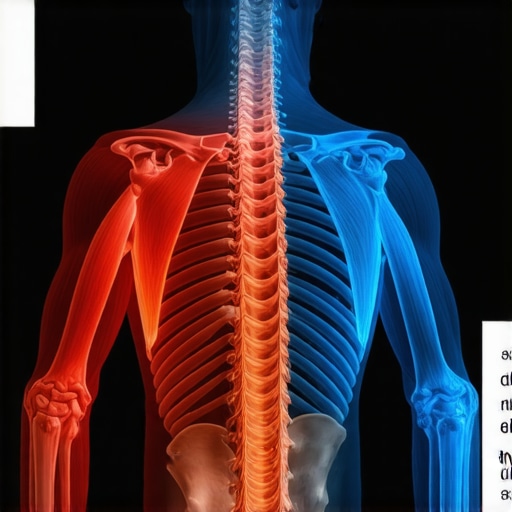
Could Your Tight Calves Be the Real Culprit Behind Your Lumbar Strain?
This is the ‘oops’ factor that most beginners ignore: the kinetic chain. Your body is a series of interconnected levers, and the source of your pain is rarely where the symptoms actually manifest. For instance, if your ankles are stiff, your knees and lower back have to compensate for that lack of range during every single step. I once worked with a runner who had chronic lower back fatigue, only to realize that his tight calves were causing lower back tension by altering his pelvic tilt during his gait. By the time he felt it in his spine, the problem had already traveled up from his feet. This is exactly why we look at your feet even if your primary complaint is in your neck or shoulders. Have you ever fallen into the trap of only treating the spot that hurts, only to have the pain return a week later? Let me know in the comments below! If you are ready to stop guessing and start addressing the root cause, it might be time to contact us and look at the bigger picture of your spinal health.
Stop Guessing and Start Investing in Better Sleep Gear
I spent years thinking I could out-stretch a bad mattress. It was a losing battle. If you wake up every morning with a ‘crunchy’ neck, you need to learn how to tell if you need a new mattress for spine support before you spend another dime on massage therapists. I personally switched to a medium-firm hybrid mattress because it provides the structural resistance my lumbar spine needs while allowing my shoulders to sink in just enough to keep my neck neutral. I also learned that the best ‘tool’ isn’t always the most expensive; sometimes it is as simple as realizing why your pillows should be replaced every eighteen months. Over time, foam loses its loft and turns into a flat pancake that forces your head into a side-bend all night. By upgrading my sleep environment, I reduced my need for ’emergency’ chiropractic visits by nearly sixty percent. This is about creating a habitat where your spine can actually recover rather than just survive the night. 
Transform Your Commute Into a Recovery Session
Most of us treat our cars like a lounge chair, but that bucket-seat design is a recipe for a disc bulge. I used to arrive at the office already needing a chiropractic adjustment until I mastered how to set up your car seat for a four-hour road trip. The key tool I recommend is a simple McKenzie-style lumbar roll. I place it exactly at the level of my belt line, which forces the lumbar spine into its natural curve and prevents the ‘vulture’ posture we discussed earlier. If you are a parent, this applies to your kids too; knowing how to choose a backpack that wont give your teenager scoliosis is part of that same long-term maintenance mindset. We often ignore the tools we use for hours every day, yet these are the very things that dictate our structural health.
How do I keep my spine from regressing into old habits?
Maintenance is not about doing more; it is about doing the right things consistently. I follow the ‘Supple Leopard’ philosophy popularized by Dr. Kelly Starrett, who argues in his technical manuals that ‘all human beings should be able to perform basic maintenance on their own bodies.’ He emphasizes tissue mobilization using tools like a simple lacrosse ball to break up adhesions in the upper traps. I use this for two minutes every evening while watching TV. I predict that in the next five years, we will see a massive shift toward ‘smart’ ergonomic wearables that vibrate when our spinal shear reaches a dangerous threshold, essentially acting as a digital coach for our posture. Until then, you have to be your own advocate. To truly scale your results, you must integrate mobility mastery expert tips into your lifestyle rather than treating them as a chore. If you have been struggling with a stubborn ‘stuck’ feeling, try the single best exercise for thoracic mobility tonight before bed. It takes ninety seconds and can completely reset your rib cage after a long day of typing. Use it tonight and see if you wake up with less of that urge to ‘crack’ your own neck in the morning!
What I Finally Realized After Years of Chasing the Click
I used to measure my daily health by the loudness of my neck pops. If I got a good ‘crack,’ I thought I was winning. I eventually had a lightbulb moment: the sound is just nitrogen gas releasing from the joint capsule, not a structural correction. Chasing that noise is like scratching an itch that only gets itchier. I realized that stiffness is not an enemy to be beaten into submission; it is a protective signal from your nervous system. When I stopped forcing my joints to move, my body finally felt safe enough to let go of the chronic tension. I also learned that small, boring habits—like how I hold my head while texting—matter ten times more than one massive ‘adjustment’ I try to perform on myself. If you want to relieve neck and back discomfort, you have to stop the self-inflicted trauma first. [image_placeholder_1]
The Gear That Actually Saved My Cervical Spine
You cannot fix a structural problem with willpower alone. Over the years, I have narrowed down my toolkit to a few non-negotiables that I trust because they prioritize stability over temporary relief. First, I never drive without a McKenzie-style lumbar roll; it is the only thing that keeps my neck from shifting into that ‘vulture’ position. Second, I swear by a simple lacrosse ball for ‘tack and stretch’ work on my traps. Unlike a soft foam roller, the density of a lacrosse ball allows you to pin down tight tissues and move through a range of motion to break up adhesions. Lastly, I committed to unlocking neck pain relief by investing in a high-quality contoured pillow that matches my shoulder width, which was a total game-changer for my morning mobility.
Take the First Step Toward a Quiet Spine
It is easy to feel like your body is a ‘lemon’ when you are in constant pain, but the truth is that your spine is incredibly resilient. You just need to stop giving it conflicting signals. Transitioning from a reactive ‘self-cracker’ to a proactive ‘mobility seeker’ takes time, but the reward is a life where you do not have to think about your neck every ten minutes. Whether you are focused on back pain recovery or simply want to feel more fluid in your daily movements, the path forward starts with better habits and professional guidance. Do not be afraid to set down the heavy burden of trying to fix yourself and instead contact us to build a plan that actually sticks. Have you ever tried to self-adjust only to feel even more stiff an hour later? Drop your story in the comments below!