The Specific Chair Height That Stops Mid-Back Burning
I was staring at my monitor, three cups of coffee deep, when the fire started. Not a literal fire, but that agonizing, searing heat between my shoulder blades that makes you want to crawl out of your own skin. I tried the fancy lumbar pillows and the expensive ergonomic thrones, but the burning always came back. It was visceral. It was distracting. And frankly, it was making me hate my job. It wasn’t until I stopped obsessing over ‘perfect posture’ and started measuring my floor-to-seat distance with a tape measure that the pain finally vanished. Today, I’m going to show you the exact measurement that saved my spine and why your current setup is likely sabotaging your nervous system.
Your Standard Chair Height is Probably Trash
If you have ever felt like your shoulder blades feel like they’re burning after typing, you are not alone. Most of us follow the ‘feet flat on the floor’ rule blindly. I made that same mistake for years. I sat exactly how the HR manual told me to, yet I spent every evening lying on a tennis ball trying to work out the knots. The problem is that the standard desk height is built for an ‘average’ person who doesn’t exist. When your chair is even half an inch too low, your shoulder blades wing out, and your mid-back muscles—specifically your rhomboids—scream in protest as they try to keep you upright. According to the Mayo Clinic, maintaining a neutral spine is the key to preventing muscle fatigue, yet most people are nowhere near neutral. I finally learned how to sit at your desk with zero back fatigue by prioritizing my elbow-to-desk ratio over my foot-to-floor ratio. Have you ever spent a fortune on a chair only to find yourself still slouching by noon?
Is an expensive ergonomic chair actually worth the price tag?
Many people believe that throwing money at a high-end chair will solve everything, but I am here to tell you that a $50 stool at the right height beats a $1,200 chair at the wrong one. In my early days of trying to fix my own pain, I ignored the mechanical reality of my workstation. I thought I just needed more ‘core strength.’ I was wrong. No amount of planks can overcome the physics of a chair that forces your thoracic spine into a C-curve. You might find that the scapular squeeze that relieves mid-back tension only works for five minutes because your chair height is constantly dragging those muscles back into a stretched, weakened position. We need to stop treating the symptoms and start fixing the geometry of your workspace.
The Elbow Test That Never Lies
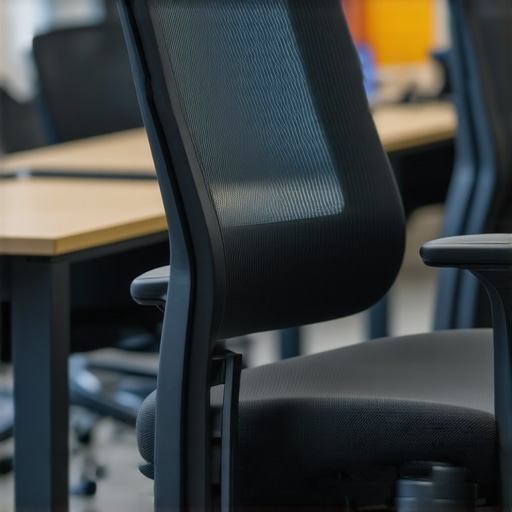
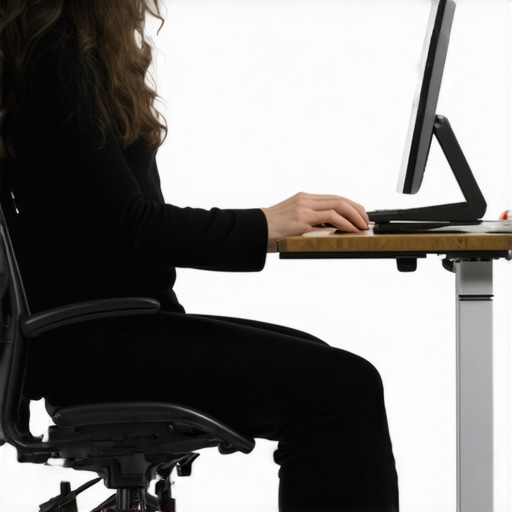
Stop looking at your feet for a second. To find your true neutral position, you need to look at your arms. Sit in your chair and let your arms hang loosely at your sides like wet noodles. Now, bend your elbows to 90 degrees as if you were typing. If your keyboard or desk surface is higher than your hands in this position, you are in trouble. Your brain will instinctively compensate by shrugging your shoulders to reach the keys. This constant micro-shrug is exactly why your desk chair height is ruining your forearms and causing that deep, gnawing ache in your upper back. To fix this, you must raise your chair until your forearms are parallel to the desk. If your feet no longer touch the ground, don’t lower the chair; instead, find a footrest. Your spine doesn’t care if your feet are on a fancy ergonomic plastic wedge or a stack of old phone books, as long as your elbows aren’t reaching upward.
Match Your Desk Height to Your Skeleton
Once you realize that the desk is the fixed object, you understand that your chair is the tool used to bridge the gap. I used to think I could just ‘sit taller’ to reach a high desk, but human willpower is no match for gravity. When you sit too low, your humerus (upper arm bone) pushes up into the shoulder socket, which compresses the nerves leading to your hands. This is a primary reason unlocking neck pain relief expert tips for lasting comfort often starts with workstation geometry rather than just stretches. If you can’t adjust your desk, you must adjust yourself. Use a tape measure to find the distance from the floor to your bent elbow, then match your chair height to that exact number. This alignment ensures your scapula stays retracted and depressed, preventing the ‘winging’ that leads to muscle tears and chronic knots.
How I Fixed My Setup Using Only Reams of Printer Paper
I remember a particularly brutal week at a temporary office where the desks were built for giants. I was five-foot-eight sitting at a thirty-two-inch table. Within two hours, my neck felt like it was being squeezed in a vise. I didn’t have an adjustable chair, so I went to the supply closet and grabbed four reams of printer paper. I stacked two on the chair to lift my hips and two under my feet to keep my lower back from arching. The relief was almost instantaneous. By changing the height, I allowed my traps to finally shut off. If you are struggling right now, try the 30-second pec stretch to fix slumping shoulders to reset your baseline, then apply these height changes. You’ll find that the brueggers relief move to reverse hours of hunched sitting becomes significantly more effective when you aren’t fighting your furniture the other eight hours of the day.
The Hidden Danger of Armrests
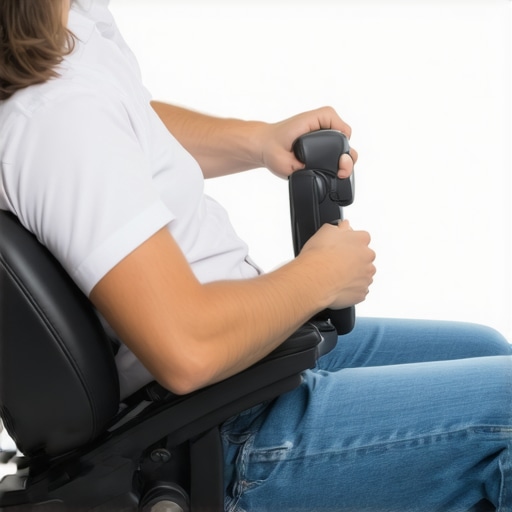
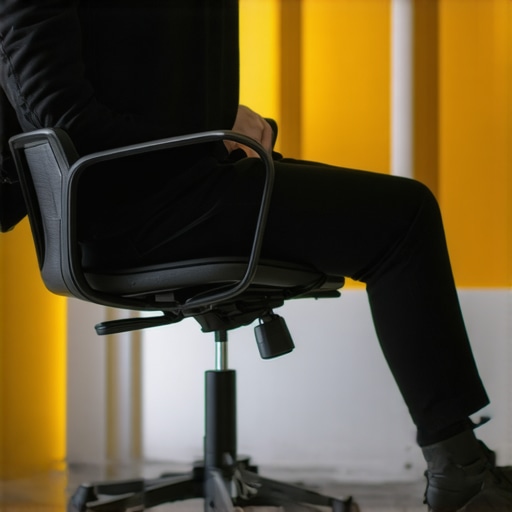
Most people use armrests as a crutch, but they are often the enemy of a healthy thoracic spine. If they are even slightly too high, they push your shoulders into your ears. If they are too low, you lean to one side, causing a lateral tilt in your pelvis. I often recommend removing armrests entirely if they prevent you from sliding your chair close enough to the desk. When you sit too far back, you reach forward, and that reach is what kills your posture. You want to be tucked into the desk so that your core—not your neck—is supporting your weight. This is a foundational concept in the simple way to sit on a stool without pain, where the lack of a backrest forces you to rely on proper skeletal stacking rather than leaning on poorly designed plastic supports.
If you have been aggressively stretching your upper traps every time they feel tight, you might actually be making the problem worse. This is what I call the ‘Locked Long’ paradox. In my years of analyzing movement and ergonomics, I have found that the muscles between your shoulder blades—the rhomboids and middle traps—usually aren’t tight because they are short; they are tight because they are being stretched to their absolute limit like a rubber band about to snap. When you stretch them further, you are just increasing that agonizing tension. Instead of more flexibility, you likely need to explore chiropractic secrets to boost neck comfort and function that prioritize spinal stability over simple stretching. We have to stop treating every sensation of ‘tightness’ as a signal to pull and start treating it as a signal to stabilize.
Is your hand numbness actually a neck problem?
One of the most advanced nuances I see missed by general practitioners is the ‘Double Crush’ syndrome. You might think you have carpal tunnel because your wrist aches or your fingers tingle after a long day at the keyboard, but often, why your thumb pain is actually coming from your neck is due to nerve compression happening way up at the cervical spine. Your nerves are like a garden hose; a kink at the faucet (your neck) makes the flow weak and turbulent at the nozzle (your hand). A study published in the Journal of Physical Therapy Science highlights that addressing proximal spinal alignment is frequently more effective for distal limb symptoms than treating the limb itself. This is a cornerstone of the hidden link between neck pain and spinal health. If you only treat the wrist, you are just mopping up the floor while the sink is still overflowing.
The Military Posture Trap That Ruins Your Ribs
The biggest ‘oops’ factor I see in people trying to fix their ergonomics is the over-correction. In an effort to stop slouching, they pull their shoulders back so hard that their lower ribs thrust forward. This is a disaster for your spinal mechanics because why your ribs flare when you reach overhead is usually a sign that you have lost your core’s ‘canister’ position. By forcing this stiff ‘military’ stance, you are actually compressing your lower spine and shutting off your diaphragm. To fix this, I often recommend the dead bug variation that actually fixes lower back instability, which teaches you to keep your ribs down and your spine neutral while your limbs move independently. 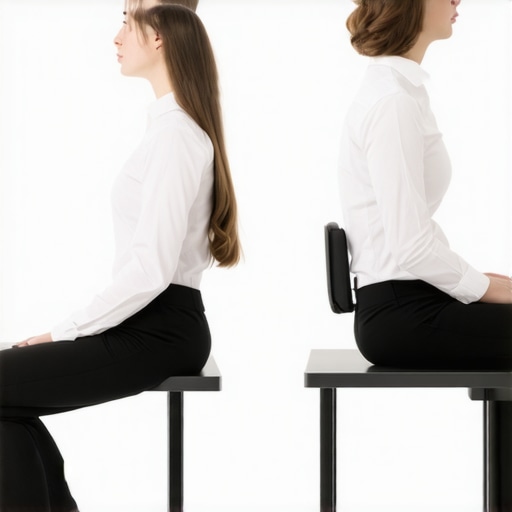
Furthermore, many of my clients are surprised to learn that why your core strength isn’t stopping your back from hurting is often because they are engaging their superficial ‘six-pack’ muscles instead of the deep multifidus and transversus abdominis that actually support the vertebrae. Real expertise in recovery means knowing the difference between ‘show’ muscles and ‘go’ muscles. True effective neck pain management a step-by-step guide doesn’t involve forcing a ‘perfect’ look, but rather finding a functional ‘neutral’ that allows your nervous system to relax. Have you ever fallen into the trap of over-correcting your posture only to find it hurts even more? Let me know in the comments below.
Consistency is where most people fail. You can have the most expensive setup in the world, but if you don’t have a system to maintain your progress, the fire in your shoulder blades will eventually return. I had to learn the hard way that recovery isn’t a one-time event; it is a daily practice. This is why I developed a personal protocol that focuses on spinal hygiene rather than just periodic stretching. When I integrated a morning spinal hygiene routine every desk worker needs, my flare-ups dropped from once a week to virtually zero.
Stop Relying on Your Memory and Use a Timer Instead
The most important tool I own isn’t a chair or a brace; it’s a simple interval timer app on my computer. I follow a strict variation of the 20-20-20 rule for desk workers and neck health, but with a twist: every 20 minutes, I don’t just look away; I perform one set of the brueggers relief move to reverse hours of hunched sitting. This resets my neurological ‘timer.’ Without an automated reminder, your brain will enter a flow state, and before you know it, you’ve been hunched over a spreadsheet for three hours. This physiological ‘reset’ is non-negotiable for anyone serious about mobility mastery expert tips for back pain prevention and recovery.
How can I maintain my spinal mobility for the long haul?
Maintenance is about micro-dosing movement. Dr. Stuart McGill, a world-renowned spine biomechanics expert and author of Back Mechanic, emphasizes that the ‘cumulative load’ on your discs is what leads to injury. By breaking up your sitting time, you reduce that load. I personally use a firm lacrosse ball to target the exact spots where my rhomboids meet my spine. If you’ve never tried it, how to use a massage ball to release hip flexor tension can be a game-changer, but using it on the mid-back is even better for desk workers. I place the ball against a wall and lean into it, moving it specifically to find those ‘trigger points’ that cause referred pain up into the neck.

The Low-Tech Recovery Tool That Lives in My Desk Drawer
Besides the lacrosse ball, I am a huge advocate for resistance bands. I don’t use them for ‘working out’ in the traditional sense, but for performing the single best exercise for thoracic mobility: the banded pull-apart. Keeping a light band in your desk drawer allows you to activate your posterior chain without even leaving your office. This prevents the ‘locked long’ muscles we discussed earlier from becoming completely dormant. It is these small, consistent activations that lead to back pain recovery how chiropractic care transforms lives by reinforcing the work done in the clinic.
The Future of Posture is Dynamic Movement
I predict that in the next few years, we will see a massive shift away from ‘static’ ergonomic furniture. The trend is moving toward dynamic seating—chairs and platforms that utilize haptic feedback or subtle weight shifts to keep your core muscles engaged throughout the day. We are moving toward a world where your furniture teaches you mastering back neck pain relief tips from the pros through biofeedback. Until then, you are the pilot of your own spinal health. I challenge you to try this: set a timer for 30 minutes right now, and when it goes off, perform five slow, controlled scapular squeezes. Don’t just read about it; actually move. Your future self will thank you for the lack of burning between your shoulders.
What Most Ergonomic Experts Forget to Mention
Through years of trial and error, I have discovered that the biggest mistake most people make is equating ‘comfort’ with ‘softness.’ A soft chair feels great for ten minutes but provides zero feedback to your nervous system. My biggest breakthrough was realizing that my mid-back pain wasn’t a lack of flexibility, but a lack of structural awareness. I had to learn how to restore your back mobility proven chiropractic strategies by focusing on stability first. Another lesson? Your monitor height and chair height are a married couple; you cannot change one without affecting the other. If you raise your chair but leave your screen low, you replace mid-back pain with a neck strain faster than you can say ‘ergonomics.’ Finally, I learned that sitting is a skill, not a passive state. You have to actively check in with your ribcage alignment to ensure you aren’t falling into the military posture trap we discussed earlier.
The Toolkit That Keeps Me Pain-Free
I don’t believe in gadgets, but I do believe in physics. My daily recovery routine is built around a few non-negotiables. First, I always keep a copy of Stuart McGill’s Back Mechanic nearby; it is the gold standard for understanding how to protect your discs. Second, I use a high-density lacrosse ball for localized trigger point work. Third, I rely on neck back pain solutions insights from wellness experts to stay updated on the latest neurological research regarding spinal health. Lastly, I keep a light-resistance loop band in my desk drawer for those hourly pull-aparts. These simple, low-cost tools have saved me thousands in medical bills by allowing me to apply boost your back health simple yet effective chiropractic hacks the moment I feel tension creeping in.
Take Back Control of Your Daily Comfort
The burning sensation you feel at the end of the day isn’t a life sentence. It is a signal—a request for better geometry and more frequent movement. You have the power to reprogram how your body responds to your workstation. By prioritizing your elbow height, ditching the useless armrests, and implementing a strict movement timer, you are doing more than just avoiding pain; you are investing in your long-term mobility. Don’t wait for the fire to become an injury. Explore unlock neck pain relief essential chiropractic tips for 2025 and start making these small, mechanical shifts today. Your spine is the pillar of your health, and it deserves a workspace that supports its natural design. Have you ever tried raising your chair only to realize your feet no longer reach the floor? Let me know what you used as a makeshift footrest in the comments below!