How to Sit at Your Desk with Zero Back Fatigue
I remember the exact moment my back decided it had finally had enough. I was three hours into a deep-work session, and when I tried to reach for my coffee, a sharp, electric zing shot right through my lower spine. I wasn’t doing anything extreme; I was just… sitting. It was humiliating. I’m a guy who prides himself on being the helpful neighbor when it comes to health advice, yet there I was, hobbling toward the kitchen like I’d just aged forty years in a single afternoon. That was my rock bottom, and it’s probably why you’re here too. You’ve realized that no matter how many ergonomic gadgets you buy, that nagging ache keeps coming back.
Stop Chasing the Myth of the Perfect Chair
The biggest mistake I made early on—and trust me, I spent thousands trying to solve this—was thinking that a more expensive chair would automatically fix my posture. I bought the mesh ones, the kneeling ones, and even a saddle chair that made me look like I was ready for a rodeo. But here’s the cold, hard truth: the chair doesn’t do the work for you. In fact, relying too much on external support is often why your core strength isn’t stopping your back from hurting in the first place. We think we can buy our way out of pain, but your body isn’t a machine you can just upgrade with parts; it is a living system that craves movement. I used to sit bolt upright, thinking I was being a posture pro, but I was actually just creating massive amounts of muscle tension in my mid-back. According to the Cornell University Ergonomics Web, sitting actually increases the pressure on your intervertebral discs by up to 40% compared to standing. If you’re doing it wrong, you’re basically crushing your spine for eight hours a day. Today, I’m going to share the subtle shifts—the ones that don’t cost a dime—that actually transformed my workdays. We are going to look at understanding back pain from a functional perspective so you can finally stop the cycle of stiffness and frustration. [image]
Can you really sit for eight hours without a single ache?
I know it sounds like a pipe dream. You’ve probably tried the 20-20-20 rule or attempted to use a standing desk only to find that standing desks cause hip pain of their own. You’re skeptical, and you should be. I was too. But zero fatigue isn’t about being a statue; it’s about learning to move while you sit. Have you ever found yourself doing that weird sideways slump just to find a second of relief? Tell me in the comments if you’ve reached that level of desk-desperation yet! It feels like a losing battle, but I promise there is a better way. The secret isn’t in finding one single perfect position; it’s in the art of the micro-adjustment. We’re going to dive into how the Bruegger’s relief move can save your spine and why the link between neck pain and spinal health is the piece of the puzzle you’ve been missing all along. By the time we’re done, you won’t just be sitting better; you’ll be feeling lighter. Let’s get into the nitty-gritty of how to set yourself up for a pain-free day.
Find Your Neutral with the Pelvic Pivot
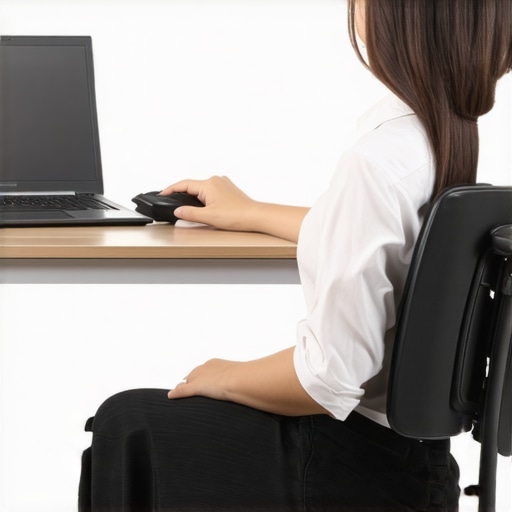
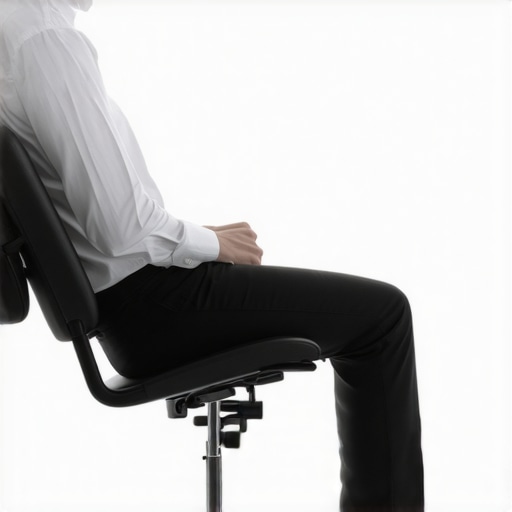
Most of us sit on our tailbones like we’re trying to hatch an egg. This rounds the lower back and puts your discs in a vice grip. Think of your pelvis like a bucket of water; if you tip it too far forward or backward, the water spills. I used to be a chronic slumper, letting the water spill out the back. Then I discovered the pelvic tilt trick for instant lumbar relief. By simply rolling my hips forward so I am sitting on my sit bones—those two hard knobs in your glutes—the natural curve of my spine returned. It felt weird at first, like I was sticking my butt out too much, but the relief was immediate. If you find why your lower back aches after standing for 10 minutes or sitting for an hour, your bucket is likely tilted the wrong way.
Stop Letting Your Eyes Strain Your Spine
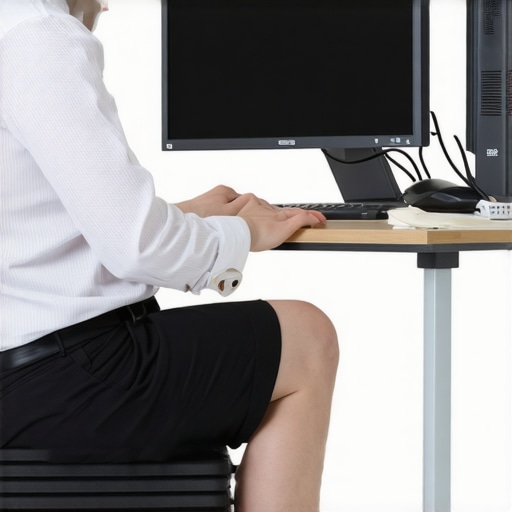
Your head follows your eyes, and your neck follows your head. If your screen is too low, you aren’t just looking down; you are dragging your entire cervical spine into a C curve. I remember trying to work from a laptop at a coffee shop for a week. By Thursday, I had a headache that felt like a hot poker behind my eyes. I realized how your vision impacts your neck position is the most underrated part of ergonomics. I had to learn how to adjust your monitor to avoid eye and neck strain by propping that laptop up on a stack of books. If your eyes are searching for pixels at the bottom of the desk, your chin will naturally tuck, leading to that tech neck we all dread. #IMAGE_PLACE_HOLDER_B#
Breathe Deep to Brace Your Back
Here is the part most posture experts miss: your breath is your internal weightlifting belt. When you take shallow chest breaths, your shoulders shrug up toward your ears, creating massive tension. I used to be a chest breather whenever I was stressed about deadlines. My mid-back would burn like it was on fire. Learning how to breathe properly to reduce tension in your shoulders was a game-changer. By breathing into the belly, you create intra-abdominal pressure that supports the spine from the inside out. It’s like inflating a balloon inside a cardboard box; it makes the whole structure more rigid and stable without needing to clench your muscles.
Ditch the Standing Desk Trap
I fell for the hype. I bought a motorized desk and stood for six hours straight. The result? My back pain didn’t go away; it just moved to my hips. I had to investigate why standing desks cause hip pain to realize that standing still is just as bad as sitting still. The real meat of the solution is variety. Switch between the pelvic-tilted sit, a brief stand, and maybe even a sprawl. Your best posture is your next posture. It’s about creating a dynamic environment where your spine isn’t forced into a single, rigid mold all day long.
I used to think that the solution to my back pain was a simple matter of flexibility. If I could just touch my toes, I thought, the tension would vanish. But here is the contrarian truth that most generic health blogs won’t tell you: sometimes, your tight muscles are actually a good thing. I’ve seen countless people—myself included—obsessively stretching their legs, yet why stretching your hamstrings won’t fix your lower back pain is usually because that tightness is a protective ‘brake’ applied by your nervous system. If your spine lacks stability, your brain locks your hamstrings to keep you from falling apart. When you force a stretch on a muscle that is trying to protect you, you aren’t fixing the problem; you’re disabling your body’s only defense mechanism. Have you ever fallen into this trap of stretching a muscle that was already screaming for stability? Let me know in the comments.
Stop Stretching Your Screaming Hamstrings
The nuance that most people miss is that pain is often a secondary signal. We treat the location of the pain rather than the source of the dysfunction. For example, you might be tempted to reach for a foam roller every time your lower back throbs, but you might find back pain recovery is actually found in stabilizing the hips rather than loosening the spine. The “oops” factor here is huge: if you over-mobilize an area that is already hyper-mobile or unstable, you are fast-tracking yourself toward a disc injury. You need to stop viewing your body as a collection of isolated parts and start seeing it as a kinetic chain. According to a landmark study in the Annals of Internal Medicine, spinal manipulation often outperforms standard exercise because it addresses the neurological communication between these segments, not just the tissue itself.
Can Adjusting Your Neck Fix Numbness in Your Hands?
This is a question I get from the more advanced ‘biohackers’ in my circle. It sounds counterintuitive, but the nerves that control your fingers originate in your cervical spine. This is exactly why we adjust your neck to fix your numb hands in a chiropractic setting. If you’re focusing on carpal tunnel exercises while the literal ‘circuit breaker’ in your neck is tripped, you’ll never see permanent results. It’s the same reason why the 30-second fix for a pinched nerve in the neck can suddenly make your grip feel stronger. We have to look at the upstream cause, which is often a subtle misalignment that doesn’t even hurt at the site of the problem.
#IMAGE_PLACE_HOLDER_C#
The Hidden Trap of Self-Cracking
We’ve all done it. You feel a little stiff, you twist your head, and—pop—instant relief. Or is it? This is one of the most dangerous habits you can develop. I call it the ‘hypermobility trap.’ When you crack your own neck, you are almost always hitting the joints that are already moving too much, not the ones that are stuck. This creates a temporary hit of endorphins, but it leaves the actual problem joint locked in place. Over time, you’re just stretching out your ligaments, leading to chronic instability. This is why you should never crack your own neck in the morning or any other time. Real chiropractic secrets to boost neck comfort involve specific, high-velocity, low-amplitude thrusts to the stuck segments, which actually restores function rather than just making noise.
Why Your Six-Pack Isn’t Saving Your Spine
Finally, let’s talk about the ‘core’ myth. People tell you to ‘strengthen your core’ to stop back pain, so you do a thousand crunches. But why your core strength isn’t stopping your back from hurting is often because you are training the superficial ‘mirror muscles’ instead of the deep intrinsic stabilizers like the multifidus. A strong six-pack on an unstable spine is like putting a Ferrari engine in a car with no lug nuts on the wheels. You might look powerful, but you are a disaster waiting to happen at high speeds. True stability comes from the deep layers, and it requires subtle, precision-based movements rather than brute-force gym sessions.
I’ve spent years refining my personal ‘survival kit’ for long-haul flights and marathon coding sessions. If you’re struggling with understanding back pain as a long-term management project rather than a quick fix, you need the right gear. Forget the $2,000 chairs for a moment; I want to talk about the $15 tools that actually move the needle. I never leave home without a high-density massage ball. While some people love the ‘thump’ of technology, knowing how to use a massage gun on your lower back safely is a skill, but a simple ball allows for sustained trigger point release that a machine just can’t replicate. I use it for my glutes and traps to prevent the tension that leads to relieving neck and back discomfort before it even starts.
The Three Tools I Actually Pack in My Suitcase
One of my non-negotiables is a portable laptop riser. If you’ve read my guide on how to adjust your monitor to avoid eye and neck strain, you know that height is everything. I also carry a small inflatable lumbar roll. It’s not about ‘fixing’ my back, but about giving my spine a different input when I’m forced to sit in a flat airplane seat. If you’ve ever wondered the simple way to sit on a stool without pain, it’s all about creating that lumbar support yourself. These tools are part of what I call mobility mastery. I also rely heavily on the ‘Big Three’ exercises popularized by Dr. Stuart McGill. Specifically, the Bird-Dog is phenomenal, provided you aren’t making the bird dog mistake that puts stress on your spine by over-arching your lower back. Dr. McGill’s research at the University of Waterloo emphasizes that ‘stiffening’ the core through these specific patterns is what actually protects the discs from micro-movements that cause pain. 
How do I maintain my spinal health over time?
The biggest hurdle isn’t the difficulty of the exercises; it’s the consistency. You don’t brush your teeth once and expect to never have a cavity; your spine is the same. I suggest integrating the morning spinal hygiene routine every desk worker needs into your existing coffee habit. If you do it while the pot is brewing, it becomes an automated part of your life. This is how you scale from ‘rehab’ to ‘performance.’ You have to stop treating your body like it’s a problem to be solved and start treating it like a garden to be tended.
Why Sensors Will Soon Replace Your Ergonomic Consultant
Looking ahead, I predict a massive shift toward biofeedback. We are already seeing wearable sensors that vibrate when your pelvis tilts into a ‘slump’ position. In the next five years, AI-driven cameras will likely be built into our monitors to suggest essential chiropractic tips for 2025 in real-time based on our specific movement patterns. We are moving away from ‘one size fits all’ advice and toward hyper-personalized, data-backed spinal care. My challenge for you: Start tomorrow with just five minutes of that morning routine. Don’t wait for the electric zing to return before you start caring for the only spine you’ve got.
What No One Tells You About Living Pain Free
After years of trial and error, I’ve realized that the real breakthrough comes when you stop trying to ‘fix’ a problem and start respecting the system. Here are a few lightbulb moments that changed everything for me:
- The ‘Why’ Matters More Than the ‘What’: If your hamstrings are tight, do not just stretch them; find out if your brain is using them as a protective brake for an unstable spine.
- Neurological Priority: Your discomfort isn’t just about soft tissue; it’s about the communication between your brain and your joints. This is why back pain recovery often starts with clearing those neurological blockages rather than just rubbing a sore muscle.
- The Power of the Micro-Habit: Five minutes of daily care is worth more than a two-hour gym session once a week. It is about the consistent signals you send to your nervous system.
The Only Gear That Earned a Permanent Spot in My Bag
I’ve tested hundreds of gadgets, but these are the ones I actually use. First, a simple high-density massage ball is better than any expensive machine for targeted release. Second, the ‘Big Three’ exercises from Dr. Stuart McGill are the gold standard for anyone looking to revitalize your mobility and create a bulletproof core. Finally, never underestimate a portable laptop riser to fix your line of sight. These tools are the foundation of mobility mastery and allow me to work from anywhere without fear of a flare-up.
[image]
Build a Body That Supports Your Life
You do not need to be a professional athlete to have a healthy, functional spine. You just need to be a little bit more mindful than you were yesterday. Whether it is adopting a morning spinal hygiene routine or just learning to breathe into your belly, every small action adds up. Don’t let your desk define your health; you have the power to change how you feel, one micro-adjustment at a time. Your journey to ending back pain and regaining your freedom is a marathon, not a sprint. Take that first step tomorrow morning.
Have you ever tried a gadget that promised the world but did absolutely nothing for your posture? Let me know in the comments below!