The Dead Bug Variation That Actually Protects Your Back
I remember the exact moment my living room floor became my prison. I was halfway through a set of leg lowers—convinced that ‘feeling the burn’ meant I was finally curing my chronic stiffness—when a sharp, electric jolt shot through my lumbar spine. I didn’t move for twenty minutes. It was the ultimate irony: I was trying to protect my back, but I was actually tearing it apart. Most of us have been there, desperately trying to boost our back health only to end up more fragile than when we started. Today, I’m going to show you the one specific tweak to the dead bug exercise that changed everything for me. It’s not about how far you move; it’s about what you don’t move.
Stop treating your spine like a hinge during core work
The biggest lie I ever believed was that ‘core strength’ meant having visible abs. In reality, your core’s primary job isn’t to move your trunk—it’s to prevent it from moving while your limbs do the work. According to experts at the Mayo Clinic, core exercises are most effective when they teach the muscles to work together to provide stable support for the spine. When I first started doing the dead bug, I made a massive mistake: I let my ribs flare and my lower back arch off the floor every time I extended my leg. I was basically using my spine as a see-saw. If you’ve ever wondered why your core strength isn’t stopping your back from hurting, this lack of stability is almost certainly the culprit.
Is this variation actually worth the extra focus?
You might be thinking, ‘It’s just a dead bug, how different can it be?’ Trust me, it’s the difference between a resilient spine and a recurring appointment for an ice pack. This isn’t just another ‘hack.’ This is about re-learning how to breathe and brace. Have you ever felt that nagging ‘click’ in your hip or a dull ache in your low back right after a workout? If so, you’re likely missing the ‘deep’ stability that this specific dead bug variation provides. We’re moving away from mindless reps and toward intentional protection. Let’s look at why your back keeps flaring up even when you think you’re doing everything right.
Seal the Gap Between Your Spine and the Floor
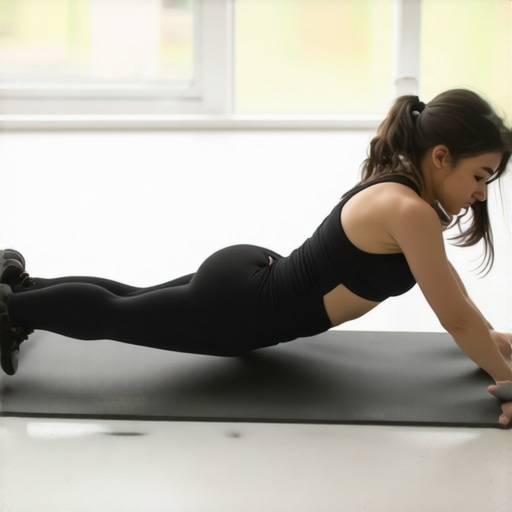
The first step isn’t even about moving your legs. It is about the ‘crush.’ Imagine there is a grape sitting directly under your lower back. Your only goal for the next five minutes is to turn that grape into juice and never let the pressure off. This is where most people fail immediately. They lie down, reach their arms up, and a tunnel forms under their lumbar spine. If you can slide a hand under your back, you aren’t protecting your discs; you are dangling them over a cliff. Use the pelvic tilt trick for instant lumbar relief to find that neutral starting position where your spine meets the floor in a solid, unyielding line. In my early days of rehab, I’d use a folded-up towel under my back to give me something physical to push against—the biofeedback is crucial because your brain will try to convince you that you’re flat when you’re actually arching.
Force the Air Out to Lock Your Spine in Place
Once you have the ‘crush’ down, you have to master the exhale. When you breathe into your chest, your ribs lift. When your ribs lift, your back arches. It is an anatomical chain reaction that kills core stability. I call this the ‘Canister Breath.’ You want to fill your entire midsection with air—front, sides, and back—and then exhale forcefully through pursed lips as if you are blowing through a straw. This engages the deep transversus abdominis. If you struggle with this, learning how to breathe properly to reduce tension in your shoulders can actually translate directly to better core bracing.
Move the Limbs but Keep the Torso Frozen
Now comes the movement. As you slowly lower one arm and the opposite leg, your body will try to cheat. It will want to flare the ribs to make the reach feel longer. Don’t let it. If your ribs start to pop up, you have gone too far. This is why why your ribs flare when you reach overhead is such a common indicator of poor spinal control. Stop the movement the millisecond you feel that ‘grape’ pressure lighten. For me, when I first started this, my leg only moved about six inches before my back wanted to lift. I felt like a failure because I wasn’t touching the floor. But by staying in that tiny range, I was actually forcing my muscles to work together for the first time. I remember a Tuesday afternoon at my local gym. I was determined to prove my fitness by doing the most advanced version of this with a heavy medicine ball. Halfway through, my back started to arch, and my ribs were sticking out like a bird’s chest. A trainer I respected walked by and simply said, ‘You’re just stretching your back, not strengthening your core.’ I was mortified. I put the ball down, went back to the floor, and focused solely on the breath and the pelvic tilt. It felt 100 times harder. My abs were vibrating, and my lower back felt quiet. No zingers, no dull aches. It was a messy, humbling realization that restore your back mobility proven chiropractic strategies often start with the smallest, most disciplined movements rather than the loudest ones. Focus on the quality of the hold rather than the quantity of the reps. If you do three perfect reps where your spine never leaves the floor, you’ve done more for your health than someone doing fifty sloppy ones. This kind of intentionality is what separates boost mobility ease pain chiropractic techniques unveiled from standard gym floor fluff. Your spine isn’t a toy; it is the mast of your ship. Keep it steady, or the whole boat sinks.I’ve spent years watching people try to stretch their way out of pain, only to find themselves back in my office three weeks later. Here’s the hard truth: for many of us, more flexibility is the last thing our spines need. We’ve been conditioned to think that ‘tight’ muscles are the enemy, but in the context of the lower back, that tightness is often your body’s desperate attempt to create the stability you aren’t providing through movement control. This is a core tenet of Dr. Stuart McGill’s research, which suggests that excessive spinal flexibility is often a greater risk factor for injury than stiffness. If you’ve been aggressively pulling on your legs every morning, you might want to consider why stretching your hamstrings won’t fix your lower back pain and focus on building ‘stiffness’ instead.
Stop chasing the stretch and start building stiffness
I see it all the time with yogis—people who can touch their toes to their forehead but still suffer from a nagging, deep ache. This happens because the ligaments and joints are taking the load that the muscles should be handling. If you find yourself in this boat, understanding why your yoga flow might be stressing your sacroiliac joint might be a wake-up call. We need to shift the focus from ‘lengthening’ to ‘securing.’ This is where the advanced dead bug comes back into play—it’s an isometric battle against your own limbs.
Does your pelvic floor stay active during the extension?
This is the level-two nuance that most ‘fit’ people miss entirely. Your core isn’t just the ‘six-pack’ muscles; it’s a pressurized canister that includes your diaphragm at the top and your pelvic floor at the bottom. If your pelvic floor is checked out, your lumbar spine is essentially a house without a foundation. Learning why your pelvic floor matters for spinal stability is the secret to making that ‘crush’ we talked about earlier permanent. Research published in the Journal of Biomechanics supports this, showing that spinal stability is a result of neuromuscular coordination rather than just raw muscle strength. If you can’t feel this internal connection, you might struggle to how to balance on one leg to check your spine effectively because your center of gravity isn’t anchored.
The bracing trap that actually compresses your discs
Here is the ‘oops’ factor I fell for: I used to brace so hard that I would turn red in the face and hold my breath. While this creates a lot of pressure, doing it incorrectly can actually increase the compressive load on your discs to a dangerous degree. You want enough tension to protect the spine, but not so much that you’re grinding your vertebrae together. This is a common mistake people make when they try to follow mobility mastery expert tips for back pain prevention and recovery. You also need to watch your neck. If you’re straining your jaw while trying to stabilize your back, you’re just moving the problem upstream. In fact, knowing how to strengthen your deep neck flexors can help keep your entire spinal column in alignment during these floor exercises. Have you ever fallen into the trap of thinking more stretching was the answer, only to feel worse? Let me know in the comments below.Maintaining this shift from ‘flexibility’ to ‘stability’ isn’t about being perfect for an hour at the gym; it’s about what you do the other 23 hours. I call it ‘Spinal Hygiene.’ You wouldn’t skip brushing your teeth for a week and then try to fix it with one six-hour brushing session, right? Your back is the same. This is why the morning spinal hygiene routine every desk worker needs is non-negotiable for me. I use a very specific McKenzie Lumbar Roll—not the cheap soft ones that flatten out, but the firm D-section roll—because it actually maintains the lordosis while I’m stuck in Zoom calls. If you’re still struggling with your setup, why your laptop stand is still causing neck strain might reveal that you’re focusing on the wrong height for your eye line rather than your spine.
The gear that actually earned a spot in my house
I’ve wasted hundreds on gadgets, but only a few stay in my rotation. I use a firm lacrosse ball for pinpoint trigger work on my glutes, but I’m incredibly careful with the ‘power’ tools that have become popular recently. For example, knowing how to use a massage gun on your lower back safely is the difference between muscular relief and a massive inflammatory flare-up. Don’t just pummel the bone; stay on the soft tissue. The Journal of Orthopaedic & Sports Physical Therapy (JOSPT) emphasizes that while these passive tools provide temporary relief, they must be paired with active stabilization exercises to create a neuro-muscular change that sticks.
How do I maintain this stability without living on the floor?
The secret to long-term results is integration. Once you master the dead bug, you have to take that ‘locked-in’ feeling into the real world. I practice the pelvic tilt secret for effortless posture while walking every time I take the dog out or walk to the car. It turns a daily chore into a mini-rehab session. I predict that in the next five years, we’re going to see a massive shift toward wearable biofeedback—think tiny sensors in your shirt that vibrate when your ribs flare or your shoulders slump. We’re moving away from ‘fixing’ pain after it happens and toward ‘engineering’ resilience before the first spark of discomfort. If you want to scale your results, stop looking for the next big exercise and start mastering revitalize your mobility proven strategies for back pain relief by applying that ‘crush’ technique to your squats and even your overhead reaching. My challenge to you is simple: tomorrow morning, don’t reach for your phone first. Reach for the floor, do three perfect, slow-motion dead bugs, and set your spine for the day. You will feel a profound difference in your fatigue levels by lunchtime.
The Hardest Lesson My Lumbar Spine Ever Taught Me
Looking back, I wasted years thinking that a ‘stiff’ back was a broken back. I was obsessed with flexibility, but I was actually just making my spine more unstable. Here are the lightbulb moments that finally stopped my cycle of pain: First, less is frequently more. If a movement feels ‘too easy,’ you are probably doing it right. The goal of spinal stability isn’t to sweat; it’s to stay perfectly still against resistance. Second, trust the ‘quiet’ days. Some days your back will feel boring—no pain, no tightness, just there. That is the ultimate goal. Don’t go looking for trouble by over-testing your limits. Finally, stability is a skill, not just strength. You don’t need ‘stronger’ abs; you need a brain that knows how to fire those muscles before you lift a laundry basket. If you’re ever in doubt about whether your discomfort is just a ‘workout burn’ or something more, it’s vital to learn how to tell if your back pain is serious before pushing through it.
The Small Investments That Transformed My Spine
I don’t believe in buying every gadget on the market, but these three items earned a permanent spot in my home because they actually support the mechanics we’ve discussed. #IMAGE_PLACEHOLDER_E# I swear by the D-Section Lumbar Roll. Unlike soft pillows, this keeps your natural curve intact during long drives or work calls. It’s the simplest way to boost your back health without even thinking about it. I also keep a Standard Lacrosse Ball nearby. I use this specifically for ‘glute smashing.’ When your glutes are stuck, your lower back has to move more to compensate, which is exactly why your glute medius is more important than your abs for back health. Lastly, I always recommend Dr. Stuart McGill’s Research. His books are the gold standard for understanding how to build a back that lasts rather than a back that just bends.
Your Journey Toward a Resilient Future
Healing isn’t linear. You’ll have days where you feel invincible and days where the old twinges return. The difference now is that you have the tools to handle it. You aren’t fragile; you’re just learning to coordinate a complex system. When you focus on stability first, you’ll naturally restore your range in a way that feels safe and permanent. Your spine is designed to support you—now it’s your turn to support your spine. Have you ever felt like your core exercises were actually making your back feel worse instead of better? Let me know your experience in the comments below!