How your laptop height is ruining your middle back mobility
I remember sitting in that velvet armchair at my favorite local coffee shop, three hours deep into a project, when I tried to look up and realized my spine had essentially turned into a solid block of concrete. A sharp, hot sensation was radiating between my shoulder blades, and no amount of self-cracking seemed to help. I looked around and saw everyone else in the exact same position—noses inches from their screens, shoulders hiked up to their ears, and spines curved like a question mark. It was my lightbulb moment: my laptop wasn’t just a tool; it was a cage for my thoracic mobility. Today, I want to show you exactly how that tiny screen on your desk is robbing you of your ability to move and what we can do to reclaim that freedom before the damage becomes permanent.
The Day I Realized My Portable Office Was a Spine Trap
For years, I prided myself on being able to work from anywhere. My kitchen table, the couch, the airport lounge—it didn’t matter. But I made a massive mistake early on: I thought ergonomics was just a buzzword for people who liked spending money on fancy chairs. I ignored the fact that setting up your laptop at a coffee shop pain-free requires more than just a flat surface. My middle back, or thoracic spine, was paying the price. When you look down at a screen, your head—which weighs about as much as a bowling ball—pulls your upper back into a forced arch. Over time, the muscles between your ribs and vertebrae actually tighten up, and your joints lose their slide. This isn’t just about bad posture; it’s about losing the physiological ability to rotate and extend. Have you ever felt that weird, stiff sensation where you can’t quite take a full, deep breath because your chest feels locked?
Is a Laptop Stand Really Worth the Extra Clutter?
You might be thinking that carrying around extra gear is a hassle, or that your back is fine for now. I used to say the same thing until I learned that according to research published in the Journal of Physical Therapy Science, prolonged forward head posture significantly decreases vital lung capacity and thoracic mobility. It is not just a vanity issue. If you do not address the specific chair height and screen level that stops that mid-back burning, you are essentially training your body to be hunched forever.
How Your Screen Level Decides Your Movement Quality
The real culprit is the relationship between your eyes and your hands. Because the keyboard and screen are attached on a laptop, you cannot have one at the right height without the other being wrong. If the keyboard is comfortable for typing, the screen is too low, forcing your mid-back to round out like a turtle shell. This is exactly why your shoulder blades feel like they are burning after typing for even thirty minutes. I spent years trying to strengthen my core to fix this, but no amount of planks can overcome the physics of a head leaning forward for eight hours a day. I even tried doing the scapular squeeze for tension relief, which helped temporarily, but the pain always came back because the root cause—the laptop height—stayed the same. Have you ever noticed that your back feels locked even after you have finished work for the day? That is the sign that your mobility is already being compromised.I once spent a week working from a rented cabin with no desk, just a low coffee table and a plush sofa. By day three, my neck felt like it was being squeezed in a vise. I ended up stacking four heavy hardcover cookbooks under my laptop just to get the top of the screen level with my eyebrows. It looked ridiculous, but that makeshift tower was the difference between finishing my project and needing a week of bed rest. If you want to survive the digital age, you have to stop treating your laptop like a single unit. Think of it like a set of Legos; the screen and the keyboard belong in different zip codes.
Stop Looking Down at Your Lap
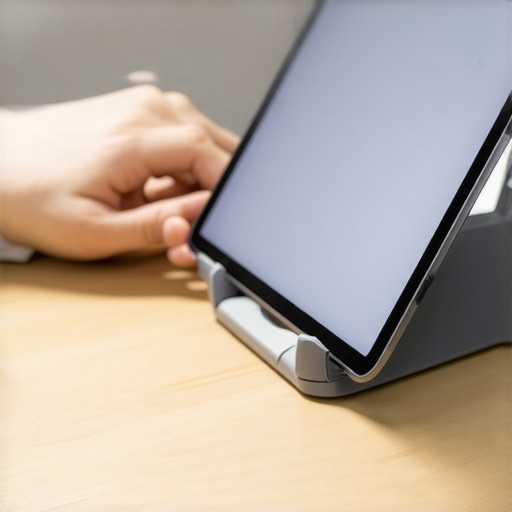
The first rule of spinal survival is that your eyes should always be parallel to the top third of your screen. When you look down, you aren’t just moving your eyes; you’re shifting the entire weight of your skull onto the tiny vertebrae at the base of your neck. To fix this, you need a portable stand. If you’re at a cafe and don’t have one, find something to stack. Once the screen is up, your hands must stay down. Using an external keyboard and mouse allows your shoulders to drop back into their natural pockets. This simple separation is how to sit at your desk with zero back fatigue and stop the cycle of slouching.
The 20-Minute Reset Button
Your body isn’t designed to be a statue. Every twenty minutes, you need to perform what I call a system reboot. This isn’t a long yoga session; it’s a quick tactical movement to tell your nervous system that you aren’t actually a gargoyle. Use the Bruegger’s relief move to reverse hours of hunched sitting by sitting at the edge of your chair, spreading your knees, and rotating your palms outward while pulling your shoulder blades together. It’s like stretching a tight rubber band back to its original shape. 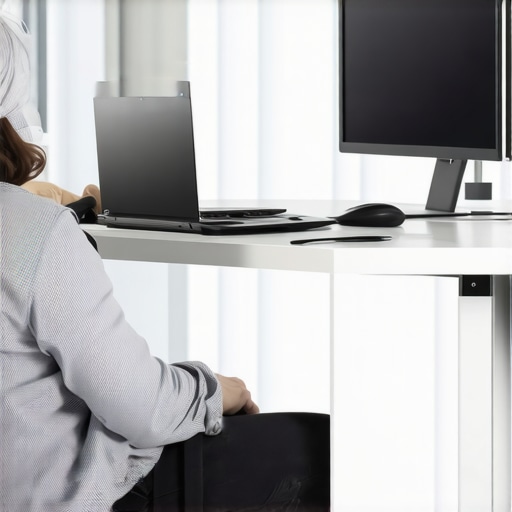
Force Your Ribs to Move Again
The thoracic spine is essentially the anchor for your rib cage. When you hunch, those ribs get stuck in a downward position, making deep breathing nearly impossible. To break this cycle, you need to introduce rotation. I found that the side-lying stretch that opens up a tight rib cage is the most efficient way to unlock that stuck feeling in your mid-back. You’re essentially wringing out your spine like a wet towel, forcing the joints to rediscover their range of motion.
Fight the Forward Head Slide
While you type, your chin gradually drifts toward the screen like it’s being pulled by a magnet. This tech neck creates a massive amount of leverage against your upper back muscles. You can neutralize this by performing the chin tuck drill to combat tech neck instantly. Imagine a string is pulling the crown of your head toward the ceiling while you pull your chin straight back—not down. It feels silly, and you’ll definitely have a double chin for a second, but it’s the only way to re-center that weight over your shoulders.
Open Up the Front to Save the Back
Most back pain isn’t actually a back problem; it’s a front problem. Because we spend all day reaching forward, our pectoral muscles become short and tight, acting like guy-wires that pull our shoulders into a permanent slump. You have to counteract this tension daily. Integrating the 30-second pec stretch to fix slumping shoulders against a doorframe will do more for your mid-back pain than any temporary massage. When the front of your chest is open, your back muscles don’t have to work nearly as hard to keep you upright. If you are struggling with deeper stiffness, you might need to restore your back mobility with proven chiropractic strategies to get those vertebrae moving in the right direction again.I used to think that if a muscle felt ‘tight,’ the only logical solution was to stretch it until it surrendered. I fell into this trap for years, especially with the burning sensation between my shoulder blades. But here is the contrarian truth: that ‘tight’ feeling in your upper back usually isn’t because the muscles are short; it is because they are already over-stretched and exhausted from holding up your head. When you reach for a foam roller to ‘crack’ your mid-back, you might actually be destabilizing the area further. We need to stop treating the sensation and start treating the mechanical cause. Real mobility mastery involves understanding that stability and flexibility are two sides of the same coin.
The Core Strength Lie That Keeps You Stiff
We have been told for decades that a ‘weak core’ is the root of all evil. However, I often see patients who have incredible abdominal strength but are still in constant pain. The problem is that they have learned to ‘brace’ their spine like a rigid statue. According to research from the Journal of Electromyography and Kinesiology, over-bracing the trunk can actually increase spinal compression and lead to premature disc wear. This is exactly why your core strength isn’t stopping your back from hurting—you are likely too stiff to move naturally. Your spine needs to be a whip, not a telephone pole. If you are constantly ‘sucking it in,’ you are actually preventing your diaphragm from moving, which locks up your thoracic cage from the inside out.
Stop Stretching Your Overworked Mid-Back Muscles
Here is the ‘oops’ factor most people miss: when you feel that nagging ache in your upper back, your first instinct is to pull your shoulders forward to stretch it out. Stop. Those muscles are already screaming because they are being pulled apart by your forward posture. Stretching them more is like pulling on a fraying rope. Instead, you should be focusing on the hidden link between neck pain and spinal health, which often involves strengthening the deep stabilizers that have gone dormant. #IMAGE_PLACE_HOLDER_C#
Why Does the Pain Return Even After a Good Adjustment?
Many people find that they get instant relief from a chiropractor, but within three days, the old familiar ache starts creeping back. This happens because your nervous system has a ‘movement map’ that is stuck in the past. If you don’t rewire how you move, your brain will pull your vertebrae back into their old, dysfunctional positions. You have to combine structural care with chiropractic secrets to regain full mobility after injury, which involves specific loading exercises. Also, beware of the chin tuck mistake that is making your neck pain worse. If you are jamming your chin down into your throat, you are creating a hinge point in your mid-neck that can lead to headaches and even numbness in the hands.
The Hamstring Fallacy
Another common mistake is thinking that touching your toes will save your back. In reality, why stretching your hamstrings won’t fix your lower back pain is because that tightness is often a neurological ‘brake’ applied by your brain to protect a vulnerable spine. If your back is unstable, your brain tightens your hamstrings to act as secondary stabilizers. If you force them to stretch, you are taking away your body’s last line of defense. Have you ever fallen into this trap of stretching a muscle that just won’t loosen up? Let me know in the comments.Once you stop the immediate bleeding of daily pain, you have to transition into the maintenance phase. I am a bit of a gear nerd because I have realized that willpower alone won’t save your posture at 4 PM on a Friday when a deadline is looming. I personally swear by the Roost Stand—not because it looks cool, but because it is the only portable lift sturdy enough to prevent screen wobble while reaching the exact height needed to save my neck. When you pair that with a compact mechanical keyboard, you are not just working; you are actively practicing mobility mastery by keeping your chest open and your scapulae retracted. I have found that this specific hardware separation is the only way to avoid that heavy, dragging feeling in my upper traps after a long session.
How do I keep my spine healthy over years of desk work?
Consistency is the boring answer, but it is the only one that works. You need to build a morning spinal hygiene routine every desk worker needs to lubricate your joints before you even touch a keyboard. For my evening wind-down, I rely on a simple lacrosse ball; learning how to use a tennis ball to melt away mid-back knots has been my most effective DIY physical therapy. Dr. Stuart McGill, a world-renowned spine biomechanist and author of ‘Back Mechanic,’ emphasizes that ‘spine health is earned in the minutes between the hours.’ This means your recovery shouldn’t just happen at the gym or the chiropractor’s office; it happens every time you choose to stand up or adjust your screen height during your shift. 
Where the Future of Spinal Health is Heading
I predict we are moving toward an era of ‘Passive Ergonomics.’ Within the next few years, I expect AI-driven webcam software to subtly notify us through haptic feedback or screen dimming whenever our head drifts forward by more than an inch. We are already seeing the beginnings of this with wearable sensors that vibrate when you slouch, helping you enhance mobility naturally with chiropractic care principles integrated into your wearable tech. This shift will move us away from ‘fixing’ chronic pain and toward preventing it entirely through real-time biological data.
Take the 48-Hour Ergonomic Challenge
If you really want to see a difference in how your body feels, I challenge you to spend the next 48 hours strictly adhering to the eye-level screen rule. Don’t just read this and nod; go find two thick books or a sturdy box right now and prop that laptop up. You will find that you need to restore your back mobility much less often when you aren’t actively breaking it every morning. If you still feel that deep, internal ‘stuckness’ even after a week of a perfect ergonomic setup, it might be the right time to regain full mobility after injury through a professional structural assessment.
The Hardest Lesson I Learned About Chasing the ‘Perfect’ Stretch
I spent years thinking that more stretching was the only way to restore your back mobility. I was wrong. The biggest lightbulb moment for me was realizing that my mid-back didn’t need more pulling; it needed more support and smarter movement patterns. Here are the hard-won truths I found along the way: First, those ‘tight’ muscles in your upper back are often just exhausted from overwork, not shortened. Instead of aggressive pulling, try the morning spinal hygiene routine every desk worker needs to prime your joints before you even open your emails. Second, a laptop stand is non-negotiable for long-term health. Without it, you are fighting a losing battle against physics. Finally, real mobility mastery happens in the small, micro-adjustments you make every hour, not just in a gym session once a week.
The Three Resources That Actually Change Your Daily Comfort
I don’t recommend tools lightly, but these three have fundamentally shifted how I feel at the end of a long workday. First, a portable stand like the Roost is the gold standard for maintaining eye level. Second, I highly recommend the book ‘Back Mechanic’ by Dr. Stuart McGill; it changed how I viewed back pain relief and spinal stability. Finally, learning how to use a tennis ball to melt away mid-back knots has been my most effective DIY therapy for those days when the pressure feels unbearable. These resources help address the hidden link between neck pain and spinal health by giving you practical, repeatable steps to take control of your environment.
Your Spine Deserves a Better Version of You
It is easy to feel like your body is failing you when the burning sensation starts to set in, but remember that your spine is incredibly resilient if you give it the right environment. You have the power to enhance mobility naturally with chiropractic care principles and simple lifestyle shifts that protect your discs and nerves. Don’t wait for a major crisis to start caring for your posture. The freedom to move without that heavy, dragging feeling between your shoulder blades is within your reach. Start with one small change today—even if it is just propping your screen up with books—and watch how your body responds. Have you ever tried an ergonomic setup and felt immediate relief, or did it take a few days to adjust? Let me know in the comments below!