How to Tell if You Need a New Mattress for Spine Support
I remember the Tuesday morning I had to roll out of bed like a log just to reach the floor. I wasn’t even forty yet, but my lower back felt like it had been through a slow-motion car wreck. I spent fifteen minutes doing a weird sideways shuffle before I could even think about pouring a cup of coffee. It was a wake-up call, literally. For months, I’d been blaming my heavy lifting or my desk chair, but the culprit was right under me every night. Today, I’m going to help you figure out if your bed has transitioned from a sanctuary into your spine’s worst enemy. We are going to look at the subtle red flags that mean your mattress is officially toast, ensuring you stop the cycle of waking up feeling like a human question mark. Have you ever found yourself dreading the moment your feet hit the floor in the morning? [image]
Your Morning Back Pain is a Warning Shot
I made a massive mistake a few years back that I still regret. I fell for the ‘plush’ trap. I bought the softest, most cloud-like mattress I could find because it felt amazing for the five minutes I sat on it in the showroom. Within a month, I realized why your SI joint hates your soft mattress—it simply doesn’t offer the structural integrity your vertebrae need to stay neutral. Your spine needs a firm foundation, not a sagging hammock. When that support vanishes, your muscles have to work overtime all night just to keep your frame held together. According to the Sleep Foundation, while a mattress might technically ‘last’ ten years, the structural support materials often degrade significantly after year seven. If you are currently searching for how to get out of bed without that morning back twinge, you are likely treating a symptom of a much larger furniture problem.
Is a new mattress actually going to fix my spine?
It is perfectly natural to be skeptical of the marketing hype. We’ve all seen the flashy ads promising a ‘miracle sleep’ for three thousand dollars. Let’s be real: a mattress won’t cure a chronic injury on its own, but a bad one will absolutely prevent your body from healing. Think of your mattress as the ‘alignment rack’ for your body. If the rack is crooked, you’re never going to achieve the better posture and mobility you are working so hard for during your waking hours. We are looking for that ‘Goldilocks’ zone where your shoulders and hips can sink in just enough to stay comfortable, but your lumbar spine remains perfectly level. While you are at it, don’t forget that your pillows should be replaced every eighteen months to keep your neck in line too. If you’re currently waking up with a dull ache that mysteriously vanishes by lunch, your bed is almost certainly the culprit.
Stop the Sagging Before Your Spine Resents You
To stop the cycle of morning stiffness, you first have to objectively measure the failure of your current sleep surface. Don’t rely on your ‘feel’ alone because your body can adapt to a bad environment until it breaks. I recommend the string test: pull a piece of twine tightly across the width of your mattress from edge to edge. If you see a gap of more than an inch between the string and the mattress surface where you normally sleep, the internal core has collapsed. This dip creates a mechanical disadvantage for your vertebrae, forcing a constant lateral bend or a rounded lumbar posture all night long. This lack of structural integrity is exactly why your SI joint hates your soft mattress and why you feel like you’ve run a marathon by 6:00 AM.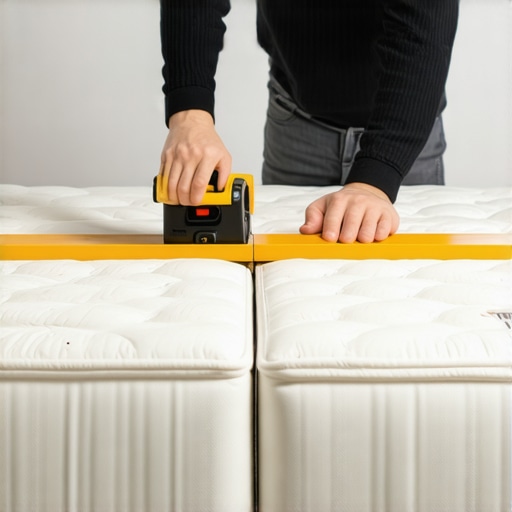
Build a Better Pillow Fort for Alignment
While you are waiting for a new mattress to arrive, you can use tactical pillow placement to act as a secondary support system. If you prefer your side, you must place a firm pillow between your knees and ankles to keep your pelvis from rotating. You can find more specifics in the side sleepers guide to pillow placement. For those who prefer to face the ceiling, sliding a bolster or a rolled-up quilt under your knees is non-negotiable. This move flattens the lumbar spine against the mattress, preventing the ‘arched back’ strain that causes that deep, mid-back throb. Learning how to sleep on your back without waking up stiff is often just a matter of proper limb elevation to take the tension off the psoas muscle.
How I Learned the Hard Way About Firmness
A few years ago, I was so desperate to fix my back that I tried the ‘plywood trick.’ I slid a half-inch thick sheet of MDF board between my box spring and the mattress. The first night was a revelation; the sagging stopped, and for the first time in weeks, I didn’t have a sharp pinch in my L5-S1 joint upon waking. However, by night three, my shoulders and hips were bruised because the surface had no ‘give.’ It was a messy, uncomfortable lesson that taught me the difference between rigidity and support. You need a comfort layer that allows for pressure relief, but the base must be immutable. If your bed is failing, you are effectively fighting a losing battle against gravity for eight hours every night.
Master the Log Roll Exit
How you leave the bed is just as important as how you lie in it. Most people perform a ‘crunch’ move to sit up, which puts massive shearing force on the lumbar discs when they are at their most vulnerable. Instead, use the log roll: keep your shoulders and hips moving as one unit, roll onto your side, and use your arms to push your torso up while your legs swing toward the floor. This is the best way to get out of bed for disc health because it keeps the spine neutral during the transition to a weight-bearing position. Once you are upright, immediately move into the 3-step morning routine for hip mobility to wake up the glutes and lubricate the joints before you sit down for breakfast. Consistently applying these proven strategies for back pain relief will bridge the gap between a bad bed and your next chiropractic visit.One of the biggest mistakes I see—and one I fell for early on—is the obsession with ‘stretching it out.’ When your back feels like a rusted hinge, your first instinct is to pull, twist, and reach for your toes. But here is the nuance most people miss: tightness is often a protective mechanism, not a lack of flexibility. If your spine lacks stability, your brain will literally lock your muscles down to prevent further injury. In these cases, reaching for a deep stretch is like trying to loosen a knot by pulling on both ends of the rope; you aren’t fixing the problem, you’re just stressing the tissue. This is exactly why your foam roller might be hurting your lower back if you’re using it on your lumbar spine instead of your thoracic area or hips. Instead of stretching the site of the pain, we need to look at the ‘anchors’ above and below. I’ve seen countless patients focus on their lumbar region when the real culprit was a pair of dead glutes or stiff ankles. When you start strengthening your glutes to take the pressure off your spine, the lower back tension often evaporates without you ever having to touch it. This concept of the kinetic chain is why we look at your feet to solve your neck issues. A collapsed arch can cause a ripple effect that ends with a migraine.
Could your daily ‘rest’ be the thing keeping you injured?
Many people believe that ‘taking it easy’ is the gold standard for recovery. However, a landmark study published in The Lancet highlighted that for non-specific low back pain, staying active is far superior to bed rest. Movement is a lubricant. When you stay stationary, your discs don’t get the fluid exchange they need to stay healthy. It’s a bit of a paradox: why your back feels better when you keep moving is because you are flushing out inflammatory markers that pool when you’re sedentary.  Here’s an ‘oops’ factor to watch out for: don’t mistake ‘movement’ for ‘intensity.’ I once tried to ‘walk off’ a flare-up by doing a three-mile hike on uneven terrain—big mistake. You want controlled, linear movement like a flat-surface walk or the 30-second reset for tech neck fatigue if the issue is higher up. Have you ever fallen into the trap of resting for three days straight only to find you’re stiffer than when you started? Let me know in the comments. We need to move away from the idea that pain always equals ‘damage’ and start seeing it as ‘data.’ If you can learn to interpret what your body is telling you—whether it’s why your neck clicks when you turn your head or why your hip feels locked—you can finally stop the cycle of temporary fixes. To truly restore your back mobility, you have to look past the mattress and into your daily movement habits. If you’re ready to stop guessing, contact us to get a professional assessment of your unique spinal mechanics.I’ve spent thousands of dollars testing every ‘magic’ device on the market, from vibrating foam rollers to expensive ergonomic stools. Most of it is fluff. However, I never travel without a high-quality massage gun and a standard lacrosse ball. The trick with percussive therapy isn’t just slamming it into your glutes; you need to understand how to use a massage gun on your lower back safely without irritating the nerve roots. I personally use it on my hip flexors to release the front of my pelvis, which does more for my back than hitting the back itself. For that stubborn ache between the shoulder blades, I rely on how to use a tennis ball to fix that spot under your shoulder blade. It’s about precision, not power. When I’m driving, I don’t trust the built-in ‘lumbar support’ in most cars. I’ve found that how to use a rolled-up towel to fix your cars lumbar support provides a much more customizable curve that fits my specific anatomy. Combine that with the posture fix for people who spend hours behind a steering wheel, and you can arrive at your destination without feeling like you need a crane to get out of the seat.
How do I maintain my spinal mobility over time?
Consistency beats intensity every single time. You don’t need a grueling hour-long routine; you need a system of micro-breaks. I’m a huge advocate for the Brueggers relief move to reverse hours of hunched sitting every thirty minutes. This isn’t just a stretch; it’s a neurological reset for your postural muscles. Dr. Stuart McGill, a world-renowned spine biomechanist and author of Back Mechanic, highlights that muscle endurance in the core is a far better predictor of back health than raw strength. By implementing mobility mastery expert tips for back pain prevention and recovery, you are building that endurance. We are aiming for long-term resilience, where you can enhance mobility naturally with chiropractic care as a foundation, then maintain it with these daily habits.
Smart Sensors and the Next Decade of Chiropractic Care
I predict that within the next few years, we will see a shift toward wearable haptic feedback devices. Instead of trying to remember to sit up straight, small sensors integrated into our clothing or worn as discreet patches will provide a gentle vibration the moment our shoulders slump. This real-time feedback loop will revolutionize better posture and mobility by training our brains, not just our muscles. Until that tech becomes mainstream, you have to be your own sensor. Start with a small, manageable habit today: try the 30-second Bruegger’s reset right now—literally, stand up and open your chest before you finish this article—to feel how much tension you’ve already accumulated today.
Lessons from a Decade of Fighting the Morning Hobble
Over the years, I’ve learned that comfort is often a liar. That ultra-plush pillow top feels like a warm hug in the showroom, but by 3:00 AM, it’s a gravity trap that locks your lumbar spine into a flexed, unnatural position. One major lightbulb moment for me was realizing that my mattress wasn’t just ‘old’—it was actively deforming my spine’s natural curve every single night. I also discovered that no amount of morning yoga can fully undo eight hours of structural collapse; you simply have to fix the foundation first. Finally, I learned that small, incremental changes—like placing a firm pillow under your knees—provide more immediate relief than any expensive ‘miracle’ gadget ever could. It’s about working with your unique anatomy, not against it, to enhance mobility naturally with chiropractic care as your baseline.
The Daily Gear That Keeps My Spine Happy
If you want to move beyond the basics, there are a few specific resources I swear by. First, Back Mechanic by Dr. Stuart McGill is the literal bible of spinal hygiene; it taught me how to move without micro-injuring my discs during everyday tasks. Second, I never travel without a standard lacrosse ball to target those deep trigger points in my glutes that often pull on my lower back. Third, regular maintenance through proven chiropractic strategies has been the cornerstone of my long-term recovery. These professional adjustments ensure that even when I make a mistake—like sleeping on a saggy hotel bed—my body has the resilience to bounce back quickly. For those looking for a comprehensive long-term plan, I highly recommend checking out expert tips for back pain prevention and recovery to build a truly bulletproof frame.
You Don’t Have to Settle for a Stiff Spine
Waking up in pain is incredibly common, but I want you to remember that it is never ‘normal.’ Your body is a self-healing organism that is remarkably capable of recovery if you just stop irritating the tissue for eight hours a night. By prioritizing the right support and focusing on better posture and mobility, you can transform your mornings from a physical struggle into a springboard for the rest of your day. You have the tools now—from the string test to the log roll—to take full control of your spinal health. If you’re feeling overwhelmed or simply want a professional eye to assess your unique mechanics, don’t hesitate to contact us for a personalized evaluation. Let’s get you back to moving the way you were meant to. What’s the one change you’ve made to your bedroom or sleep routine that actually made a difference for your back pain? Let me know in the comments below!