The Simple Way to Sit on a Stool Without Pain
I’ll never forget the night my favorite local brewery became a torture chamber. There I was, perched on a sleek wooden barstool, trying to enjoy a pint. Within ten minutes, a familiar, gnawing ache crept into my lower back. I tried the “soldier” pose—chest out, shoulders back—but that only made my muscles tighter. I looked like a nervous bird. Eventually, I just gave up and stood. It was embarrassing and, frankly, exhausting. I spent years thinking my back was the problem, when the real culprit was my complete lack of strategy for backless seating. If you’ve ever felt that sharp pinch or the dull throb that comes with “stool fatigue,” you aren’t alone. Today, I’m going to share the exact posture shifts I used to reclaim my social life without needing a chiropractor on speed dial.
Stop Fighting the Stool and Start Sitting Smarter
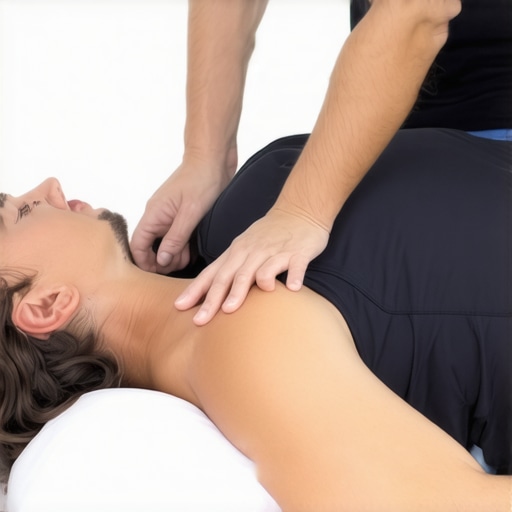
For the longest time, I made the classic mistake of thinking I could muscle my way through a three-hour dinner on a stool. I thought sitting up straight was the golden rule. It’s a myth that has caused more stiff backs than I care to count. In reality, forcing a rigid posture creates unnecessary tension in your paraspinal muscles. [IMAGE_PLACEHOLDER] According to research from Harvard Health, poor sitting habits can lead to increased pressure on your spinal discs, which is why that “slump” feels inevitable after twenty minutes.
Does this actually work if my back is already a mess?
You might be skeptical. I get it. When your spine feels like a stack of Jenga blocks ready to topple, the idea of sitting on a backless perch seems like a recipe for disaster. But the secret isn’t about having a perfect chair; it’s about how you distribute your weight. By strengthening your glutes and learning to hinge properly, you can turn even the most basic wooden stool into a comfortable seat. Have you ever had to leave a party early just because the seating was “too cool” for your comfort? Drop a comment and tell me your story. We’re going to fix those posture and mobility issues once and for all.
Turn Your Hips into a Stable Tripod
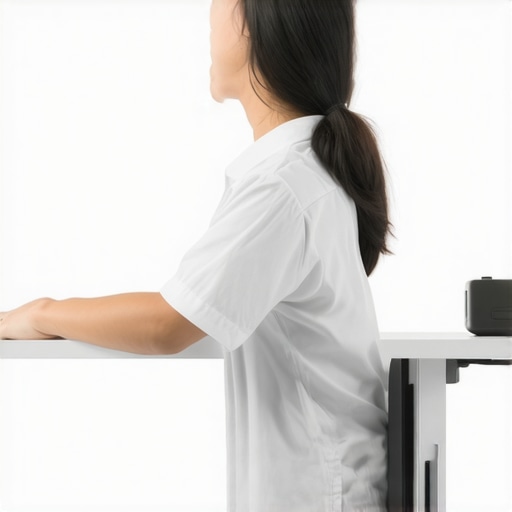
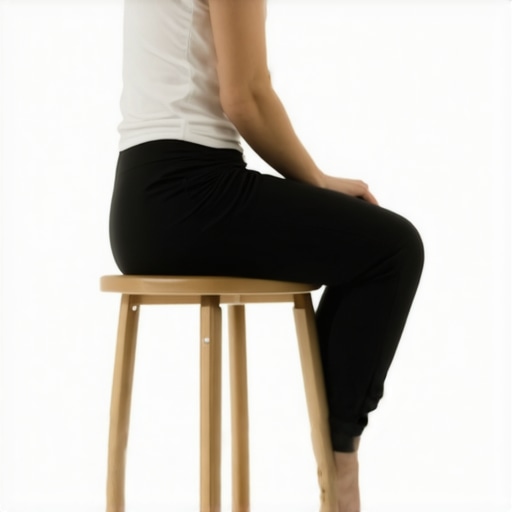
The biggest mistake we make on a stool is treating it like a chair with the back cut off. It’s not. When you sit on a traditional chair, you’re often leaning and relying on external support. On a stool, you’re perching, which requires internal stability. Imagine your pelvis is a bowl of water. If you tip it too far forward, your back arches aggressively and your hip flexors scream. If you tip it back, you slump into a “C” shape that crushes your discs. You want the bowl level. This foundational alignment is exactly why we look at your pelvis when your neck hurts; if the base is tilted, the whole tower of your spine suffers. #IMAGE_PLACE_HOLDER_B#
Stop Trying to Be a Soldier
Most people respond to back pain by snapping into a rigid, military-straight posture. Please, stop doing this. I used to do it at every networking event, thinking I looked professional and healthy, but the truth about why your perfect posture is actually making you stiff is that you are locking your joints and starving your muscles of oxygen. Instead of “sitting up straight,” think about “growing tall” through the crown of your head as if a string is gently pulling you upward. This subtle shift allows your spine to maintain its natural curves without the intense muscular bracing that leads to painful spasms. Last summer, I was stuck on a backless metal bench for a long wedding ceremony. Instead of bracing like a statue, I focused on relaxing my shoulders and letting my sit-bones take the weight. By the time the vows were over, I felt loose and ready for the dance floor, while the guy next to me was practically groaning in pain.
Use Your Feet as Stabilizers
You cannot have a stable back if your feet are dangling or tucked under the rungs like a pretzel. Your feet act as the outriggers on a canoe; if they aren’t engaged, your lower back has to do all the heavy lifting to keep you upright. I’ve found that the secret to better balance starts with your big toe and keeping your feet flat on a solid surface. If the stool is too high, find a rung that allows your knees to be slightly lower than your hips. This open hip angle prevents the dreaded “pincer” effect on your lower vertebrae and keeps the pressure off your lumbar region.
Wiggle to Keep the Discs Happy
Static is the ultimate enemy of spinal health. Even the best posture will eventually hurt if you don’t move for an hour. I’ve learned to perform “micro-resets” every ten minutes. A tiny pelvic tilt here, a gentle ribcage rotation there—it keeps the blood flowing to your spinal tissues. You’ll find that why your back feels better when you keep moving is because motion is the only way your intervertebral discs receive the nutrients they need to stay hydrated. If you feel a constant “pull” in your lower back while sitting, check the front of your body; often, why tight hip flexors are the real cause of your lower back arch is due to your front muscles being locked in a shortened position for too long.Everyone tells you to “engage your core” to protect your back. But in the clinic, I see people who have “over-braced” their spine into a state of permanent tension. This is why your strong core might actually be too rigid. Instead of acting like a shock absorber, your spine becomes a solid, brittle rod. Research published in the Journal of Biomechanics suggests that excessive trunk stiffness can actually increase the load on individual spinal segments rather than distributing it. It’s the difference between a suspension bridge and a stone pillar; one flexes with the wind, the other cracks.
Your “Strong Core” Might Be Your Worst Enemy
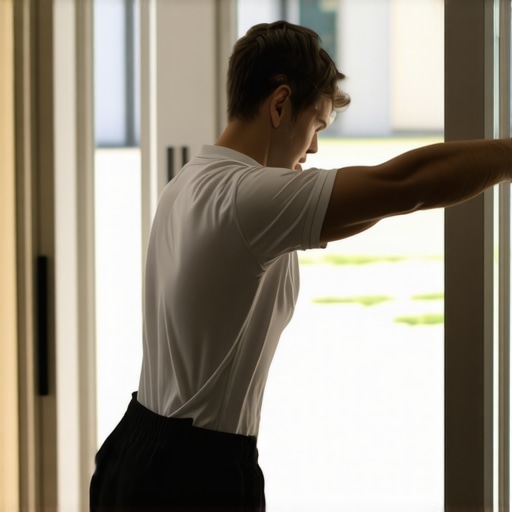
We have been conditioned to believe that a rock-hard midsection is the ultimate shield against injury. But the “hidden nuance” here is that true stability is dynamic. If you’re walking around with your abs sucked in 24/7, you’re actually inhibiting your diaphragm and increasing intra-abdominal pressure in a way that stresses the pelvic floor and the lumbar discs. #IMAGE_PLACE_HOLDER_C# This is where mobility mastery comes into play. It’s not about how hard you can squeeze; it’s about how well you can move under control. Have you ever fallen into the “perma-brace” trap? Let me know in the comments.
Stop Yanking on Your Hamstrings
Let’s talk about the hamstring trap. When your back hurts, the first thing most people do is reach for their toes. They think tight hamstrings are pulling on their pelvis. But often, that “tightness” is actually protective tension or even neural tension. If you keep yanking on a nerve that is already irritated, you’re just pouring gasoline on the fire. This is exactly why stretching your hamstrings won’t fix your back pain if the root cause is structural. I’ve seen patients stretch for years with zero progress because they were actually aggravating a disc issue rather than lengthening a muscle.
Why does my mid-back feel like it needs to pop every hour?
This is a classic “nuance” issue. Many people think they have a “back problem” when they actually have a “ribcage problem.” If your thoracic spine doesn’t rotate, your lower back has to pick up the slack. We often find that why we look at your ribcage movement for better mobility is the key to long-term relief. If you’re constantly “self-cracking” your mid-back, you’re likely just manipulating a hypermobile joint while the actual stuck segment remains frozen nearby. Instead of chasing the “pop,” focus on the lateral move that opens up a tight rib cage. This is how you achieve lasting comfort rather than a thirty-second dopamine hit from a joint click. Another common “oops” is foam rolling the lumbar spine. While it feels good on the quads, why your foam roller might be hurting your lower back is that it pushes the vertebrae into extension, which is exactly what most sensitive lower backs don’t need. Focus on the muscles, not the bone.
Keep a Tennis Ball in Your Laptop Bag
I stopped lugging around a three-foot foam roller years ago because it was too bulky and often too aggressive for my lower back. Now, I swear by a simple tennis ball or a slightly firmer lacrosse ball. These tools allow for the precision that a roller lacks. I personally use it to target the ‘knots’ that form right under my shoulder blade after a long day of sitting. If you have been struggling with that specific mid-back pinch, learning how to use a tennis ball to fix that spot under your shoulder blade is a game-changer. It’s about applying pressure to the soft tissue without crushing the vertebrae themselves. This targeted approach helps revitalize your mobility by addressing the exact point of tension rather than just rolling over the surface of the problem.
The Low-Tech Hack for Better Lumbar Support
You don’t need a thousand-dollar chair to save your spine. In fact, some of the most expensive office chairs still fail if you don’t know how to position your body. I always carry a small, high-density foam roll or even a rolled-up gym towel when I travel. Knowing the correct way to use a lumbar roll in your office chair can transform your workday. The goal isn’t to push your back forward, but to fill the natural gap in your lower curve, allowing your muscles to finally ‘turn off.’ When I’m dealing with acute tension, I also make sure I’m using the correct way to use a heating pad for muscle-spasms—using heat to increase blood flow for 15-20 minutes, rather than just leaving it on for hours, which can actually increase inflammation. Expert researchers like Dr. Stuart McGill have long emphasized that spinal stability is about creating a ‘girdle of stiffness’ through core bracing rather than relying solely on external props, which is why these tools should be used as aids, not crutches.
How do I maintain my progress without spending hours at the gym?
Maintenance is the part where most people fail because they think it requires a dedicated hour of exercise. It doesn’t. It requires micro-moments of mindfulness. I use what I call ‘the 30-second rule.’ Every time I get up from my desk or a barstool, I perform the 30-second reset for tech neck fatigue. This prevents the cumulative strain from turning into a permanent structural shift. I predict that in the very near future, we will move away from bulky ergonomic furniture and toward wearable haptic sensors integrated into our clothing that gently vibrate to remind us of our pelvic alignment. Until then, you have to be your own sensor. If you want to stay ahead of the curve, I highly recommend checking out these essential chiropractic tips for 2025 to keep your routine modern. My challenge to you: tonight, instead of just sitting on the couch, take five minutes to use a tennis ball on your upper back while you watch TV. Your spine will thank you tomorrow.
Three Surprising Realizations from My Spinal Journey
After years of navigating the world of backless stools and stiff office chairs, I’ve come to understand that the physical seat is rarely the primary enemy—it’s our rigid expectation of ‘perfect’ posture. First, I learned that sitting perfectly still is actually worse than sitting slightly ‘wrong’ but moving often. Second, I discovered that my feet are just as important for my back as my spine itself; if they aren’t grounded, my lumbar muscles never get to rest. Finally, I realized that back pain recovery is about consistency, not intensity. It’s the thirty-second resets that save you, not the once-a-month massage.
The Survival Kit I Never Leave Home Without
I’ve distilled my back-care essentials down to a few items that fit in any laptop bag. I never travel without a tennis ball for precision trigger point work, but for long-term seated comfort, I’ve mastered how to use a rolled-up towel as a portable lumbar support. I also trust the principles of spinal stability found in expert biomechanical research, which prioritize functional stiffness over excessive flexibility. For those times when the ache feels deep, I return to these proven strategies for back pain relief to reset my nervous system and reduce inflammation. These tools aren’t just accessories; they are my insurance policy against a social flare-up.
Reclaiming Your Life One Seat at a Time
Don’t let the fear of a ‘cool’ brewery stool or a flat wedding bench keep you from making memories. You now have the strategy: level your pelvis, ground your feet, and never stay static for more than ten minutes. If you find that you’re still struggling to sit comfortably despite these shifts, it might be time to contact us to see if an underlying structural issue is holding you back. You deserve to focus on the conversation and the people around you, not the throbbing in your spine. Have you ever found a specific trick that makes a backless chair actually bearable for you? Let me know in the comments below!