
The Proper Way to Carry a Diaper Bag and Protect Your Discs
I remember standing in the middle of a grocery store aisle, a fussy toddler on my left hip and a twenty-pound diaper bag digging into my right shoulder. I reached for a gallon of milk, and that was it. A searing, white-hot flash shot from my neck down to my shoulder blade, leaving me breathless. I didn’t just feel old; I felt completely broken. I had spent years obsessing over health, yet here I was, failing the most basic test of parenthood: the gear-carrying shuffle. We treat these bags like portable command centers, but without a strategy, they are basically ticking time bombs for our spinal discs. Today, I am going to share exactly how I fixed my carrying habits so you can relieve neck and back discomfort and actually enjoy your time out with the kids.
Stop Treating Your Diaper Bag Like a Heavy Cross to Bear
Most of us make the mistake of choosing style or convenience over long-term spinal health. Early on, I insisted on using a trendy one-shoulder messenger bag because it looked great in photos. I was dead wrong. That lopsided weight distribution is a fast track to the hidden link between neck pain and spinal health problems. When you consistently load one side of your body, your spine performs a weird, subconscious tilt to compensate. This doesn’t just hurt; it shifts your discs into high-pressure zones.
Is a heavy bag actually capable of causing a disc herniation?
You might think it is just a bit of soreness, but the repetitive strain of an unbalanced 15-pound bag can lead to significant micro-trauma. Have you ever felt that sharp, lightning-bolt sensation in your shoulder after a long day at the park?
Your Spine Needs Symmetry to Survive the Toddler Years
It is not just about the bag itself; it is about the mechanics of how you move with it. Much like learning how to pick up your kids without throwing your back out, carrying the daily essentials requires a bit of mechanical awareness. If you are still using a single-strap bag, you are essentially asking for a rib-cage pinch or a lumbar flare-up. Even simple tasks, like picking up your laundry basket, become much more dangerous when your core is already fatigued from a day of lopsided hauling. According to the American Chiropractic Association, back pain is one of the most common reasons for missed work, and for parents, it often starts with how we carry our gear. We need to rethink the backpack versus the shoulder bag debate if we want to stay mobile.
Ditch the Messenger Bag if You Want to Keep Walking Straight
Transitioning from a stylish over-the-shoulder bag to a structured backpack was the single best decision I made for my mobility. Think of your spine as the mast of a ship; if the cargo is all lashed to one side, the mast has to bend and strain to keep the ship upright. Over time, that bend becomes your new normal, leading to chronic tension and misalignment. While I originally researched how to choose a backpack that won’t give your teenager scoliosis, I realized the ergonomic principles are identical for adults struggling with heavy gear. A backpack distributes weight across both shoulders, keeping your center of gravity where it belongs and allowing your muscles to work in pairs rather than in isolation.
Stack the Weight Like a Tetris Master
Most parents just throw things into the bag as they find them, placing items like heavy water bottles or bulky tablets in the outermost pockets. This is a massive mistake for your lumbar health. The physics of leverage dictates that the further a weight is from your spine, the ‘heavier’ it feels to your muscles because the lever arm is longer. I remember a sweltering Saturday at the local park where I had three full water bottles in the outermost pocket of my pack. My mid-back felt like it was being pulled through a meat grinder. I stopped on a bench, emptied everything out, and moved those bottles to the compartment closest to my back. The relief was instantaneous. Always place your heaviest items—wipes, water, and electronics—flush against the back panel. This simple shift prevents the bag from pulling your shoulders backward and straining your neck. 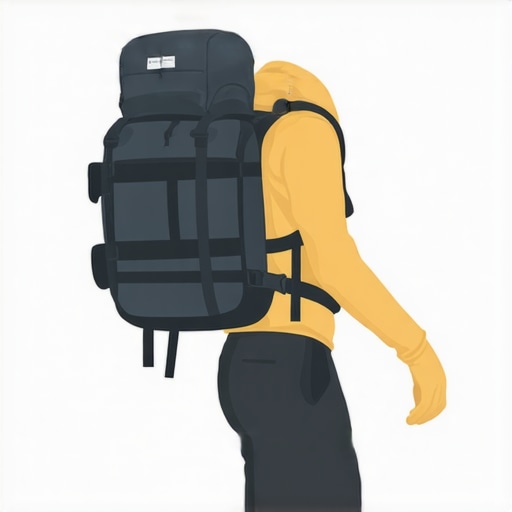
Why High and Tight is the Only Way to Wear a Pack
If your diaper bag is bumping against your tailbone, it is far too low. A low-hanging bag creates a pendulum effect, forcing your lower back to overcompensate with every step you take. You need to master how to carry your backpack without slumping by adjusting the shoulder straps so the bottom of the bag sits just above your waist. This position allows your pelvic girdle to support the weight rather than leaving your delicate cervical spine to do the heavy lifting. If you notice a dull, throbbing ache in your trapezius muscles, it is often a sign of why your shoulder feels heavy after typing or carrying poorly distributed loads. High straps pull the load into your core, which is naturally designed for stability.
The 30-Second Movement That Saves Your Neck
Even with a perfect bag, standing and walking for hours causes ‘static’ fatigue where blood flow to the muscles slows down. To combat this, I use a simple trick similar to the 30-second reset for tech neck fatigue. Every hour, I take the bag off for just sixty seconds and perform a series of gentle shoulder rolls and chin tucks. This movement re-lubricates the spinal discs and prevents that ‘locked’ feeling that leads to spasms. Incorporating boost mobility ease pain chiropractic techniques unveiled in these small bursts can stop a flare-up before it starts. I also focus on chiropractic secrets to boost neck comfort and function, like keeping my ears aligned over my shoulders even when I am looking down at my toddler. This small adjustment reduces the effective weight of my head on my neck, saving me from a massive tension headache later that evening.While the 30-second reset is great for immediate relief, we need to address the common myth that stretching is a universal cure-all. In fact, if you are struggling with a hypermobile cervical spine, obsessive stretching can actually destabilize the area further, leading to more frequent spasms. Most people think they need more flexibility, but what they really need is chiropractic secrets to boost neck comfort and function that focus on isometric stability. I fell into the trap of ‘stretching through the pain’ for months before realizing I was just irritating the nerves even more. This is where restore your range how chiropractic care enhances movement becomes about precision, not just force.
Your Neck Pain Might Be a Foot Problem in Disguise
Your spine doesn’t exist in a vacuum. I’ve seen countless parents spend hundreds on ergonomic bags only to still suffer because they were wearing worn-out flip-flops or unsupportive sneakers while hauling gear. This is exactly why we look at your feet to solve your neck issues. When your feet lack support, your pelvis tilts, your lower back arches excessively, and your head jutts forward to maintain balance. A study in the Journal of Physical Therapy Science indicates that foot arch support and proper gait significantly influence head and neck posture, reinforcing the idea that your neck pain might actually be a ‘ground-up’ problem. If you want to unlock neck pain relief essential chiropractic tips for 2025, you have to start by looking at what’s touching the ground. 
The Heat Trap That Keeps You Stiff
Another sophisticated nuance involves the ‘Oops’ factor of temperature therapy. Why icing isn’t always the best move for a stiff neck is a major point of confusion for those trying to self-treat. Many parents reach for an ice pack at the first sign of a spasm, but if the issue is purely muscular tightness from fatigue rather than an acute injury, ice can cause the tissue to contract even further, locking the joint in place. Conversely, using a heating pad on an acute, inflamed injury can increase swelling and prolong recovery. Learning how to use heat and ice for maximum relief is an essential skill that separates temporary fixes from long-term healing.
Why does my mid-back feel so stiff when the pain is in my neck?
This is one of the most frequent questions I get from readers who have moved beyond the basics. The thoracic spine—your mid-back—is designed for rotation, while your neck and lower back are designed for stability. When your mid-back locks up from the weight of a heavy pack, your neck is forced to move in ways it wasn’t intended to, leading to that ‘cricked’ feeling. This is precisely why we adjust your mid-back to help your lower back recover and protect your cervical spine. Have you ever fallen into the ‘just stretch it out’ trap only to find yourself in more pain the next day? Let me know in the comments below!
The transition from managing acute pain to achieving true long-term results requires more than just knowing how to pack a bag; it requires a toolkit you can rely on when your body starts to signal trouble. I learned the hard way that ignoring those small ‘whispers’ from my mid-back led to the ‘screams’ in my neck later on. To stay ahead of it, I’ve integrated a few non-negotiable tools into my daily routine that keep me from sliding back into old patterns. One of my absolute favorites is using a simple tennis ball or lacrosse ball. Learning how to use a tennis ball to fix that spot under your shoulder blade changed everything for me. It targets the rhomboids and the mid-trapezius with a precision that a foam roller simply cannot match, especially when you are dealing with the specific pressure points created by carrying heavy gear. Speaking of rollers, you have to be careful; there is a reason why your foam roller might be hurting your lower back if you are using it with poor form or on the wrong segments of the spine.
The Best Tools for Real-World Recovery
I also keep a percussion massage gun in my car for those long soccer tournament weekends. However, you cannot just fire that thing into your spine and hope for the best. You need to understand how to use a massage gun on your lower back safely to avoid aggravating your nerves or causing bruising. I use mine exclusively on the large muscle groups—like the glutes and quads—which indirectly takes the tension off my lower back. According to a systematic review published in The Journal of Orthopaedic & Sports Physical Therapy (JOSPT), thoracic spine manipulation shows immediate improvements in pain levels and cervical range of motion for those with mechanical neck pain. This highlights that keeping your mid-back mobile is the secret weapon for neck health. When I am consistent with these tools, I see the kind of back pain recovery how chiropractic care transforms lives in a way that feels permanent rather than fleeting.

How do I maintain my spinal mobility over time?
Consistency is the boring truth of spinal health. You cannot just do a ‘mobility day’ once a month and expect your discs to stay resilient. Maintenance is about the micro-habits: the way you sit at your desk, the shoes you wear, and the daily 30-second resets we discussed earlier. I’ve shifted my mindset from ‘fixing’ my back to ‘feeding’ my spine with movement. By following mobility mastery expert tips for back pain prevention and recovery, I treat my spine like an athlete treats their knees—with preventative care and respect. If you want to unlock neck pain relief essential chiropractic tips for 2025, you need to start viewing your daily movement as a form of biological hygiene.
Where Spinal Support is Heading in the Next Few Years
As we move further into the decade, I predict we are going to see a massive shift toward AI-integrated wearable posture sensors. Instead of just guessing if your bag is too low or your head is tilting, we will have real-time haptic feedback that gently vibrates to remind us of our alignment. We are already seeing the early stages of this with smartwatches, but the future will be about precise, fabric-integrated tech. Until then, the best thing you can do is stay educated and proactive. If you have been struggling with that one stubborn spot, I want you to try the tennis ball reset tonight—just two minutes against a wall before bed can break the cycle of tension. It is time to stop reacting to pain and start engineering a more mobile life.
Hard Truths from a Parent Who Almost Broke Their Spine
I wish someone had told me early on that pain is a lagging indicator. Usually, by the time your neck starts screaming, the mechanical breakdown in your posture has been happening for months. My biggest lightbulb moment was realizing that my “convenient” one-arm carry was actually a form of self-sabotage. I also learned that if you feel the need to stretch every ten minutes, you probably don’t need more flexibility—you need more stability. This is where back pain recovery how chiropractic care transforms lives by resetting those core patterns. I stopped trying to ‘tough it out’ and started listening to the whispers of my body before they became shouts.
The Tiny Toolset That Keeps Me Moving
You don’t need a massive home gym to protect your spine. My personal toolkit is actually quite small but incredibly effective. First, a firm lacrosse ball is my best friend for fixing that spot under your shoulder blade that gets so tight after a day at the zoo. Second, I never leave the house for a long walk without supportive sneakers that respect my arch; it is vital for effective neck pain management a step-by-step guide to start from the ground up. Lastly, I keep a physical reminder in my car to check my head position, helping me avoid that forward-slump that ruins a good day.
Finally Reclaiming Your Mobility
The road to long-term comfort isn’t paved with expensive gadgets, but with consistent, small adjustments. You have the power to change how you feel just by rethinking the physics of your daily carry. Don’t let a heavy diaper bag or a poorly adjusted pack steal your joy or your ability to keep up with your kids. By prioritizing your alignment today, you are investing in a future where you can play, lift, and run without fear of a flare-up. You deserve to move through the world with ease and confidence. What is the heaviest thing you find yourself carrying most days that leaves you feeling stiff? Drop a comment below and let’s troubleshoot your gear together!